Financial
Best Retirement Calculator: How to Compare Options for Your Planning Stage
The best retirement calculator is the one that answers the question you are asking right now. Most take a starting balance, a contribution amount, an assumed return and a number of years, then project a future balance; others test how long that balance lasts once withdrawals begin. This guide compares growth projections, withdrawal tools, 401(k) calculators and coast FIRE calculators, shows the formulas behind them, and explains which type fits each planning stage.
What "best retirement calculator" actually means
"Retirement calculator" covers several different jobs:
- Projecting how a portfolio grows before retirement.
- Testing whether a withdrawal plan lasts long enough.
- Estimating how much to contribute to a 401(k) or similar plan.
- Finding the point where you can stop contributing and let compounding finish the work (coast FIRE).
- Stress-testing a plan against many different market sequences.
A tool that is excellent for one job can mislead on another. A growth projection says nothing about withdrawal sustainability, and a withdrawal tool cannot tell you what to contribute next year. So the useful comparison question is: which calculator matches my stage and the decision in front of me?
The five types of retirement calculator worth comparing
1. Long-term growth (nest egg) calculators
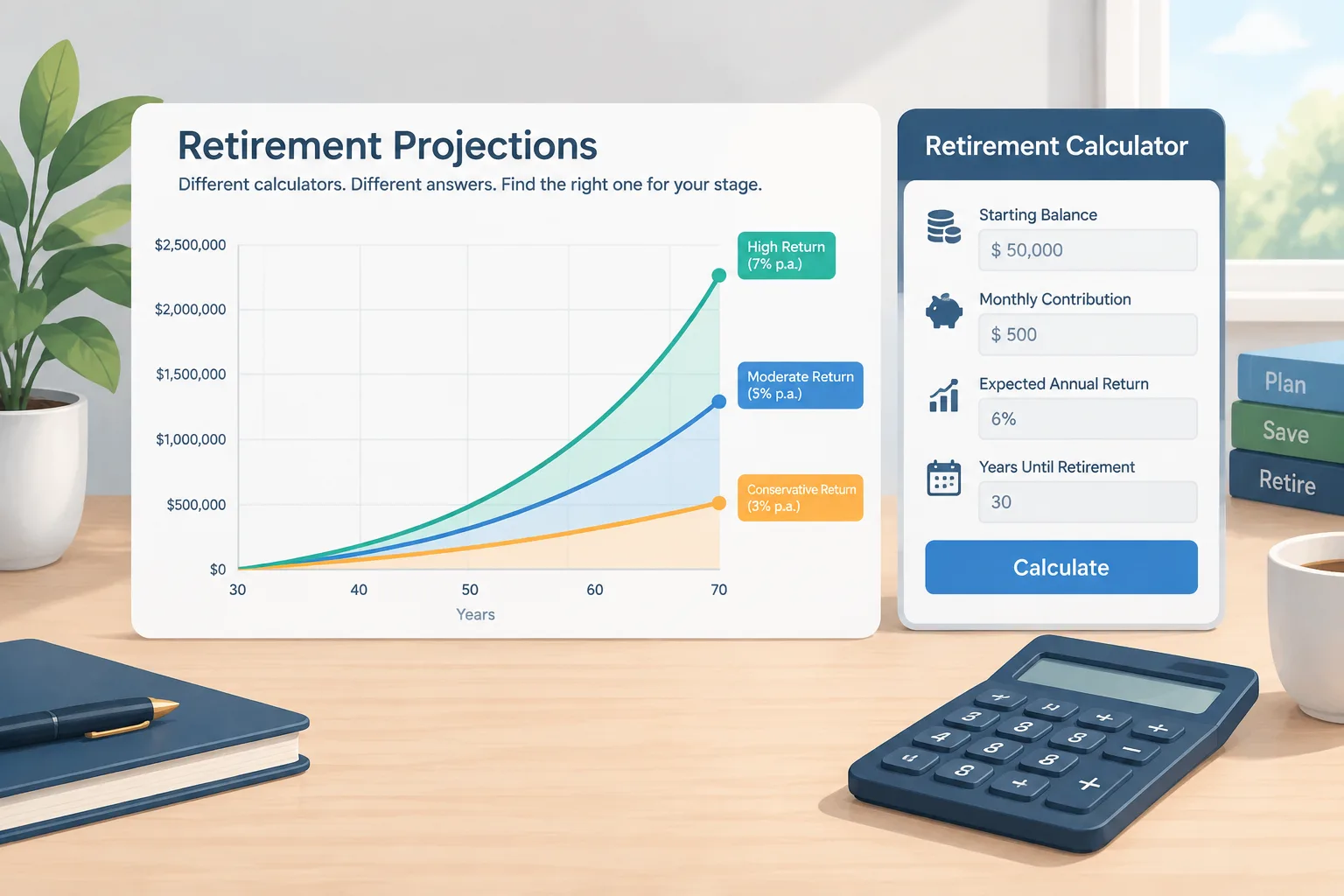
You enter a current balance, a contribution, an expected return and a time horizon, and it returns a projected balance. This is the right tool for early accumulation questions such as "am I saving enough?" The output is a projection, not a promise: move the return assumption by one percentage point and the result changes a lot. Cross-check it with our compound interest calculator or the future value calculator.
2. Withdrawal sustainability calculators
These flip the question and ask how long a balance lasts once you start taking money out. Typical inputs are portfolio value, annual spending, inflation and return assumptions. This is the type to use in the five-to-fifteen-years-before-retirement window, when the size of the portfolio matters less than whether the withdrawals are sustainable.
3. 401(k) contribution calculators
Workplace-plan calculators focus on contributions, employer match and growth inside the account, which makes them useful for questions like raising your contribution rate by two percentage points. Pair one with a take-home pay calculator to see how the change affects your monthly budget.
4. Coast FIRE calculators
A coast FIRE calculator asks how much you need invested today so that, with no further contributions, it reaches your target by retirement age. Once you reach that number you still cover current living costs, but you no longer need to add to the retirement pot. Our coast FIRE calculator handles the compounding step.
5. Scenario-based and Monte Carlo style calculators
Instead of one fixed return, these run the projection many times with different return sequences and report how often the plan survives. They are the closest thing to a stress test, and they matter most near retirement, when the order of returns is critical. Read the assumptions: the output is a range of outcomes under a model, not a forecast.
The formulas inside a retirement calculator
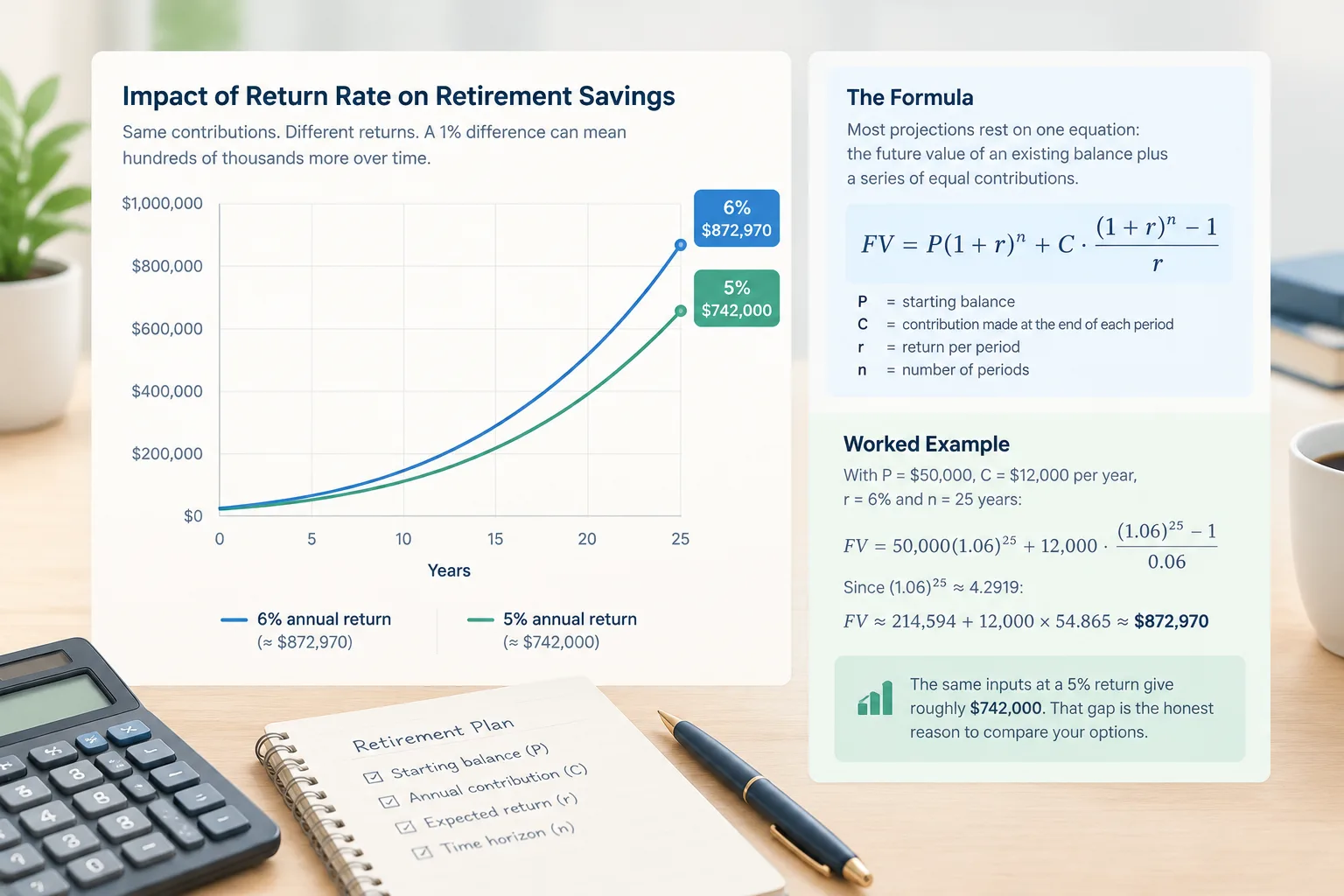
Most projections rest on one equation: the future value of an existing balance plus a series of equal contributions.
Here is the starting balance, is the contribution made at the end of each period, is the return per period, and is the number of periods.
Worked example. With , per year, and years:
Since :
The same inputs at a 5% return give roughly \$742{,}000. That gap is the honest reason to test more than one scenario.
To estimate the portfolio a given income requires, many planners use a withdrawal-rate rule of thumb:
Example. A \$60,000 income need at a 4% withdrawal rate implies a target of \$60,000 ÷ 0.04 = \$1,500,000. The 4% figure is a convention drawn from historical research, not a promise, and lower rates leave more margin.
For coast FIRE the target is discounted back to today:
Example. A \$1,500,000 target, a 6% real return and 25 years to retirement give \$1,500,000 ÷ 4.2919 ≈ \$349,500. Once that balance is reached, the existing money alone is projected to reach the target.
Keep nominal and real numbers separate, and convert carefully:
At a 7% nominal return and 3% inflation, .
Which calculator fits your planning stage
| Planning stage | Calculator type | Main inputs | What to watch |
|---|---|---|---|
| Early accumulation | Growth projection plus 401(k) tool | Balance, contribution rate, years, return | Contribution rate moves the result more than the return assumption |
| Mid-career, roughly on track | Coast FIRE | Target, years to retirement, real return | Whether the target is in today's dollars |
| 5–15 years from retirement | Withdrawal sustainability | Spending, portfolio, withdrawal rate | Taxes and health costs are often missing |
| Near or in retirement | Scenario-based testing | Spending range, longevity range | A single success figure hides its assumptions |
How to use a retirement calculator step by step
- State your spending target in today's dollars. Decide the annual income you want and whether it is before or after tax. Mixing the two is the most common source of confusion.
- Choose real or nominal returns and stay consistent. If spending is in today's dollars, use a real return. If you use a nominal return, inflate the spending as well.
- Enter the balance and contribution you actually have. Not the ones you intend to have. The projection is only useful when the inputs match reality.
- Run the base case, then two stress cases. Repeat with a return one percentage point lower and a horizon three to five years longer.
- Cross-check with a second calculator type. A growth projection and a withdrawal calculator should tell a consistent story.
- Re-run once a year. These are long-horizon tools; checking weekly mostly adds noise.
Try the retirement calculator to build a base-case projection, then compare it with your coast FIRE number to see whether contributions could ease later.
Common mistakes and honest limits
- Ignoring inflation. A balance decades away buys less than the same figure today.
- Using one fixed return. Markets do not deliver steady returns, so a single average hides both good and bad sequences.
- Forgetting fees and taxes. Fund fees compound against you and withdrawals are often taxable; calculators that ignore both look optimistic.
- Treating a rule of thumb as a certainty. Withdrawal-rate figures come from historical study and model assumptions.
- Double-counting income sources. Including a pension in the income need while also leaving it in the portfolio overstates the plan.
FAQ: common questions about the best retirement calculator
Is there one best retirement calculator?
No. The best one depends on the question. For accumulation, a growth projection with a visible formula is enough. For a retirement-date decision, a withdrawal or scenario calculator is more informative. Many people end up using two: one to build the number, one to test spending against it.
Are free retirement planning calculators accurate enough?
Accuracy depends on your inputs, not the price. A free calculator with transparent formulas can be as useful as a paid one. What matters is whether it states its return, inflation and fee assumptions and lets you change them; a tool that hides those assumptions is hard to check.
What is the difference between a 401k retirement calculator and a general one?
A 401(k) calculator models contributions, employer match and growth inside the workplace plan. A general retirement calculator models your whole portfolio, including accounts outside the plan. Use the 401(k) version for a contribution decision and the general one for the overall picture.
Do I need a coast FIRE calculator if I already save steadily?
It is optional, but useful. The coast number shows the point where further contributions are no longer required for the target, which can change how you think about saving pressure and career choices. Living costs still need to be covered from income.
What rate of return should I enter?
Use a range rather than a single figure, and say whether it is nominal or real. A real return stays comparable to spending expressed in today's dollars. The range should reflect your asset mix and how much uncertainty you are willing to plan around; the purpose is to test robustness, not to predict.
How do I check whether a retirement calculator is any good?
Look for four things: a visible formula, editable assumptions, inflation either modelled or clearly excluded, and an output expressed as a range rather than one confident number. If you cannot reproduce the result with the future value calculator, you cannot fully check it.
Looking for more tools?
Try our free Financial Calculators