compound interest account
Compound Interest Accounts: Where Your Money Actually Compounds
Learn how a compound interest account works, the compound interest formula with a worked example, and how to compare accounts that pay compound interest.
A compound interest account is any account where the interest you earn is added to your balance and then earns interest itself. That mechanic — interest on interest — separates a compounding account from one that pays interest out separately. This guide explains how a compound interest account works, shows the formula with a real example, and covers how to compare accounts that pay compound interest. It is for savers who want to check the math before opening an account.

What a Compound Interest Account Actually Is
In a simple-interest arrangement, you earn interest on your original deposit only. In a compound interest account, each interest payment is credited to the balance, so the next interest calculation runs on a larger base. The base keeps growing, which is why the growth curve bends upward instead of staying a straight line.
Two features define the account:
- Interest is credited to the balance rather than paid out separately.
- The crediting happens on a schedule — daily, monthly, quarterly, or annually.
A compound interest savings account at a bank is the familiar example, but certificates of deposit, money market accounts, and some brokerage cash sweep programs use the same mechanic. What changes is the rate, the compounding frequency, and the rules on access to your money.
How Compound Interest Accounts Work
Three numbers drive the result:
- Nominal rate (APR) — the stated annual rate before compounding.
- Compounding frequency — how many times per year interest is credited.
- Annual percentage yield (APY) — the effective annual return, with compounding already included.
APY is the number worth comparing, because it folds compounding into one figure. Two accounts with the same nominal rate but different frequencies will show different APYs, and the more frequent one will be slightly higher.
| Compounding frequency | Periods per year (n) |
|---|---|
| Annually | 1 |
| Semi-annually | 2 |
| Quarterly | 4 |
| Monthly | 12 |
| Daily | 365 |
The Compound Interest Formula
For compounding at a fixed frequency:
Where is the ending balance, is the starting principal, is the nominal annual rate as a decimal, is the number of compounding periods per year, and is the time in years.
If interest compounds continuously instead, that expression converges to:
Most deposit accounts use the discrete version, so the first formula is the one you will use for a savings account or a CD.
A worked example you can check
Deposit $10,000 at a 4% nominal annual rate, compounded monthly, and leave it for 10 years. Here , , , and .
The balance is about $14,908, of which roughly $4,908 is interest. At simple interest, 4% a year on $10,000 for 10 years would be $4,000. The extra $908 is interest earning interest.
Stretch the same setup to 30 years and the multiplier becomes about 3.31, giving a balance near $33,100. Time does far more work than the exact compounding frequency does.
Which Accounts Pay Compound Interest
High-yield savings accounts. Interest is usually credited monthly and added to the balance. These are the most straightforward compound interest savings accounts and generally allow withdrawals.
Traditional savings accounts. Same mechanic, lower rate.
Certificates of deposit. A fixed rate for a fixed term, with interest often compounding monthly or quarterly. Withdrawing early usually triggers a penalty, so compounding only runs uninterrupted if you leave the CD alone.
Money market accounts. Often pay a savings-like rate with limited transactions. Compounding depends on the account terms.
Checking accounts. Most pay little or nothing, and balances move in and out too fast for compounding to do much.
Bond interest and reinvested dividends can also compound, but the mechanics and risks differ: a bond fund's value can fall, while an insured deposit balance does not.
How to Compare Compound Interest Savings Accounts
- Start with APY, not the nominal rate. APY already includes compounding.
- Check compounding frequency. It matters, but less than most people expect.
- Look at balance requirements. A minimum you cannot maintain can cost you the advertised rate.
- Read the fee schedule. A monthly maintenance fee can wipe out interest on a small balance.
- Confirm deposit insurance. In the United States, bank deposits are commonly insured by the FDIC and credit union deposits by the NCUA, up to limits set by law. Insurance covers the deposit, not investment products.
A quick test: apply the APY to the balance you actually plan to keep there. A 0.10 percentage point difference on a $2,000 balance is a few dollars a year. You can compare rates side by side with the compound interest calculator, and the APR calculator helps when a disclosure quotes APR instead of APY.
Step-by-Step: Running the Numbers Before You Open an Account
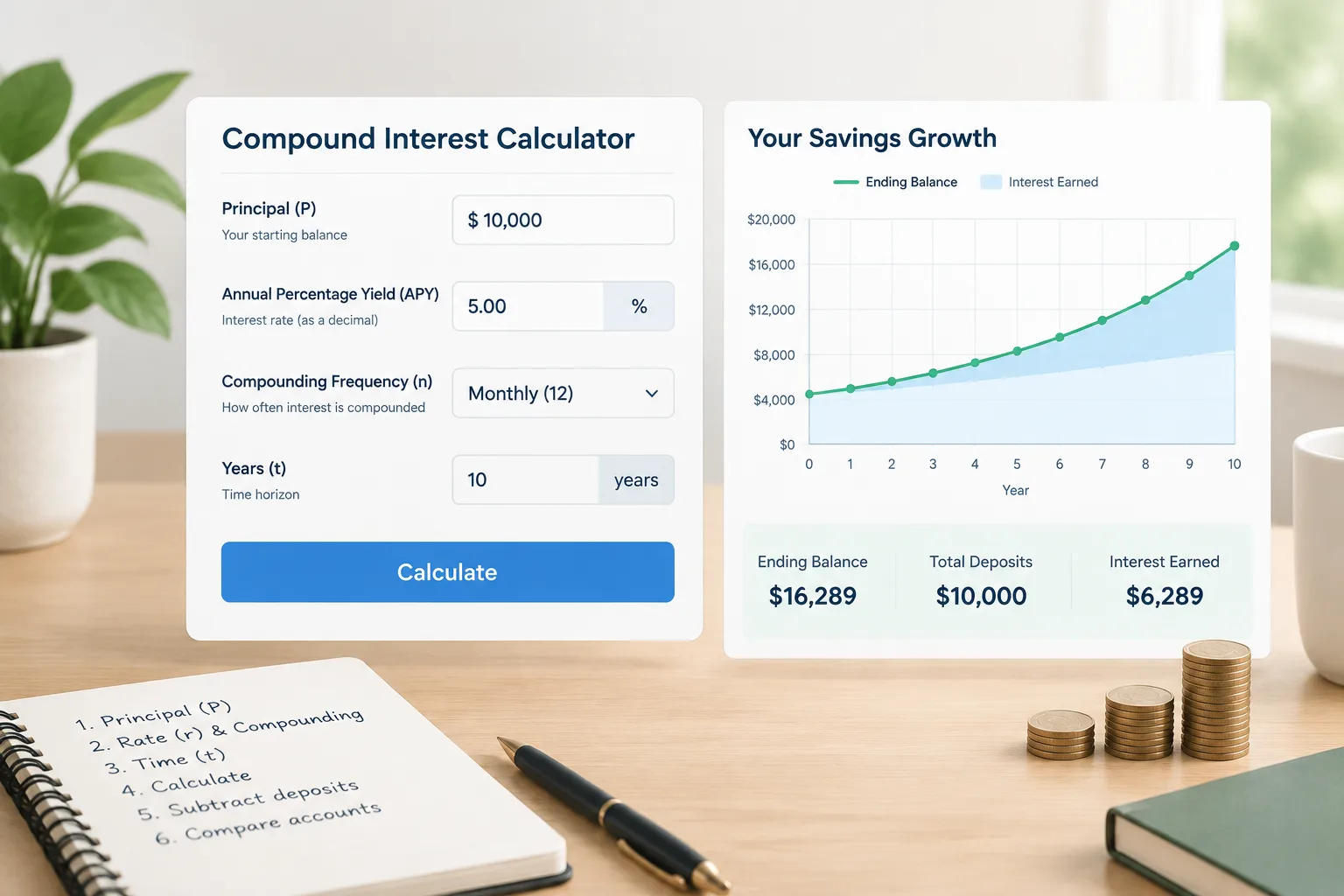
- **Write down your starting balance ().** Use what you will actually deposit.
- Find the APY in the account disclosure. If you only have the nominal rate, note the compounding frequency so you can convert it.
- **Set your time horizon ().** Compounding rewards years, not weeks.
- Run the formula. Enter , , , and and read the ending balance.
- Subtract your deposits. Ending balance minus principal equals interest earned.
- Repeat for a second account. Use the same and for both so only rate and frequency change.
To isolate a single deposit with no extra contributions, use the future value calculator. If the account sits inside a longer retirement plan, the retirement calculator puts compounding in context.
Common Misconceptions and Where the Math Stops
"Daily compounding doubles my money faster." At typical savings rates, the gap between daily and monthly compounding is tiny. Rate and time dominate.
"APR and APY are the same." They are not. APR is nominal; APY includes compounding. For a savings account, APY is the comparable figure.
"The balance is guaranteed to grow in real terms." The nominal balance rises if the rate is positive, but inflation reduces purchasing power. If the APY is below inflation, real value falls even as the dollar balance grows.
"The formula accounts for taxes." It does not. Interest in a taxable account is generally taxed as it is earned, which shrinks the effective compounding base.
"A high rate today stays high." Deposit rates move with the broader rate environment. The formula assumes a constant rate, which is a simplifying assumption, not a forecast.
The compound interest formula is a mathematical tool. It does not predict what any specific account will pay, and nothing here is investment advice.
FAQ
What is a compound interest account?
An account where earned interest is added to the balance and then earns interest itself. Savings accounts, money market accounts, and CDs commonly work this way. The defining feature is that interest stays in the account and joins the compounding base.
How often do compound interest accounts compound?
It varies. Many savings accounts compound daily and credit interest monthly; CDs often compound monthly or quarterly. Your account disclosure states the frequency, and the APY on the same disclosure already reflects it.
Is a compound interest savings account better than a CD?
It depends on access and rate. Savings accounts usually allow withdrawals without penalty; CDs typically pay a fixed rate for a fixed term and charge for early withdrawal. If you may need the money, savings flexibility often outweighs a slightly higher CD rate.
How much does compounding frequency actually matter?
Less than most people assume. Going from annual to monthly compounding at a 4% nominal rate raises the effective yield to about 4.07%. Going from monthly to daily changes it by hundredths of a percentage point.
Do compound interest accounts beat inflation?
Not automatically. The nominal balance grows, but real growth depends on whether the APY exceeds inflation over the same period. When it does not, purchasing power declines even though the balance rises.
Can I lose money in a compound interest account?
In an insured deposit account, the nominal balance does not fall from market movements, though it can fall in real terms if inflation outpaces the rate. Uninsured products such as bond funds can lose value.
Run Your Own Numbers
The fastest way to understand a compound interest account is to plug in your own figures. Change the principal, the rate, and the years one at a time, and watch which input moves the ending balance most. Start with the compound interest calculator on Calculator Lists — it is free, it does not store your inputs, and it shows the formula it uses.
Looking for more tools?
Try our free Free Calculators