coast fire calculator
Coast FIRE Calculator: Find Your Coast Number
Learn what a Coast FIRE calculator does, how to calculate your Coast FIRE number, and how savings, time, and growth assumptions affect your path to financial independence.
A Coast FIRE calculator helps you estimate the investment amount you may need today so that, under a chosen growth assumption, it could potentially grow into your future retirement target without additional retirement contributions. It is designed for people exploring financial independence, retirement planning, and long-term saving strategies. The calculator uses your current age, retirement age, target retirement amount, current savings, and expected returns to estimate your Coast FIRE number.
What Is Coast FIRE?
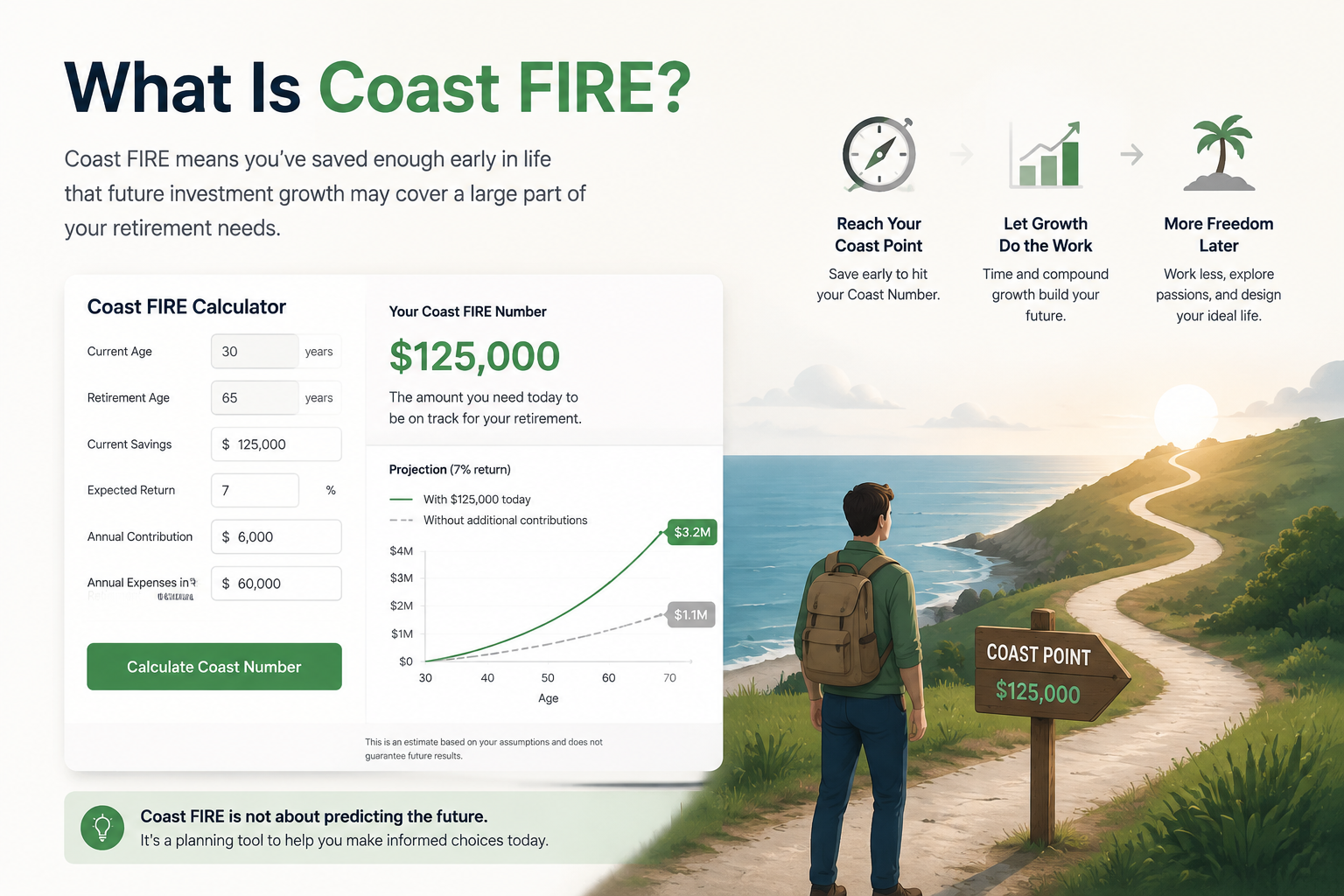
Coast FIRE is a financial independence concept where a person saves enough money early in life that future investment growth may cover a large part of their retirement needs. After reaching the Coast FIRE point, someone may choose to reduce retirement contributions and focus on other goals, such as changing careers, working fewer hours, or pursuing personal projects.
The key idea is that time and compound growth can help existing investments increase in value. A Coast FIRE calculation does not predict future market performance or guarantee a retirement outcome. Instead, it provides a mathematical estimate based on assumptions that you choose.
A Coast FIRE number is the amount of money you would need invested today to potentially reach your retirement target by your planned retirement age.
For example, someone who wants to retire at age 65 may need a smaller amount invested at age 30 because the money has more years to potentially grow. Someone starting at age 50 may need a larger current investment because there is less time available for compounding.
You can use the Coast FIRE calculator to test different assumptions and see how your current savings compare with your estimated Coast FIRE number.
How Coast FIRE Is Calculated
Coast FIRE formula
The basic Coast FIRE calculation works by reversing the compound growth formula.
The future value formula is:
Future Value = Current Investment × (1 + Annual Return)ⁿ
Where:
- Future Value is the retirement amount you want to reach.
- Current Investment is your Coast FIRE number.
- Annual Return is your assumed yearly investment growth rate.
- n is the number of years until retirement.
To find the amount needed today, rearrange the formula:
Coast FIRE Number = Retirement Target ÷ (1 + Annual Return)ⁿ
This calculation assumes the investment remains invested and compounds over time.
Example calculation
Suppose you estimate that you need $1,000,000 for retirement at age 65. You are currently 35 years old, giving you 30 years to grow your investments. You assume an annual return of 7%.
The calculation is:
Coast FIRE Number = $1,000,000 ÷ (1.07)³⁰
Coast FIRE Number = $1,000,000 ÷ 7.61
Coast FIRE Number ≈ $131,400
Under these assumptions, having about $131,400 invested today could potentially grow to around $1,000,000 in 30 years.
The result depends heavily on the assumptions used. A different return estimate, retirement age, or target amount will change the result.
Factors That Affect Your Coast FIRE Number
Time until retirement
Time is one of the most important variables in Coast FIRE calculations. A longer investment period generally means a smaller amount may be needed today because compound growth has more time to work.
For example, the same retirement target may require significantly different starting amounts for someone with 35 years to invest compared with someone who has 15 years.
Expected investment growth rate
The assumed annual return has a major impact on the calculation. A higher return assumption lowers the estimated Coast FIRE number, while a lower return assumption increases it.
Historical market returns can provide context, but past performance does not determine future results. A Coast FIRE calculation should be viewed as a planning model rather than a forecast.
Retirement spending goal
Your retirement target affects the calculation directly. A person expecting lower expenses may need a smaller retirement portfolio than someone planning for higher expenses.
When estimating a retirement target, consider possible costs such as housing, healthcare, daily expenses, taxes, and lifestyle choices.
Inflation assumptions
Inflation can reduce purchasing power over time. A retirement target should consider whether the amount represents today's money or a future dollar amount.
Using inflation-adjusted assumptions can make long-term planning more realistic. Economic conditions change, so inflation and return assumptions should be reviewed periodically.
Coast FIRE vs Barista FIRE
Coast FIRE and Barista FIRE are related but different approaches to financial independence.
Coast FIRE usually means reaching a point where existing investments may grow toward a retirement goal without additional retirement contributions. The person may continue working for income, but the focus shifts away from aggressive retirement saving.
Barista FIRE usually involves reaching partial financial independence where a person works a lower-stress or part-time job to cover current expenses, benefits, or other needs while maintaining a growing investment portfolio.
The main difference is the role of ongoing work:
- Coast FIRE focuses on letting investments grow toward a future retirement goal.
- Barista FIRE typically uses continued employment income to support present-day living costs.
Neither approach is a guarantee of financial independence. Both require personal assumptions about expenses, savings, work, and future financial conditions.
How to Use a Coast FIRE Calculator
Step 1: Enter your current age
Start with your current age because the number of years available for growth affects the calculation.
Step 2: Choose your retirement age
Enter the age when you would like to reach your retirement target. A longer timeline generally reduces the amount needed today.
Step 3: Add your retirement goal
Estimate the future amount you would like available at retirement. This may be based on expected spending needs and other financial goals.
Step 4: Select an expected return assumption
Enter a reasonable annual growth assumption for your model. Remember that actual investment results can vary and returns are not guaranteed.
Step 5: Compare your current savings with the Coast FIRE number
The calculator compares your existing investments with the estimated amount needed today. If your current savings are below the estimate, the gap can help you understand how much additional saving may be required.
Try the free Coast FIRE calculator to explore different scenarios.
Common Mistakes and Limitations
Using unrealistic return assumptions
A very high expected return can make the required Coast FIRE number appear smaller than it may realistically be. Conservative assumptions can provide a wider safety margin when creating a plan.
Ignoring inflation
A future retirement target should consider how prices may change over time. A number that seems sufficient today may have different purchasing power decades later.
Treating the result as a prediction
A Coast FIRE calculator is a planning tool, not a guarantee. Markets, personal circumstances, taxes, expenses, and economic conditions can change.
Forgetting non-investment factors
Financial independence decisions also involve health, family responsibilities, career preferences, housing choices, and personal priorities. The calculator provides one financial estimate, not a complete life plan.
Frequently Asked Questions
What is a Coast FIRE number?
A Coast FIRE number is the estimated amount of money you need invested today so that it may grow into your desired retirement amount by a future retirement age, based on a selected growth assumption.
How do you calculate Coast FIRE?
You calculate Coast FIRE by dividing your future retirement target by the compound growth factor. The formula is: Retirement Target ÷ (1 + Annual Return)ⁿ, where n represents the number of years until retirement.
Is Coast FIRE the same as early retirement?
No. Coast FIRE does not necessarily mean stopping work early. It means reaching a savings point where future growth may cover retirement needs, while you may continue working for income or other reasons.
What is the difference between Coast FIRE and Barista FIRE?
Coast FIRE focuses on allowing existing investments to grow toward retirement. Barista FIRE usually involves working part-time or in a lower-stress role to cover current expenses while maintaining financial progress.
Can a Coast FIRE calculator predict my retirement future?
No. A Coast FIRE calculator provides an estimate based on your inputs and assumptions. Investment returns, inflation, expenses, and personal circumstances can change over time, so results should be reviewed as part of ongoing financial planning.
Start Exploring Your Coast FIRE Number
A Coast FIRE calculator can make long-term retirement planning easier by showing how time, savings, and assumptions interact. Use it as a transparent calculation tool to compare scenarios, understand your current position, and explore possible paths toward your financial goals.
For additional planning tools, you can also explore other financial calculators such as a compound interest calculator or a retirement calculator.
Looking for more tools?
Try our free Free Calculators