compound interest
Compound Interest Calculator 401k: How Retirement Growth Works
Learn how a compound interest calculator 401k estimate works, including formulas, examples, contribution steps, limitations, and common questions about retirement growth.
A compound interest calculator 401k helps you estimate how retirement savings may grow over time by combining your starting balance, regular contributions, expected rate of return, and compounding frequency. It is useful for employees, retirement savers, and anyone comparing how different saving habits may affect a 401k balance. Use the compound interest calculator to explore different scenarios with transparent formulas.
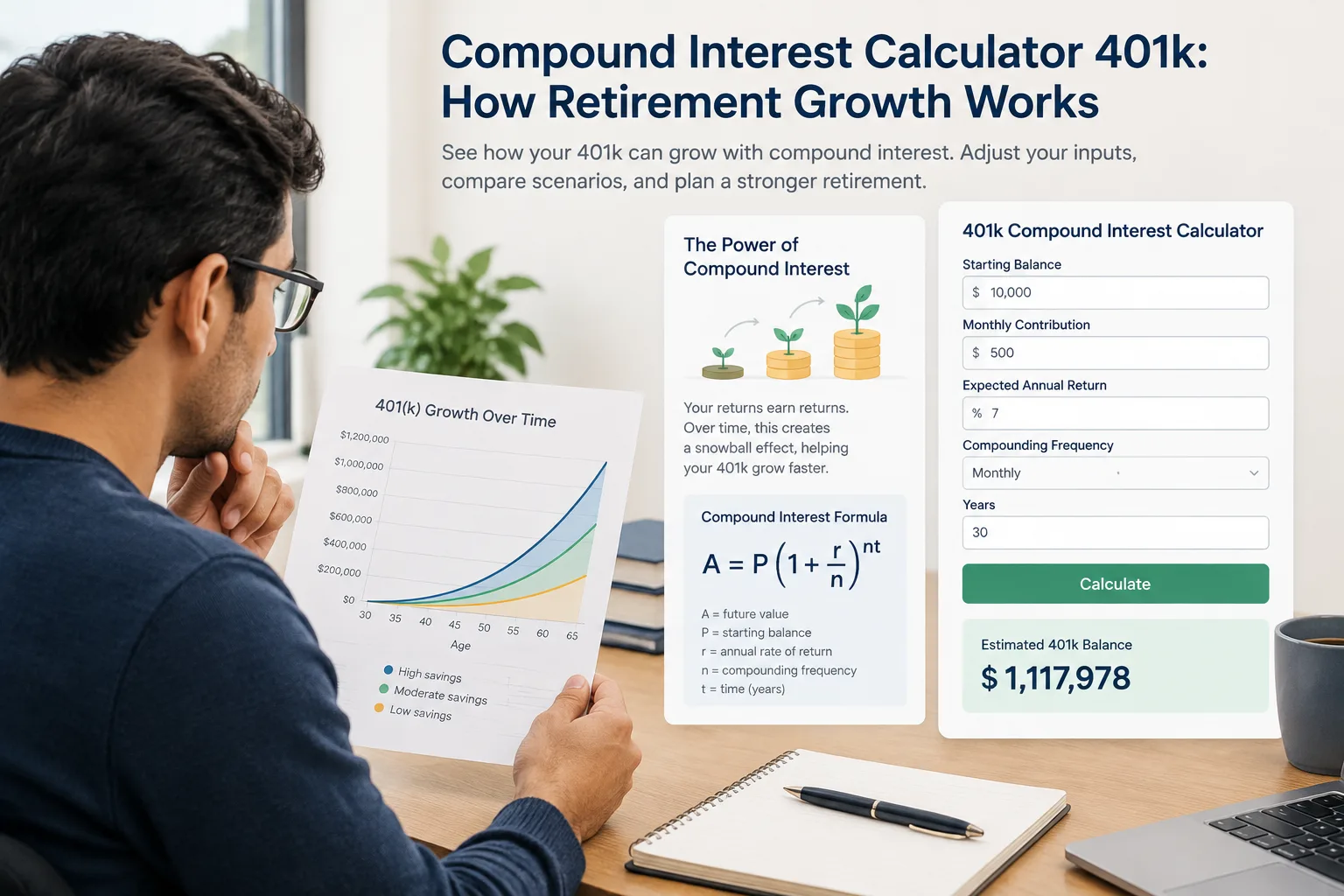
What Is Compound Interest in a 401k?
Compound interest describes the process where earned returns are added to an account balance, allowing future returns to be calculated on both the original money and previous growth. In a 401k account, this means contributions and investment growth can build on each other over time.
A 401k is a workplace retirement savings account where employees may contribute part of their income, often with employer contributions depending on the plan. A compound interest calculator 401k does not predict future market performance. Instead, it uses assumptions such as contribution amounts, time periods, and estimated annual growth rates to show possible outcomes.
The longer money remains invested, the more noticeable compounding effects may become because growth has more time to accumulate. However, actual account values can vary because investment returns are not fixed and markets fluctuate.
How Compound Interest Is Calculated for a 401k
A basic compound growth formula is:
Where:
- (A) = future account value
- (P) = starting principal or initial balance
- (r) = annual interest rate expressed as a decimal
- (n) = number of times interest compounds per year
- (t) = number of years
This formula shows growth on an existing balance. A 401k calculation often also includes regular contributions, which requires adding the future value of those deposits.
For recurring contributions made at regular intervals, a simplified future value formula is:
Where:
- (FV) = future value of the account
- (C) = regular contribution amount
- Other variables have the same meaning as above
Compound Interest Example With 401k Contributions
Assume a person has:
- Initial 401k balance: $10,000
- Monthly contribution: $300
- Estimated annual growth rate: 6%
- Compounding period: monthly
- Investment period: 25 years
Using the formula, the calculator converts the annual rate into a monthly rate:
The calculation then applies the growth effect across 300 months. The estimated future balance is approximately $225,000, depending on the exact timing of contributions and rounding method used.
This example is only a mathematical illustration. It does not represent a guaranteed return or a prediction of actual investment performance.
How to Use a 401k Compound Growth Calculator
A compound interest calculator 401k usually requires several inputs. Follow these steps:
1. Enter Your Current 401k Balance
Start with the amount already saved. If you have an existing workplace retirement account, use the current balance shown by your provider.
2. Add Your Regular Contributions
Enter how much you plan to contribute each month or year. Small recurring deposits can have a significant effect over long periods because each contribution may also have time to grow.
3. Choose an Estimated Growth Rate
Enter an assumed annual return rate. This is only a scenario input. Historical returns do not guarantee future results, and actual returns may be higher or lower.
4. Select the Investment Period
The number of years until retirement affects the potential impact of compounding. Longer periods generally create more opportunities for growth and fluctuation.
5. Review the Estimated Result
Use the calculator output to compare scenarios, such as increasing contributions or changing the saving period. For broader retirement estimates, you can also explore the retirement calculator.
Factors That Affect 401k Compound Growth
Several factors influence how a 401k balance changes over time:
Contribution Amount
Higher contributions generally increase the amount of money available to grow. Contribution limits and employer matching rules vary by plan and year, so users should check their specific retirement plan details.
Time in the Market
Compounding depends heavily on time. Starting earlier gives savings more years to experience potential growth and market changes.
Rate of Return Assumption
A higher assumed return creates a larger projected balance in a calculator, but it also represents greater uncertainty. A calculator scenario should be viewed as an estimate rather than a forecast.
Fees and Account Costs
Investment fees and account expenses can reduce long-term results. A simple calculator may not include every possible cost unless those inputs are provided.
Common Mistakes and Limitations
Treating Calculator Results as Guaranteed Outcomes
A compound interest calculator 401k provides a mathematical estimate based on entered assumptions. Real retirement accounts are affected by market performance, fees, taxes, contribution changes, and personal circumstances.
Using Unrealistic Growth Rates
Choosing an unusually high return assumption can create misleading expectations. Users should consider a range of possible scenarios rather than relying on one number.
Ignoring Inflation
A future account balance is measured in future dollars. Inflation can affect purchasing power, meaning the amount shown by a calculator may not represent the same spending ability in the future.
Forgetting Contribution Changes
Many people change jobs, increase savings rates, or adjust contributions over time. A single calculation may not capture these changes.
Frequently Asked Questions About 401k Compound Growth
How does a compound interest calculator 401k work?
A compound interest calculator 401k estimates future savings by applying a growth formula to your current balance, contributions, estimated return rate, and investment period. It shows a possible outcome based on the information entered.
How much can my 401k grow with compound interest?
The growth amount depends on factors including your starting balance, contribution level, time period, and assumed return rate. There is no fixed result because investment returns change over time.
Does a 401k compound interest calculator predict my retirement balance?
No. The calculator creates an estimate based on assumptions. Actual retirement balances may differ because investment performance and personal savings behavior can change.
Should I include employer 401k matching contributions?
If your plan includes employer contributions, including them can create a more complete estimate. Check your plan documents for the matching rules that apply to you.
What is the best way to compare different 401k growth scenarios?
Try changing one input at a time, such as monthly contributions, years invested, or estimated growth rate. Comparing multiple scenarios can help you understand how different assumptions affect potential outcomes.
Try the Compound Interest Calculator 401k Tool
Use the compound interest calculator to test different savings amounts, growth assumptions, and time periods. The tool provides a simple way to understand how compounding works while keeping the calculation process transparent.
Looking for more tools?
Try our free Free Calculators