home affordability calculator
How Much House Can I Afford? A Practical Guide to Home Affordability
Learn how to calculate how much house you can afford using income, debts, down payment, and the 28/36 rule. Understand the formula, examples, limits, and how a home affordability calculator can help.
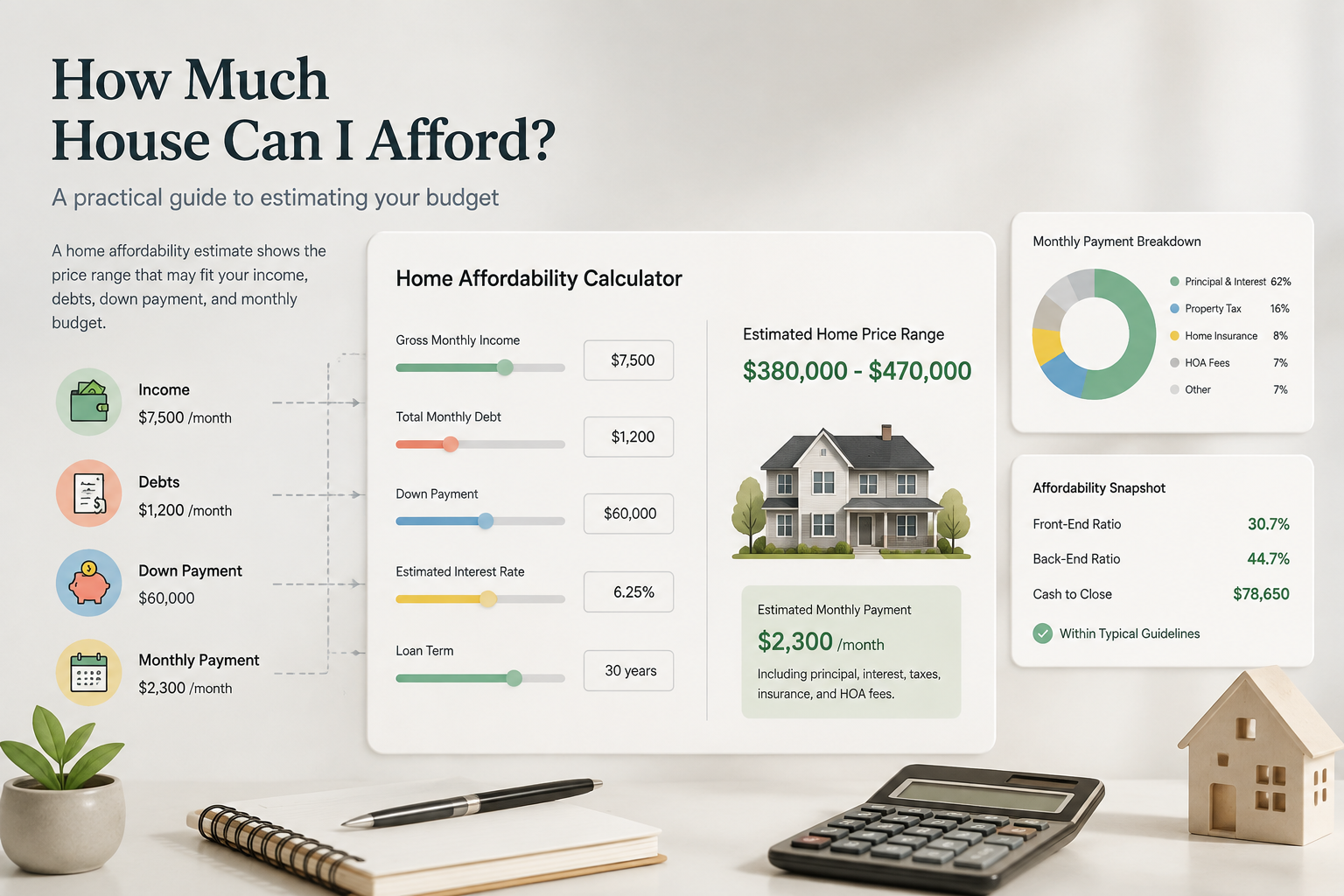
Buying a home starts with one important question: how much house can I afford? A home affordability estimate shows the price range that may fit your income, debts, down payment, and monthly budget. This guide explains how affordability is calculated, who can use the method, and how a home affordability calculator can help you estimate a realistic home price.
What Does Home Affordability Mean?
Home affordability is an estimate of how much you may be able to spend on a home while keeping housing costs within a manageable portion of your income. It considers factors such as your gross monthly income, existing debts, available savings, interest rates, loan term, taxes, insurance, and other ownership costs.
A home affordability calculation is not a guarantee that you will qualify for a mortgage. Lenders may use additional criteria, including credit history, employment stability, loan requirements, and market conditions. The result is a planning estimate that can help you understand a possible budget before comparing homes.
A home affordability calculator is useful for:
- First-time home buyers estimating a realistic price range
- Homeowners planning a future move
- People comparing different down payment amounts
- Anyone reviewing how monthly housing costs affect their budget
How Is Home Affordability Calculated?
A common way to estimate affordability is by looking at your debt-to-income ratios. One widely used guideline is the 28/36 rule.
The 28/36 rule suggests:
- Housing expenses should generally be around 28% or less of gross monthly income.
- Total monthly debt payments, including housing costs, should generally be around 36% or less of gross monthly income.
These are general guidelines, not universal rules. Different lenders and financial situations may lead to different limits.
Step 1: Estimate Your Maximum Housing Budget
The housing portion of the 28/36 rule can be represented as:
Where:
- (H) = maximum estimated monthly housing cost
- (I) = gross monthly income
Example:
If your gross monthly income is $6,000:
The estimated monthly housing budget using the 28% guideline would be $1,680.
This amount may include mortgage principal and interest, property taxes, homeowners insurance, and other housing-related costs.
Step 2: Consider Total Debt Limits
The total debt guideline can be calculated as:
Where:
- (D) = maximum estimated monthly debt payments
- (I) = gross monthly income
Example:
With a gross monthly income of $6,000:
Your total monthly debt payments would generally be considered within this guideline if they are around $2,160 or less.
If you already pay $500 per month for a car loan and student loan payments, the available housing amount becomes smaller:
In this example, other debts reduce the estimated housing budget to $1,660 per month.
Converting Monthly Housing Cost Into a Home Price
Estimating a home price requires more than dividing your budget by a monthly payment. Mortgage calculations depend on the loan amount, interest rate, loan term, taxes, insurance, and down payment.
A basic mortgage payment formula is:
Where:
- (M) = monthly principal and interest payment
- (P) = loan principal
- (r) = monthly interest rate
- (n) = total number of monthly payments
Example:
Assume:
- Loan amount: $300,000
- Annual interest rate: 6%
- Loan term: 30 years
The monthly interest rate is:
The number of payments is:
Substituting these values into the formula gives an estimated principal and interest payment of about $1,799 per month.
This example only covers principal and interest. A complete affordability estimate should also consider property taxes, insurance, maintenance, and possible fees.
You can use a mortgage calculator alongside an affordability calculator to compare different loan scenarios.
Factors That Affect How Much House You Can Afford
Income
Higher income usually increases the amount of monthly housing expense you can support. Calculations typically use gross income before taxes and deductions.
Existing Debt
Credit card balances, auto loans, student loans, and other recurring payments can reduce the amount available for housing.
Down Payment
A larger down payment may reduce the loan amount needed and may lower monthly payments. However, buyers should also consider keeping enough savings for emergencies and other costs.
Interest Rate
Mortgage rates affect borrowing costs. A higher rate generally increases monthly payments for the same loan amount, while a lower rate may reduce them.
Taxes and Insurance
Property taxes, homeowners insurance, and possible association fees can significantly change the total monthly housing cost.
How to Use a Home Affordability Calculator
A calculator can simplify the first stage of planning by combining common affordability factors in one place.
Follow these steps:
- Enter your gross annual or monthly income.
- Add your recurring monthly debts.
- Enter your available down payment amount.
- Add an estimated interest rate and loan term.
- Review the estimated home price range and monthly payment.
- Adjust the inputs to compare different scenarios.
The home affordability calculator can help you test different combinations before you begin a detailed mortgage application process.
Common Mistakes When Estimating Home Affordability
Focusing Only on the Mortgage Payment
A mortgage payment is only one part of owning a home. Buyers should also account for taxes, insurance, maintenance, repairs, and other ownership costs.
Using Maximum Qualification as a Personal Budget
A lender's maximum approval amount may be higher than what feels comfortable for your monthly budget. A personal affordability estimate should consider savings goals and everyday expenses.
Ignoring Future Changes
Income changes, family expenses, and unexpected costs can affect affordability over time. A budget that works today may need adjustments later.
Forgetting Upfront Costs
Buying a home may involve closing costs, inspections, moving expenses, and other fees. These expenses are separate from the down payment.
When Is a Home Affordability Estimate Most Useful?
A home affordability estimate is especially helpful when:
- You are starting your home search and need a realistic price range.
- You want to compare different mortgage scenarios.
- You are deciding how much to save for a down payment.
- You want to understand how debt affects your housing options.
It is a planning tool rather than a final lending decision. Mortgage approval depends on additional financial information and lender requirements.
FAQ About Home Affordability
How much house can I afford based on my income?
Your affordable home price depends on income, debts, down payment, interest rates, and other housing costs. A common starting point is reviewing the 28/36 rule and using a home affordability calculator for estimates.
What is the 28/36 rule for buying a house?
The 28/36 rule is a budgeting guideline that suggests keeping housing costs near 28% or less of gross income and total debt payments near 36% or less of gross income. It is a general guideline, not a guarantee of approval.
Does my debt affect how much house I can afford?
Yes. Existing monthly debt payments reduce the amount of income available for housing expenses. Lower recurring debt can increase your estimated affordability range.
How accurate is a home affordability calculator?
A calculator provides an estimate based on the information entered. Actual mortgage approval and final costs may differ because lenders consider additional factors and because housing expenses vary by location.
Should I buy the most expensive house I qualify for?
Not necessarily. The amount you qualify for may differ from the amount that fits comfortably within your personal budget. Consider savings, regular expenses, and future financial goals when evaluating affordability.
Try a Home Affordability Calculator
Use the home affordability calculator to estimate a possible home price range based on your income, debts, and mortgage assumptions. For additional planning, you can also compare payments with a mortgage calculator and review loan scenarios with a loan calculator.
Looking for more tools?
Try our free Free Calculators