mortgage payoff
Mortgage Payoff Calculator: Pay Off Your Loan Early
Learn how a mortgage payoff calculator works, how to calculate early loan payoff with extra mortgage payments, and how to estimate potential time and interest changes.
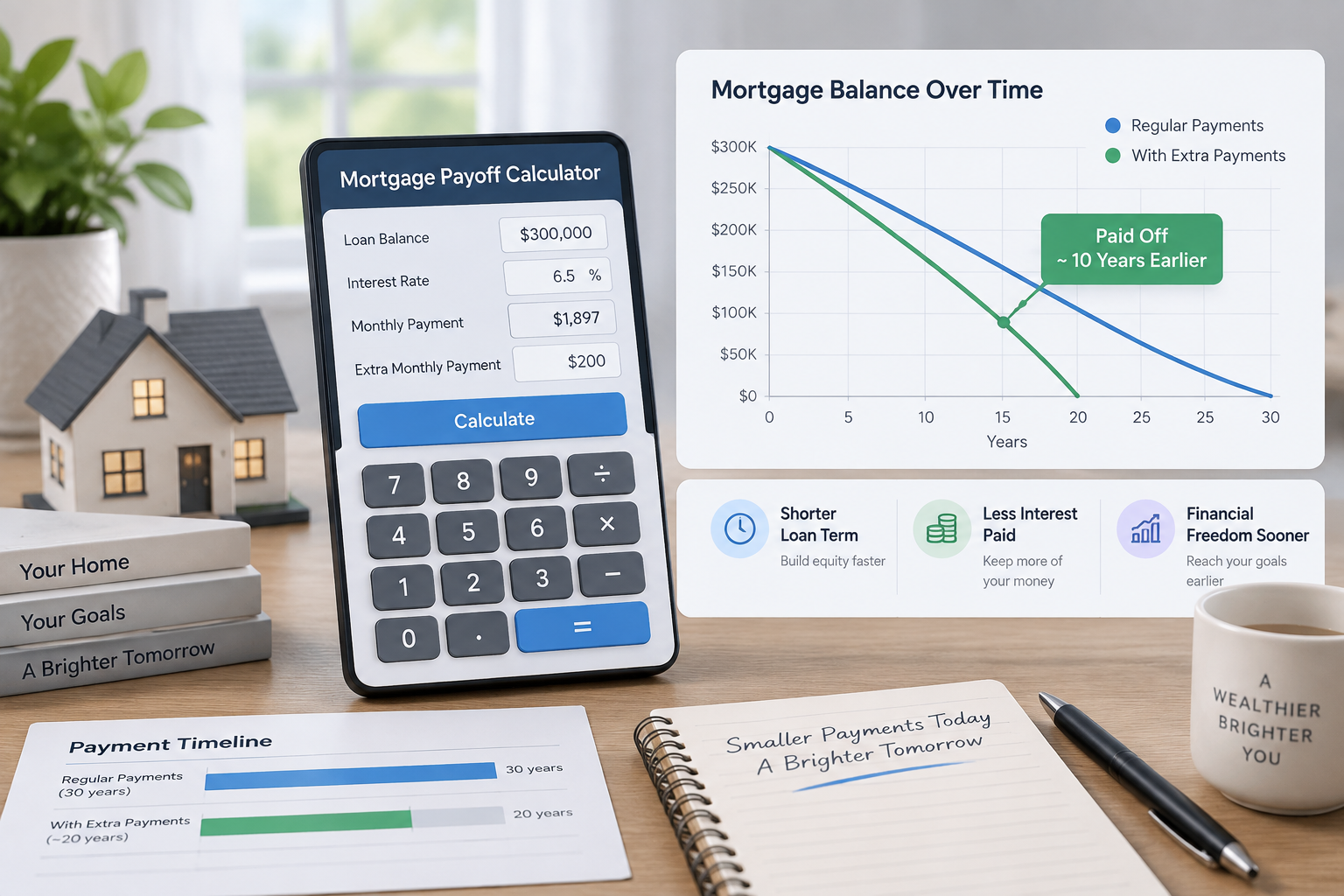
A mortgage payoff calculator is a free online tool that estimates how quickly you can repay a home loan and how extra mortgage payments may change your payoff timeline. It is designed for homeowners and borrowers who want to understand the impact of paying more than the required monthly amount. By entering your loan balance, interest rate, payment amount, and extra payments, you can compare different payoff scenarios using transparent calculations.
What Is a Mortgage Payoff Calculator?
A mortgage payoff calculator shows how a mortgage balance changes over time when regular payments and optional extra payments are applied. A typical mortgage payment includes both principal and interest. In the early years of many loans, a larger portion of each payment may go toward interest, while later payments usually reduce the principal faster.
The calculator helps answer practical questions such as:
- How many months remain until my mortgage is paid off?
- How much sooner could I finish my loan with extra payments?
- How might additional principal payments affect total interest paid?
This type of calculator is useful for homeowners reviewing their repayment plans, comparing payment options, or understanding loan amortization. It provides estimates based on the information entered and does not provide financial advice or recommend whether paying off a mortgage early is the right choice.
For a broader view of monthly mortgage costs, you can also use the mortgage calculator to estimate payment amounts before exploring payoff strategies.
How Mortgage Payoff Calculations Work
Mortgage payoff formula basics
A mortgage payoff calculation is based on the remaining loan balance, interest rate, scheduled payment, and any additional payments applied directly to principal.
For a fixed-rate mortgage, the monthly interest rate is usually calculated as:
Monthly interest rate = Annual interest rate ÷ 12
For example, if a mortgage has a 6% annual interest rate:
6% ÷ 12 = 0.5% per month
The interest charged for a month can be estimated as:
Monthly interest = Remaining balance × Monthly interest rate
Example:
- Remaining mortgage balance: $250,000
- Annual interest rate: 6%
- Monthly interest rate: 0.5%
Monthly interest:
$250,000 × 0.005 = $1,250
If the monthly payment is $1,800, the remaining amount reduces the principal:
$1,800 - $1,250 = $550 principal reduction
An extra mortgage payment increases the amount applied to principal, which can shorten the repayment period and reduce future interest charges.
Example with extra mortgage payments
Suppose a homeowner has:
- Mortgage balance: $250,000
- Interest rate: 6% annually
- Monthly payment: $1,800
- Extra payment: $200 per month
The regular payment reduces the balance based on the normal amortization schedule. The additional $200 is applied toward principal, assuming the lender applies it that way. Over time, the lower balance results in less interest being charged in future months.
The exact savings depend on factors such as the remaining loan term, payment timing, lender rules, and whether extra payments are applied to principal.
How to Use a Mortgage Payoff Calculator
Using a mortgage payoff calculator usually takes only a few steps.
Step 1: Enter your current mortgage details
Provide the information requested by the calculator, such as:
- Current loan balance
- Annual interest rate
- Remaining loan term
- Current monthly payment
Use your latest mortgage statement when possible to improve accuracy.
Step 2: Add extra mortgage payments
Enter possible additional payments, such as:
- Extra monthly payments
- Additional yearly payments
- One-time lump-sum payments
For example, you may compare paying an extra $100 per month versus making one additional $1,200 payment each year.
Step 3: Review the results
The calculator may show estimated results including:
- Estimated payoff date
- Number of months saved
- Estimated interest difference
- Remaining balance over time
These results are projections based on the entered assumptions. They may differ from your lender’s official payoff amount.
Common Mistakes and Limitations
Assuming every extra payment reduces principal immediately
Extra payments are not always handled the same way by every lender. Some lenders require instructions to apply additional money directly to principal. Check your mortgage agreement or contact your loan servicer for details.
Ignoring other financial priorities
Paying down a mortgage faster may reduce debt, but homeowners should consider their complete financial situation, including emergency savings, other debts, taxes, and personal goals. A calculator can show mathematical outcomes but cannot determine the best choice for every person.
Using incorrect loan information
Small differences in balance, interest rate, payment amount, or remaining term can change the estimate. Always check the inputs before comparing scenarios.
Treating estimates as guaranteed results
A mortgage payoff calculator provides an estimate based on assumptions. Changes in payments, fees, refinancing, loan modifications, or lender policies may affect the actual payoff timeline.
You can also compare different loan calculations using the amortization calculator to better understand how payments are distributed between principal and interest.
Frequently Asked Questions
How does a mortgage payoff calculator work?
A mortgage payoff calculator uses your loan balance, interest rate, payment amount, and extra payments to estimate how long it may take to repay the mortgage. It calculates how the balance changes over time as payments are applied.
Does paying extra on a mortgage reduce interest?
Extra mortgage payments can reduce the remaining principal balance, which may reduce future interest charges. The actual effect depends on the loan terms and how the lender applies extra payments.
How much extra should I pay toward my mortgage each month?
There is no universal extra payment amount that works for everyone. A calculator can help you compare different amounts, but your choice should consider your overall financial situation and priorities.
Is paying off a mortgage early always the best option?
Not necessarily. Early payoff may be useful for some homeowners, while others may prioritize different financial goals. A mortgage payoff calculator only shows estimated loan effects and does not replace personal financial guidance.
Try a Mortgage Payoff Calculator
Use the mortgage calculator and related loan tools on Calculator Lists to explore payment scenarios, understand mortgage numbers, and make calculations based on your own loan information. All results are estimates created from the data you provide and should be reviewed alongside your mortgage documents.
Looking for more tools?
Try our free Free Calculators