mortgage
Mortgage Recast vs Refinance: Which Saves More?
Compare mortgage recast vs refinance to understand how each option changes your loan payment, interest costs, requirements, and when each choice may fit your situation.
A mortgage recast and a refinance can both reduce your monthly mortgage payment, but they work in different ways. A mortgage recast keeps your existing loan and recalculates payments after a large principal payment, while a refinance replaces your loan with a new one. Homeowners can compare these options by looking at remaining balance, interest rate, loan term, fees, and long-term interest costs.
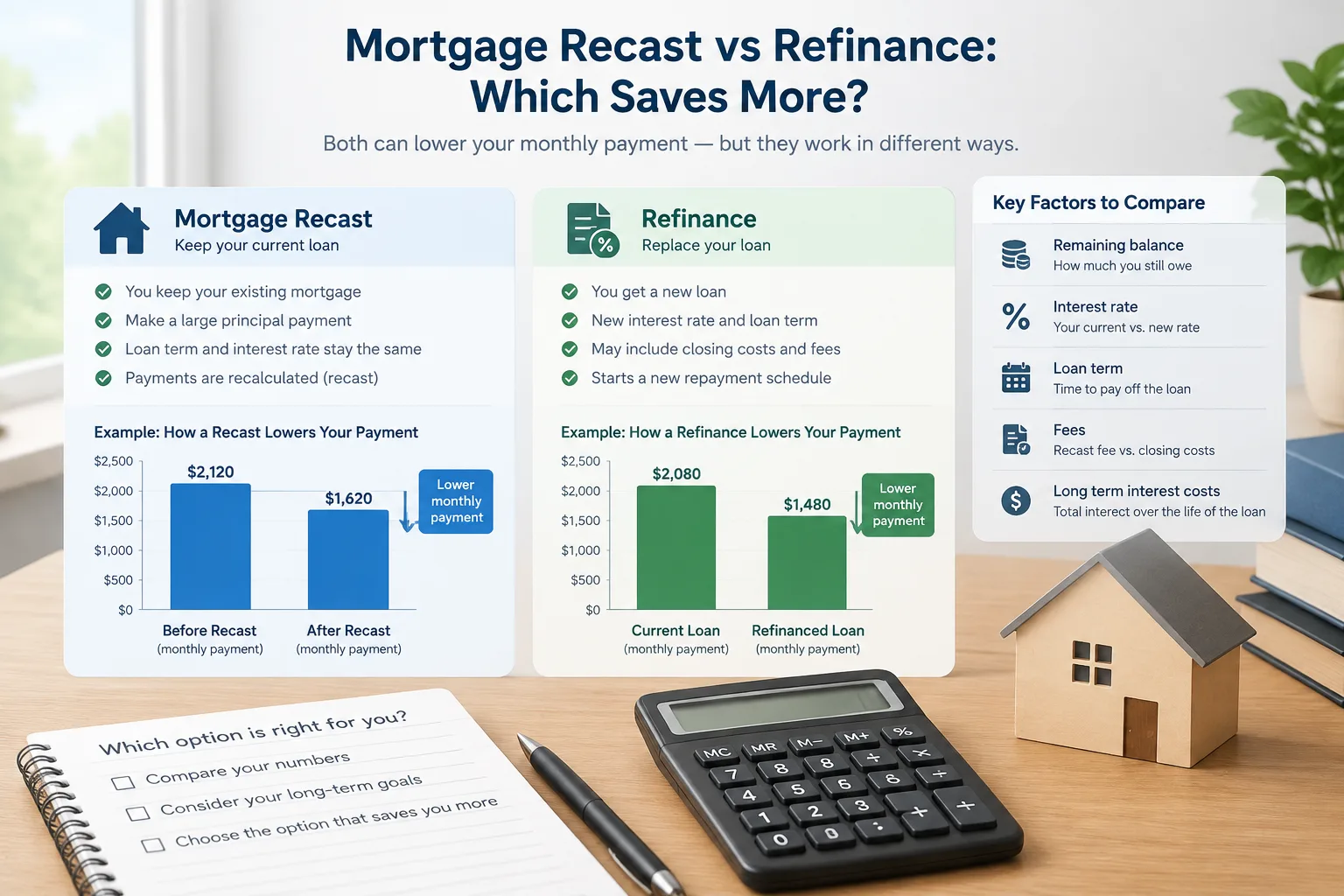
Mortgage recast vs refinance: understanding the difference
When comparing mortgage recast vs refinance, the biggest difference is whether you keep your current mortgage or create a new one.
A mortgage recast (also called mortgage re-amortization) adjusts your existing loan after you make a significant lump-sum payment toward the principal. The lender recalculates your monthly payment based on the lower balance while keeping the current interest rate and remaining loan term.
A mortgage refinance replaces your current mortgage with a new mortgage. The new loan may have a different interest rate, term length, payment schedule, and closing costs. Refinancing is often considered when borrowers want to change loan terms or access different rates, but the decision depends on individual circumstances.
Use a mortgage calculator to estimate payment changes before comparing options. For a closer look at changing loan structures, a refinance calculator can help compare estimated outcomes.
How mortgage recast and refinance calculations work
Mortgage payment formula
Mortgage payments are commonly calculated using an amortization formula. The monthly payment depends on the loan principal, interest rate, and number of payments.
Where:
- (M) = monthly mortgage payment
- (P) = loan principal balance
- (r) = monthly interest rate
- (n) = total number of monthly payments
For example, assume a homeowner has a remaining mortgage balance of 300,000, an annual interest rate of 6%, and 25 years remaining.
The monthly interest rate is:
The number of remaining payments is:
Substituting these values into the mortgage payment formula gives an estimated monthly payment of about 1,933.
This example does not include taxes, insurance, fees, or other housing costs.
Mortgage recast calculation example
A recast usually begins with a large principal payment. Suppose the homeowner above pays 50,000 toward the mortgage balance.
New balance:
The lender recalculates the payment using the same interest rate and remaining term:
The new payment is approximately 1,611 per month.
The payment decreases because the principal balance is lower, but the interest rate remains unchanged.
Refinance calculation example
A refinance uses a new loan amount and new loan terms. Assume the same homeowner replaces the remaining 300,000 balance with a new 30-year mortgage at 5% interest.
Monthly rate:
Number of payments:
The estimated payment becomes approximately 1,610 per month before considering closing costs and other expenses.
Although the payment is similar to the recast example, the reasons are different. The refinance changes the loan terms and interest rate, while the recast only changes the balance calculation.
Mortgage recast requirements
Mortgage recast requirements vary by lender and loan agreement. Common requirements may include:
- A minimum lump-sum principal payment
- A loan that allows recasting
- Current payments being up to date
- A lender processing fee
- A remaining loan term that can be recalculated
Not every mortgage can be recast. Some government-backed loans or certain loan programs may have different rules. Homeowners should check their mortgage documents or contact their lender for specific requirements.
Recast vs refinance: which factors should you compare?
Interest rate changes
A refinance can change your interest rate if market conditions or your financial profile allow a different loan offer. A recast normally keeps the original interest rate.
Closing costs and fees
Refinancing often involves application costs, appraisal fees, and closing expenses. A recast usually has fewer costs, but lenders may charge a processing fee.
Loan term changes
A refinance can extend or shorten the loan term. For example, moving from a 20-year remaining mortgage to a new 30-year mortgage may lower the monthly payment but may increase total interest over time.
A recast does not restart the loan term. It keeps the existing schedule and recalculates the payment.
Cash availability
A recast requires a large upfront principal payment. Homeowners should consider how using available cash affects emergency savings and other financial priorities.
This article provides general educational information and calculator guidance. It is not financial advice or a recommendation to choose one mortgage option over another.
How to compare a mortgage recast and refinance using a calculator
Follow these steps to estimate the differences:
- Enter your current mortgage balance, interest rate, and remaining term.
- Calculate your current monthly payment.
- For a recast comparison, subtract your planned lump-sum payment from the balance.
- Recalculate the payment using the same interest rate and remaining term.
- For a refinance comparison, enter the proposed new loan amount, rate, and term.
- Compare monthly payments, total interest, and estimated fees.
You can also use an amortization calculator to review how principal and interest change throughout the loan period.
Common mistakes and limitations
Focusing only on the monthly payment
A lower monthly payment does not always mean a lower total cost. A refinance with a longer repayment period may reduce payments while increasing the amount of interest paid over time.
Ignoring refinance costs
Closing costs can affect the value of refinancing. A borrower may need to calculate how long it takes for monthly savings to recover those costs.
Assuming every mortgage can be recast
Recast availability depends on the lender and loan terms. Always verify whether your mortgage qualifies before planning around a recast.
Comparing different loan scenarios incorrectly
A fair comparison should use similar assumptions. Compare the same remaining balance, time period, and cost categories when possible.
FAQ: Mortgage recast vs refinance
Is a mortgage recast better than refinancing?
A mortgage recast is not automatically better or worse than refinancing. A recast may be useful for someone who wants a lower payment after making a large principal payment while keeping the existing loan. A refinance may be useful when changing loan terms or interest rate is the goal.
What are the main mortgage recast requirements?
Mortgage recast requirements depend on the lender and loan agreement. Common requirements include an eligible loan type, a qualifying principal payment, and a lender-approved recalculation process.
Does a recast lower the interest rate?
No. A mortgage recast normally keeps the existing interest rate. It lowers the payment by reducing the loan balance used in the payment calculation.
How do I know if refinancing saves money?
To estimate whether refinancing may reduce costs, compare the new payment, interest rate, loan term, and closing costs with your current mortgage. A refinance calculator can help organize these numbers, but actual loan terms depend on lender approval and market conditions.
Use a mortgage calculator to compare your options
Understanding mortgage recast vs refinance starts with accurate numbers. Use Calculator Lists tools to compare mortgage payments, loan scenarios, and amortization details with transparent formulas before making financial decisions.
Looking for more tools?
Try our free Free Calculators