ROI
ROI vs Annualized Return: Key Differences, Formulas, and How to Calculate
Learn the difference between ROI and annualized return, how each formula works, when to use them, and how to compare investment performance with clear examples.
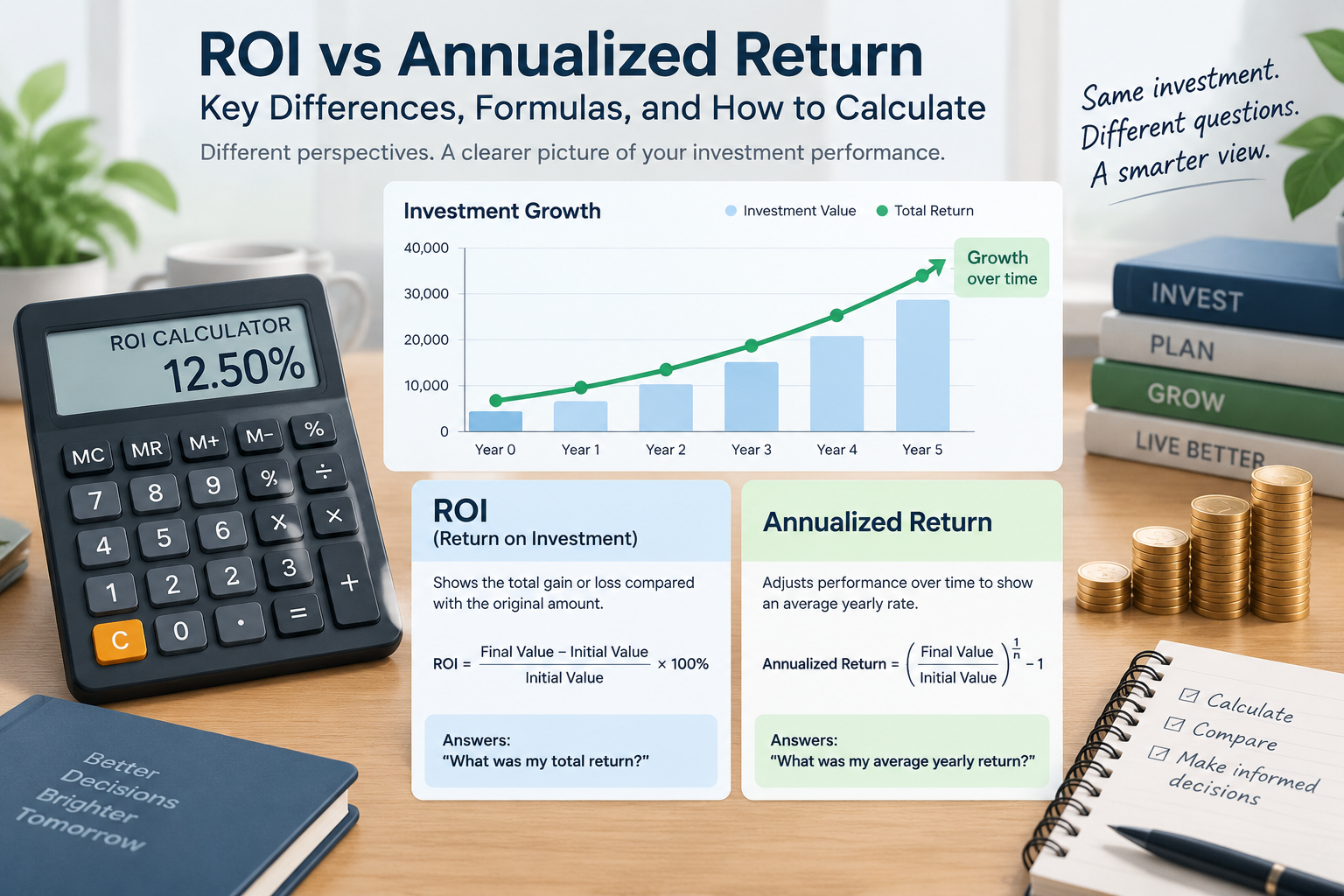
ROI and annualized return are two common ways to measure financial performance, but they answer different questions. ROI shows the total gain or loss compared with the original amount, while annualized return adjusts performance over time to show an average yearly rate. This guide explains what each metric means, how to calculate it, and who can use these formulas for basic financial analysis. You can also use the ROI calculator to quickly estimate returns with transparent calculations.
Understanding ROI and Annualized Return
What is ROI?
ROI, or return on investment, measures the percentage gain or loss from an investment compared with its original cost. It is a simple way to evaluate how much value was created or lost relative to the amount invested.
The basic ROI formula is:
ROI = (Net Return ÷ Initial Investment) × 100
Where:
- Net Return = Final Value − Initial Investment
- Initial Investment = The original amount used
ROI does not consider how long the investment was held. A 20% ROI achieved in one year and a 20% ROI achieved in ten years have the same ROI percentage, even though the yearly performance is very different.
What is Annualized Return?
Annualized return converts a total return into an estimated average yearly growth rate over a specific period. It helps compare investments held for different lengths of time.
Annualized return is often expressed as compound annual growth rate (CAGR) when there is one beginning value and one ending value.
The formula is:
Annualized Return = ((Final Value ÷ Initial Value)^(1 ÷ Number of Years) − 1) × 100
Unlike simple ROI, annualized return accounts for the effect of time and compounding.
ROI Formula vs Annualized Return Formula
The main difference between the two formulas is the treatment of time.
| Metric | Formula | Considers Time? | Best Used For |
|---|---|---|---|
| ROI | (Net Return ÷ Initial Investment) × 100 | No | Measuring total gain or loss |
| Annualized Return | ((Final Value ÷ Initial Value)^(1 ÷ Years) − 1) × 100 | Yes | Comparing performance across different periods |
ROI Calculation Example
Suppose you invest $10,000 and later sell the investment for $12,000.
Net Return:
$12,000 − $10,000 = $2,000
ROI:
($2,000 ÷ $10,000) × 100 = 20%
The ROI is 20%.
This tells you the investment increased by 20% compared with the original amount.
Annualized Return Calculation Example
Now assume the same $10,000 investment grows to $12,000 over three years.
Annualized Return:
(($12,000 ÷ $10,000)^(1 ÷ 3) − 1) × 100
= (1.2^(0.3333) − 1) × 100
≈ 6.27%
The annualized return is about 6.27% per year.
Although the total ROI is 20%, the average yearly growth rate is lower because the investment took three years to reach that result.
When to Use ROI vs Annualized Return
Use ROI When You Need a Simple Total Performance Measure
ROI is useful when you want to know the overall result of a project, purchase, or investment.
Common examples include:
- Comparing the total gain from an investment
- Reviewing the return from a business project
- Measuring the outcome of a one-time expense
ROI is easy to understand, but it should not be used alone when comparing investments with different holding periods.
Use Annualized Return When Comparing Different Time Periods
Annualized return is more useful when investments have different durations.
For example:
- Investment A earns 15% ROI in one year
- Investment B earns 25% ROI in five years
The ROI values alone do not show the yearly growth rate. Annualized return provides a more consistent comparison.
For related calculations involving growth over time, you can also explore the compound interest calculator.
How to Calculate ROI and Annualized Return Step by Step
Step 1: Identify the Initial and Final Values
Collect the starting amount and ending amount.
Example:
- Initial investment: $5,000
- Final value: $6,500
Step 2: Calculate Total Return
Subtract the initial value from the final value.
$6,500 − $5,000 = $1,500
Step 3: Calculate ROI
Divide the return by the initial investment.
($1,500 ÷ $5,000) × 100 = 30%
The ROI is 30%.
Step 4: Include Time for Annualized Return
If the investment lasted four years:
(($6,500 ÷ $5,000)^(1 ÷ 4) − 1) × 100
≈ 6.78%
The annualized return is approximately 6.78% per year.
You can use the ROI calculator to automate these calculations and reduce manual errors.
Common Mistakes and Limitations
Confusing ROI With Yearly Performance
A common mistake is treating ROI as an annual percentage. ROI only measures total performance unless a time period is specifically included in another calculation.
Ignoring the Effect of Time
Two investments can have the same ROI but very different annualized returns because the holding periods are different.
Forgetting Additional Costs
ROI calculations may change if you include fees, taxes, maintenance costs, or other expenses. The formula should clearly define which costs are included.
Assuming Past Returns Predict Future Results
ROI and annualized return describe historical performance based on provided numbers. They do not guarantee future results or predict market outcomes. Financial calculations are informational tools and should not be considered investment advice.
Frequently Asked Questions
What is the difference between ROI and annualized return?
ROI measures the total percentage gain or loss compared with the original investment. Annualized return adjusts that result into an average yearly growth rate, making it easier to compare investments over different time periods.
Is annualized return better than ROI?
Neither metric is always better. ROI is useful for understanding total performance, while annualized return is usually more helpful when comparing investments with different holding periods.
How do I calculate annualized return from ROI?
To convert a total return into an annualized return, you need the length of time the investment was held. The calculation uses the formula: ((Final Value ÷ Initial Value)^(1 ÷ Years) − 1) × 100.
Can ROI be negative?
Yes. If the final value is lower than the initial investment, the ROI will be negative, showing a loss compared with the original amount.
Does annualized return include compounding?
When calculated using the CAGR formula, annualized return includes the effect of compounding over the investment period.
Use a Calculator to Compare Returns More Easily
Understanding ROI and annualized return helps you interpret financial numbers more clearly. Use the ROI calculator for quick calculations, and review results as historical measurements rather than guarantees of future performance.
Looking for more tools?
Try our free Free Calculators