Roth IRA
Roth IRA Contribution Limits 2026: Income Phases and Deadlines
Learn the 2026 Roth IRA contribution limits, income phase-out rules, deadlines, formulas, examples, and how to estimate your eligible contribution.
A Roth IRA contribution limits 2026 guide explains how much you may be able to contribute to a Roth individual retirement account, how income phase-outs affect eligibility, and which deadlines matter. It is designed for people comparing retirement savings options, checking contribution room, or using a retirement calculator to understand long-term scenarios. Roth IRA rules depend on factors such as taxable income, filing status, age, and IRS limits.
What Are Roth IRA Contribution Limits in 2026?
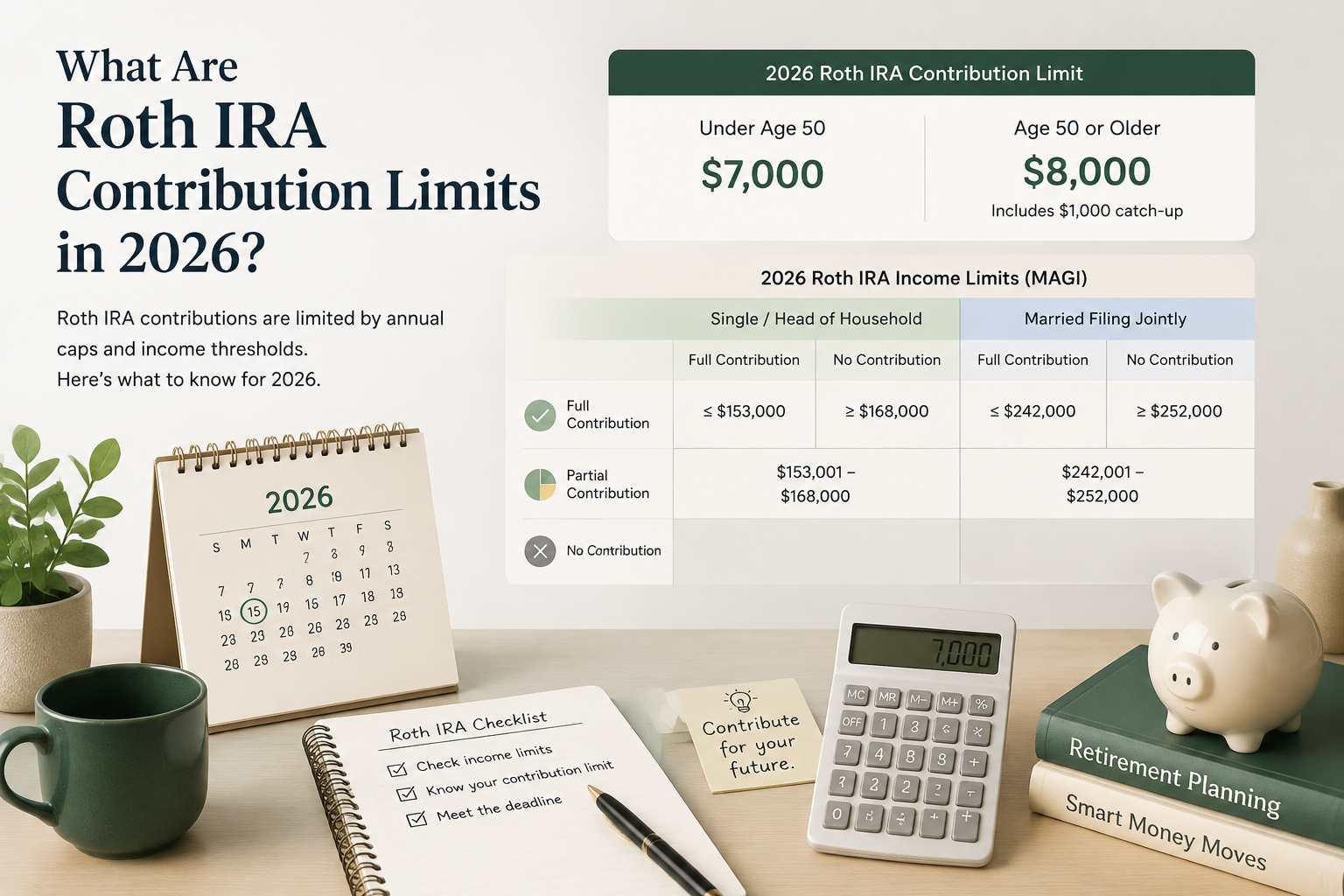
A Roth IRA is a retirement account that allows eligible individuals to contribute after-tax money. Qualified withdrawals in retirement may be tax-free if account rules are met, but contribution eligibility is limited by annual contribution caps and income thresholds.
For 2026, the contribution limit is the maximum amount an eligible person can add to their Roth IRA during the tax year. The limit applies across all of your traditional IRA and Roth IRA contributions combined. This means you cannot contribute the maximum amount to both accounts separately if the combined total exceeds the annual IRA contribution limit.
Roth IRA eligibility is also affected by modified adjusted gross income (MAGI). If your income falls below the applicable threshold, you may be able to contribute the full amount. If your income is within the phase-out range, your allowed contribution may be reduced. If your income exceeds the phase-out limit, direct Roth IRA contributions may not be allowed for that year.
These limits are designed to provide general information. They do not represent personal tax advice, and individual situations can differ based on tax filing details and other financial factors.
You can use a retirement calculator to explore how different contribution amounts could affect long-term savings estimates.
How Roth IRA Contribution Limits Are Calculated
The basic calculation starts with your annual IRA contribution limit and then adjusts for income eligibility.
A simplified formula is:
Eligible Roth IRA contribution = Annual contribution limit adjusted by age and income eligibility rules
The calculation has several parts:
- Determine the annual IRA contribution maximum for the tax year.
- Check whether you qualify for the full contribution based on MAGI and filing status.
- Reduce the contribution amount if your income falls inside the phase-out range.
- Confirm that your total contributions across IRA accounts do not exceed the annual limit.
Example: Full Contribution Eligibility
Assume the annual IRA contribution limit for a person under age 50 is $7,000. If their income is below the Roth IRA phase-out range for their filing status, their calculation may look like this:
Annual limit: $7,000
Income adjustment: $0 reduction
Eligible contribution: $7,000
This example shows the basic idea. Actual limits and eligibility depend on the official rules for the applicable tax year.
Example: Reduced Contribution During Phase-Out
Assume the annual limit is $7,000 and a taxpayer's income falls within the phase-out range. If the calculation determines that 40% of the contribution room remains available:
$7,000 × 40% = $2,800
Estimated eligible contribution: $2,800
The actual IRS calculation may involve specific rounding rules and income ranges, so users should verify their final amount using current tax information or professional guidance when needed.
Roth IRA Income Limits 2026 and Phase-Out Rules
Roth IRA income limits 2026 determine whether a person can contribute the full amount, a reduced amount, or no direct contribution at all. The phase-out system means eligibility does not always change suddenly from full access to zero access. Instead, there is usually a range where the allowed contribution gradually decreases.
Important factors include:
- Tax filing status, such as single, married filing jointly, or married filing separately.
- Modified adjusted gross income rather than only salary or wages.
- Age and total IRA contributions already made during the year.
- Whether the contribution is for the current tax year or a previous tax year before the deadline.
Because income limits can change annually, checking the current IRS rules is important before making contributions.
Roth IRA vs Traditional IRA: Key Differences
Many people compare Roth IRA vs traditional IRA options when planning retirement savings. The main difference is when taxes are generally applied.
A Roth IRA uses after-tax contributions. Qualified withdrawals may be tax-free when account requirements are satisfied. A traditional IRA may provide potential tax advantages through deductible contributions depending on eligibility, but withdrawals are generally taxed as income.
A simple comparison:
| Feature | Roth IRA | Traditional IRA |
|---|---|---|
| Contribution tax treatment | After-tax | May be deductible depending on rules |
| Withdrawal treatment | Qualified withdrawals may be tax-free | Withdrawals generally taxed as income |
| Income limits | Apply to direct contributions | Different deduction and eligibility rules may apply |
| Purpose | Long-term retirement savings | Long-term retirement savings |
The better choice depends on personal circumstances, tax situation, retirement goals, and other factors. A calculator can help compare scenarios, but it cannot determine an individual's ideal tax strategy.
Roth IRA Contribution Deadline
The IRA contribution deadline is generally connected to the tax filing deadline for the applicable year, not the end of the calendar year. This allows eligible taxpayers additional time after December 31 to make contributions for the previous tax year.
For example, a person may have an opportunity to make a contribution for a prior tax year during the following filing season before the deadline. The exact deadline can change because of weekends, holidays, or special circumstances.
Before contributing, confirm that the contribution is assigned to the intended tax year. Incorrect year selection is a common administrative mistake.
How to Estimate Your Roth IRA Contribution Step by Step
Use these steps to estimate your possible contribution:
Step 1: Identify Your Filing Status
Start with whether you file as single, married filing jointly, married filing separately, or another status. Roth IRA income limits are based on filing status.
Step 2: Estimate Your Modified Adjusted Gross Income
Use your expected taxable income information and relevant adjustments to estimate MAGI. This number is used for Roth IRA eligibility calculations.
Step 3: Check the Applicable Income Range
Compare your MAGI with the Roth IRA income limits for the year. This helps determine whether you are eligible for the full contribution, a reduced contribution, or no direct contribution.
Step 4: Calculate Available Contribution Room
After confirming eligibility, compare your desired contribution with the annual IRA limit. You can also explore future savings scenarios with the retirement calculator.
Step 5: Review Total IRA Contributions
Remember that Roth IRA and traditional IRA contributions share the same annual contribution limit. Check your combined contributions before completing deposits.
Common Mistakes and Limitations
Mistake 1: Confusing Income Limits With Contribution Limits
The contribution limit describes how much can be added. The income limit determines whether you can make a direct Roth IRA contribution and whether it must be reduced.
Mistake 2: Ignoring Filing Status
A person's Roth IRA eligibility cannot be determined from income alone. Filing status can significantly change the applicable limits.
Mistake 3: Exceeding the Combined IRA Limit
Contributing the maximum amount to both a Roth IRA and traditional IRA separately can exceed the annual IRA contribution limit.
Mistake 4: Treating Estimates as Tax Advice
Calculator results are educational estimates. Tax rules can be complex, and individual circumstances may require review from a qualified tax professional.
Limitations of Online Calculations
A calculator can simplify formulas and provide estimates, but it may not include every factor affecting eligibility. Changes in tax law, income details, and account circumstances can affect the final result.
Frequently Asked Questions
What is the Roth IRA contribution limit for 2026?
The Roth IRA contribution limit for 2026 is the maximum amount allowed for eligible IRA contributions during that tax year. The exact limit depends on IRS rules, age, and whether other IRA contributions are made.
How do Roth IRA income limits work in 2026?
Roth IRA income limits 2026 use modified adjusted gross income and filing status to determine whether someone can make a full contribution, a reduced contribution, or no direct contribution.
Can I contribute to both a Roth IRA and a traditional IRA in 2026?
Yes, but the combined contributions to all IRA accounts must stay within the annual IRA contribution limit. The limit is shared across Roth IRA and traditional IRA contributions.
What is the IRA contribution deadline for 2026?
The IRA contribution deadline is generally tied to the tax filing deadline for the relevant tax year. Check current IRS guidance for the exact date and any special extensions.
Should I choose a Roth IRA or traditional IRA?
Roth IRA vs traditional IRA decisions depend on individual tax circumstances, retirement goals, and personal preferences. A comparison calculator can help illustrate differences, but it does not provide personalized financial advice.
Use a Retirement Calculator to Explore Scenarios
Understanding contribution limits is one part of retirement planning. You can use the retirement calculator to estimate how different savings amounts and time periods may affect potential future balances. Results are estimates based on the information entered and should be used for education and planning discussions, not as a guarantee of future outcomes.
Looking for more tools?
Try our free Free Calculators