Roth IRA vs Traditional IRA
Roth IRA vs Traditional IRA: Which Fits Your Taxes?
Compare Roth IRA vs Traditional IRA with clear explanations of taxes, contribution rules, withdrawal differences, formulas, examples, and how to evaluate which account type may fit your situation.
Choosing between a Roth IRA and a Traditional IRA means comparing two ways to receive tax benefits for retirement savings. A Roth IRA uses after-tax contributions and may allow tax-free qualified withdrawals, while a Traditional IRA may provide tax advantages when contributing. This comparison helps retirement savers understand how each account works, how taxes affect the calculation, and when to use a retirement calculator to explore different scenarios.
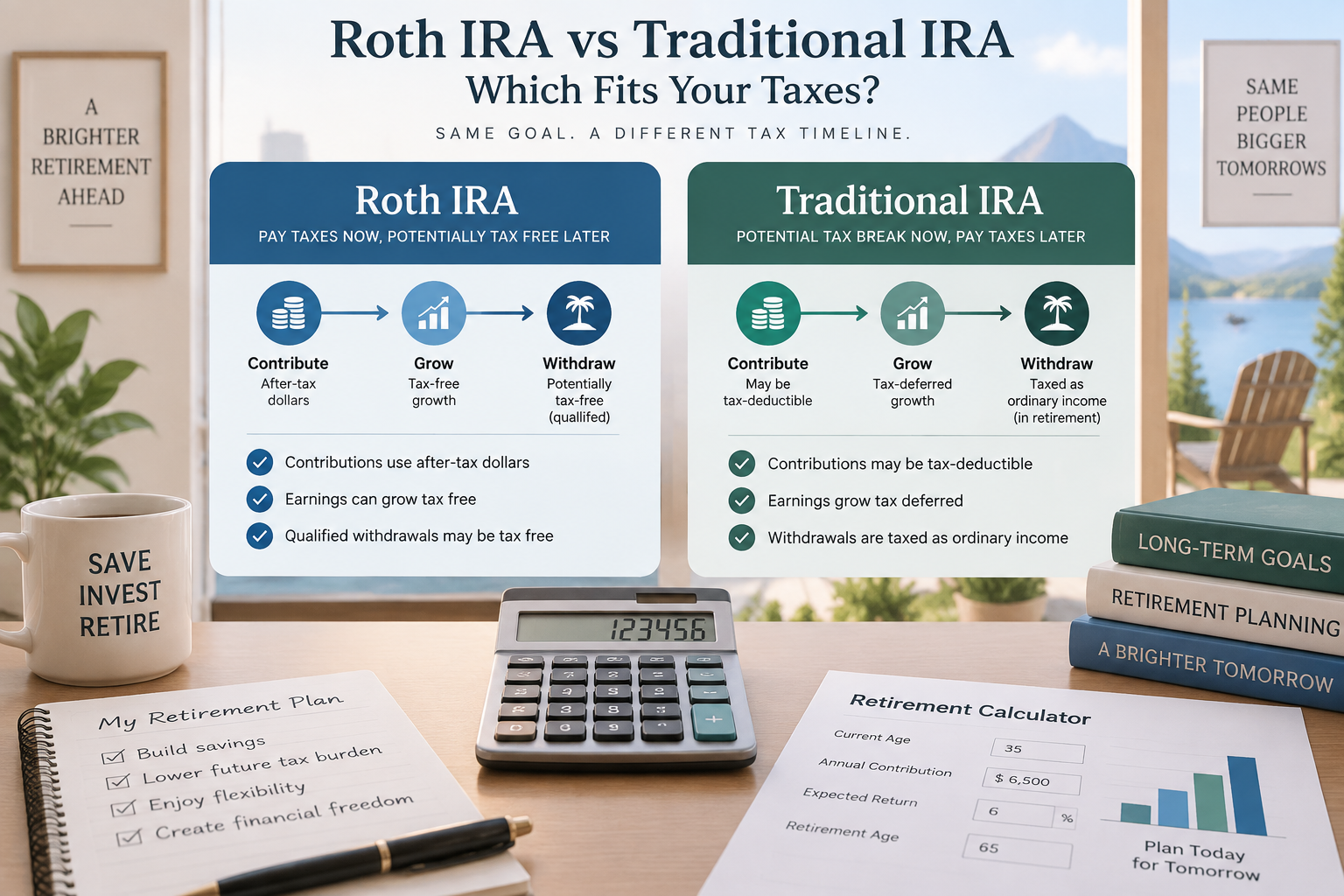
What Is the Difference Between a Roth IRA and a Traditional IRA?
Both Roth IRA and Traditional IRA accounts are individual retirement accounts designed to help people save for retirement, but they differ mainly in when taxes are applied.
A Traditional IRA generally provides a potential tax benefit when money is contributed. Contributions may be deductible depending on income, filing status, workplace retirement coverage, and current tax rules. Taxes are generally paid when money is withdrawn in retirement.
A Roth IRA works in the opposite order. Contributions are made with money that has already been taxed. Qualified withdrawals in retirement are generally tax-free under applicable rules.
The basic comparison is:
| Feature | Roth IRA | Traditional IRA |
|---|---|---|
| Contribution tax treatment | After-tax contributions | Contributions may be deductible depending on circumstances |
| Tax timing | Taxes paid before contribution | Taxes generally paid at withdrawal |
| Qualified retirement withdrawals | Generally tax-free | Generally taxable as income |
| Main consideration | Future tax expectations | Current tax benefits |
The better option depends on personal factors such as current income, expected future tax situation, retirement timeline, and eligibility rules. A calculator can help compare hypothetical outcomes, but it cannot predict future tax rates or investment performance.
How Roth IRA vs Traditional IRA Taxes Are Calculated
The key calculation difference is the timing of taxation.
Roth IRA Future Value Example
For a Roth IRA, the contribution is made after taxes. If a person contributes $5,000 and assumes a hypothetical annual growth rate of 6% for 20 years, the future value calculation is:
Future Value = Contribution × (1 + annual growth rate)ⁿ
Example:
$5,000 × (1 + 0.06)²⁰ = approximately $16,036
Under the assumption that the withdrawal qualifies for Roth IRA tax treatment, the account value may be withdrawn without federal income tax on earnings. Actual results depend on account rules, market performance, and personal circumstances.
Traditional IRA Tax Example
A Traditional IRA calculation considers taxes later in the process.
Example assumptions:
- Contribution: $5,000
- Annual growth rate: 6%
- Investment period: 20 years
- Retirement withdrawal tax rate assumption: 20%
Future value before taxes:
$5,000 × (1 + 0.06)²⁰ = approximately $16,036
Estimated after-tax value:
$16,036 × (1 - 0.20) = approximately $12,829
This simplified example shows why tax timing matters. The actual tax outcome depends on deductions, income levels, account rules, withdrawal timing, and applicable tax laws.
You can use the retirement calculator to compare savings scenarios and understand how different assumptions affect potential future values.
Roth vs Traditional: When Each Account Type May Be Useful
Roth IRA May Fit Situations Where Future Taxes Could Be Higher
Some savers prefer Roth IRA contributions because taxes are paid before money enters the account. If someone expects their future tax rate to be higher than their current rate, paying taxes earlier may be worth considering.
Common reasons people explore Roth IRA options include:
- They expect higher income in retirement.
- They want to understand tax-free qualified withdrawals.
- They are earlier in their career and currently have a lower taxable income.
These are general examples, not personal tax recommendations.
Traditional IRA May Fit Situations Where Current Tax Benefits Matter
Traditional IRA accounts may appeal to people who value possible tax deductions today or expect their retirement tax rate to be lower.
Common reasons people compare Traditional IRA options include:
- They want to evaluate current-year tax effects.
- They expect lower taxable income during retirement.
- They prefer tax-deferred growth during the saving period.
Eligibility and deduction rules vary, so account holders should review current tax guidance or consult a qualified tax professional for personal decisions.
How to Compare Roth IRA and Traditional IRA Step by Step
Step 1: Estimate Your Current Tax Situation
Start by reviewing your current income, tax bracket, and whether Traditional IRA contributions may provide a deduction based on your circumstances.
Step 2: Consider Your Retirement Tax Expectations
Think about possible future income sources, retirement withdrawals, and how taxes could affect your retirement cash flow. Future tax rates cannot be known in advance, so comparisons should use assumptions rather than predictions.
Step 3: Compare the Same Contribution Amount
For a fair comparison, use the same contribution amount and investment assumptions.
For example:
- Initial contribution: $6,000
- Growth assumption: 5% annually
- Time period: 25 years
- Withdrawal tax assumption: 20% for Traditional IRA comparison
Keeping assumptions consistent makes the difference between account types easier to understand.
Step 4: Use a Retirement Calculator for Scenarios
A calculator can help organize assumptions, compare estimated outcomes, and understand how contribution amounts and time periods affect results. Try the retirement calculator to model different retirement savings examples.
Common Mistakes and Limits of IRA Comparisons
Assuming One Account Is Always Better
There is no universal answer that applies to every saver. The better choice depends on personal tax circumstances, retirement goals, and changing rules.
Ignoring Contribution and Eligibility Rules
IRA contribution limits, income restrictions, and deduction rules can change over time. Always check current requirements before making account decisions.
Treating Investment Growth as Guaranteed
IRA calculators often use estimated rates of return to demonstrate possible outcomes. Investment performance is not guaranteed, and actual results may differ.
Comparing Different Contribution Amounts
A fair Roth IRA vs Traditional IRA comparison should use similar assumptions. Changing contribution amounts or time periods can make results difficult to interpret.
FAQ About Roth IRA vs Traditional IRA
Is Roth IRA better than Traditional IRA?
Neither account type is automatically better for everyone. Roth IRA and Traditional IRA accounts provide different tax benefits, and the better fit depends on factors such as current taxes, expected retirement income, and personal financial goals.
What is the main difference between Roth and Traditional IRA?
The main difference is when taxes are paid. Roth IRA contributions are made after taxes and qualified withdrawals may be tax-free, while Traditional IRA contributions may offer tax benefits now and withdrawals are generally taxed later.
Can I have both a Roth IRA and a Traditional IRA?
In many cases, individuals can have both types of accounts. However, annual contribution limits and eligibility rules apply, so contributions should be reviewed under current regulations.
How do I compare Roth IRA vs Traditional IRA savings?
Compare the same contribution amount, growth assumptions, investment period, and estimated tax treatment. A retirement calculator can help visualize different hypothetical scenarios.
Start Comparing Retirement Savings Scenarios
Understanding Roth IRA vs Traditional IRA differences can make retirement planning decisions easier. Use a calculator to test assumptions, compare potential outcomes, and learn how tax timing affects long-term savings. The results are educational estimates only and are not financial or tax advice.
Looking for more tools?
Try our free Free Calculators