healthy body fat percentage for men
Healthy Body Fat Percentage for Men: Ranges by Age and How to Measure
Learn what a healthy body fat percentage for men means, how ranges vary with age, how to calculate body fat percentage, and which measurement methods have limitations.
A healthy body fat percentage for men is the proportion of total body weight made up of fat, expressed as a percentage. The appropriate range depends on age, measurement method, activity level, and individual health. Understanding this measurement can help adults interpret body composition, compare results over time, and distinguish body fat from overall body weight. This guide explains the calculation, commonly used reference ranges, and practical ways to measure body fat without treating a single number as a medical diagnosis.
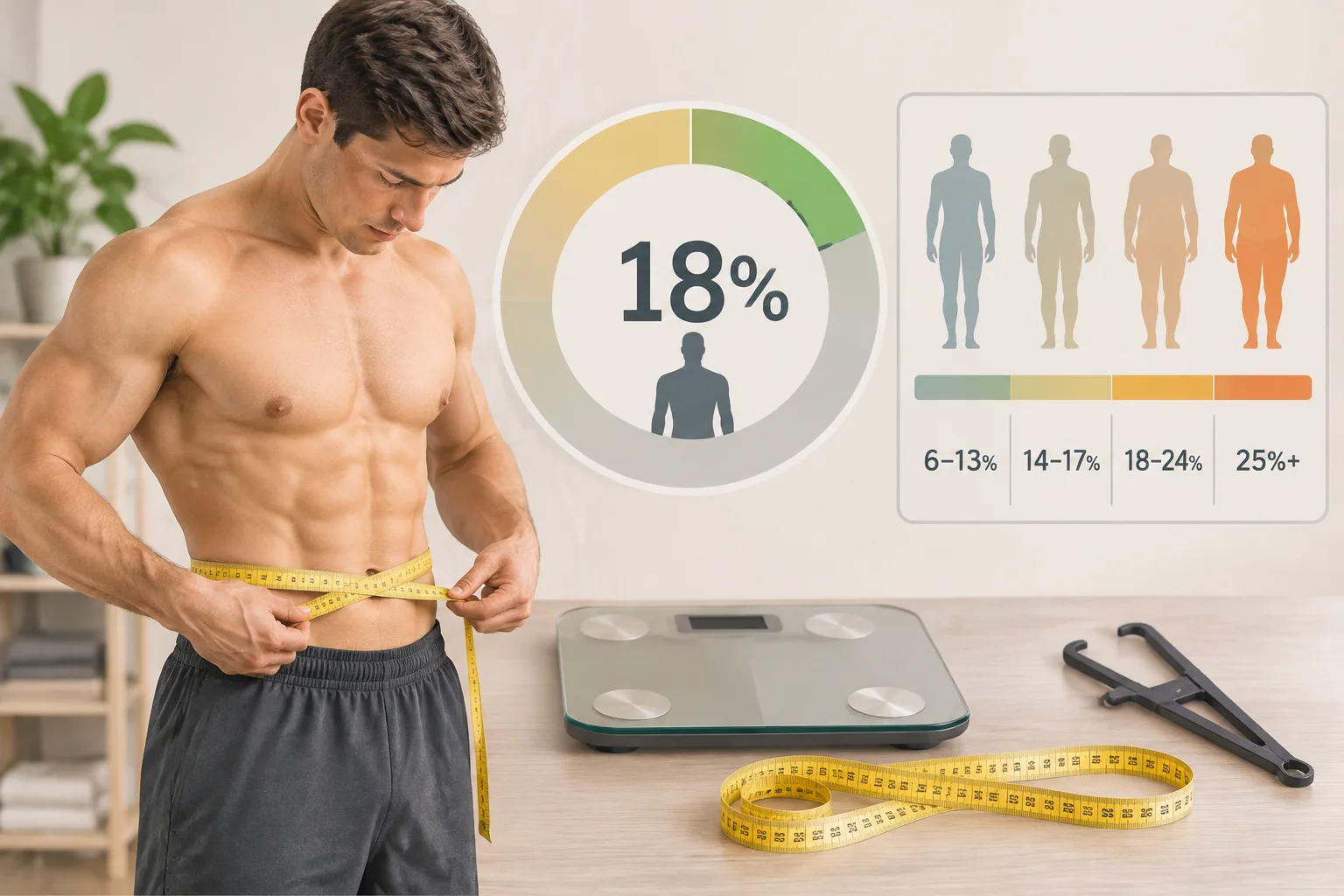
What Does Body Fat Percentage Mean?
Body fat percentage describes how much of a person's total body mass comes from fat tissue. The remainder includes lean tissues such as muscle, bones, organs, and body water. For example, a man who weighs 180 pounds and has 36 pounds of body fat has a body fat percentage of 20%.
Body fat is not inherently unhealthy. The body needs fat for energy storage, hormone production, insulation, and protection of internal organs. Essential fat supports normal physiological functions, while additional fat serves as an energy reserve. The goal is not to eliminate body fat but to understand whether an individual's body composition is appropriate for their circumstances.
Body fat percentage also differs from body mass index (BMI). BMI compares weight with height but does not directly measure fat tissue. Two men with the same height and weight can have different body fat percentages because they have different amounts of muscle and other lean tissue.
Use the BMI calculator as a complementary screening tool, rather than as a substitute for a direct body composition measurement.
Why the number matters
Body composition can provide context that body weight alone cannot. Tracking it may help people understand changes associated with exercise, aging, nutrition, or changes in physical activity. However, a body fat percentage does not independently establish whether someone is healthy.
Other factors matter, including waist circumference, blood pressure, blood glucose, cholesterol, medical history, fitness, sleep, and daily habits. A person can fall within a commonly cited body fat range and still have health concerns. Conversely, someone outside a general reference range is not automatically unhealthy.
Healthy Body Fat Percentage for Men by Age
There is no single universally accepted body fat percentage that defines health for every man. Different organizations and measurement systems use different classifications, and age-specific reference values are not interchangeable with medical diagnostic thresholds.
The American Council on Exercise (ACE) publishes general body fat categories for adult men. These categories are useful as a broad reference, but they should not be interpreted as individualized medical targets.
| ACE category for men | Body fat percentage |
|---|---|
| Essential fat | 2–5% |
| Athletes | 6–13% |
| Fitness | 14–17% |
| Average | 18–24% |
| Obesity category | 25% and above |
These are general classification categories, not a definitive healthy body fat chart for every age. In particular, the obesity category shown here is an ACE body fat classification and should not be confused with a clinical diagnosis based on body fat percentage alone. The very low essential-fat category is not a recommended target for most people.
How age affects body composition
Body composition often changes with age. Many adults gradually lose muscle mass and gain fat mass, even when their overall weight changes relatively little. Changes in physical activity, nutrition, sleep, hormones, and health conditions can all contribute.
For this reason, a body fat percentage that is common among younger adults may not have the same context for an older adult. However, age alone cannot determine an individual's ideal percentage. Two men of the same age can have substantially different body compositions and health needs.
When comparing results across age groups, distinguish three questions:
- What is common? An average describes a population and does not necessarily represent a healthy target.
- What is classified? A reference chart groups measurements according to a particular system and its assumptions.
- What is appropriate for an individual? This depends on overall health, physical function, goals, and clinical context.
A men body fat chart can help organize these distinctions, but avoid treating age bands as exact biological cutoffs. If a chart does not identify its source, population, measurement technique, or classification method, its ranges may be difficult to interpret reliably.
Is a lower body fat percentage always healthier?
No. Lower is not automatically better. Very low body fat can be associated with inadequate energy availability and may affect hormonal function, bone health, recovery, and normal physiological processes. The risks depend on the degree of fat loss, duration, nutritional intake, activity level, and individual circumstances.
Likewise, a higher measurement does not tell the whole health story. It should be interpreted alongside other indicators rather than used to label a person based on one result.
How to Calculate Body Fat Percentage
The basic body fat percentage formula is straightforward when body fat mass is known. Divide fat mass by total body weight, then multiply by 100.
Fat mass and total body weight must use the same units, such as pounds or kilograms. The result is a percentage, not a weight measurement.
Calculation example using pounds
Suppose a man weighs 180 pounds and an assessment estimates that he has 36 pounds of body fat.
The estimated body fat percentage is 20%. The remaining 144 pounds represent estimated fat-free mass, which includes muscle, bone, organs, and body water.
The calculation itself is exact when the two input values are known. In practice, the fat mass estimate may be uncertain because different measurement methods have different limitations. A precise-looking result does not guarantee a precise measurement.
Calculating body fat mass from a percentage
The formula can also be rearranged when body weight and body fat percentage are available.
For example, if a man weighs 82 kilograms and his estimated body fat percentage is 18%:
His estimated fat mass is 14.76 kilograms. His estimated fat-free mass is 67.24 kilograms, calculated by subtracting fat mass from total weight. Both estimates inherit the uncertainty of the original body fat measurement.
Estimating body fat when fat mass is unknown
Most household scales do not directly weigh fat tissue. Instead, body composition devices estimate body fat using electrical impedance, equations, or other measurement inputs. Skinfold calipers estimate subcutaneous fat thickness and use an equation to approximate overall body fat.
These methods are not the same as measuring known fat mass directly. The underlying equations may depend on age, sex, population, hydration, and other factors. If you use a body fat calculator, check which measurements it requires and what estimation method it uses. Do not assume that a result is equivalent to a laboratory assessment.
How to Measure Body Fat Percentage in Men
Several methods are available, ranging from convenient household devices to specialized clinical or laboratory assessments. The most suitable option depends on the required accuracy, cost, accessibility, and whether you need to track changes over time.
1. Bioelectrical impedance analysis
Bioelectrical impedance analysis (BIA) is used in many smart scales and handheld body composition devices. A device passes a small electrical current through the body and measures how easily it travels. An equation then estimates body composition from the impedance reading and other inputs.
BIA is convenient, but the result can change with hydration, recent exercise, food intake, alcohol consumption, and other conditions. Different devices may use different algorithms, so their results are not always interchangeable.
For tracking, follow the manufacturer's instructions and measure under similar conditions each time. Compare trends from the same device instead of assuming that every reading is an exact representation of body fat.
2. Skinfold measurements
Skinfold calipers measure the thickness of skin and underlying subcutaneous fat at selected body sites. A trained assessor uses the measurements in an equation to estimate body fat percentage.
Results depend on the measurement sites, technique, caliper quality, and equation selected. Self-measurement can be difficult, particularly at some sites. Different assessors may produce different results, so consistent technique matters when monitoring changes.
Skinfold measurements do not directly measure visceral fat, the fat stored around internal organs. An estimate from skinfolds should therefore not be treated as a complete assessment of fat distribution.
3. Waist circumference
Waist circumference is not a direct measurement of body fat percentage, but it can provide additional information about abdominal fat distribution. Measure according to a consistent protocol, such as the method recommended by the relevant health organization, and record the measurement in the same units each time.
Waist measurements can be useful alongside weight and other health indicators. They cannot tell you the exact percentage of body weight made up of fat, and thresholds used to assess health risk may vary by population and clinical guideline.
4. Dual-energy X-ray absorptiometry
Dual-energy X-ray absorptiometry (DXA) uses low-dose X-rays at different energy levels to estimate bone mineral content, lean soft tissue, and fat mass. It can provide more detailed information about body composition and regional fat distribution than many consumer devices.
DXA is not free of limitations. Results can vary with equipment, software, positioning, and testing conditions. It also involves radiation exposure, although the dose from a typical body composition scan is low. Availability and suitability should be discussed with a qualified healthcare professional when relevant.
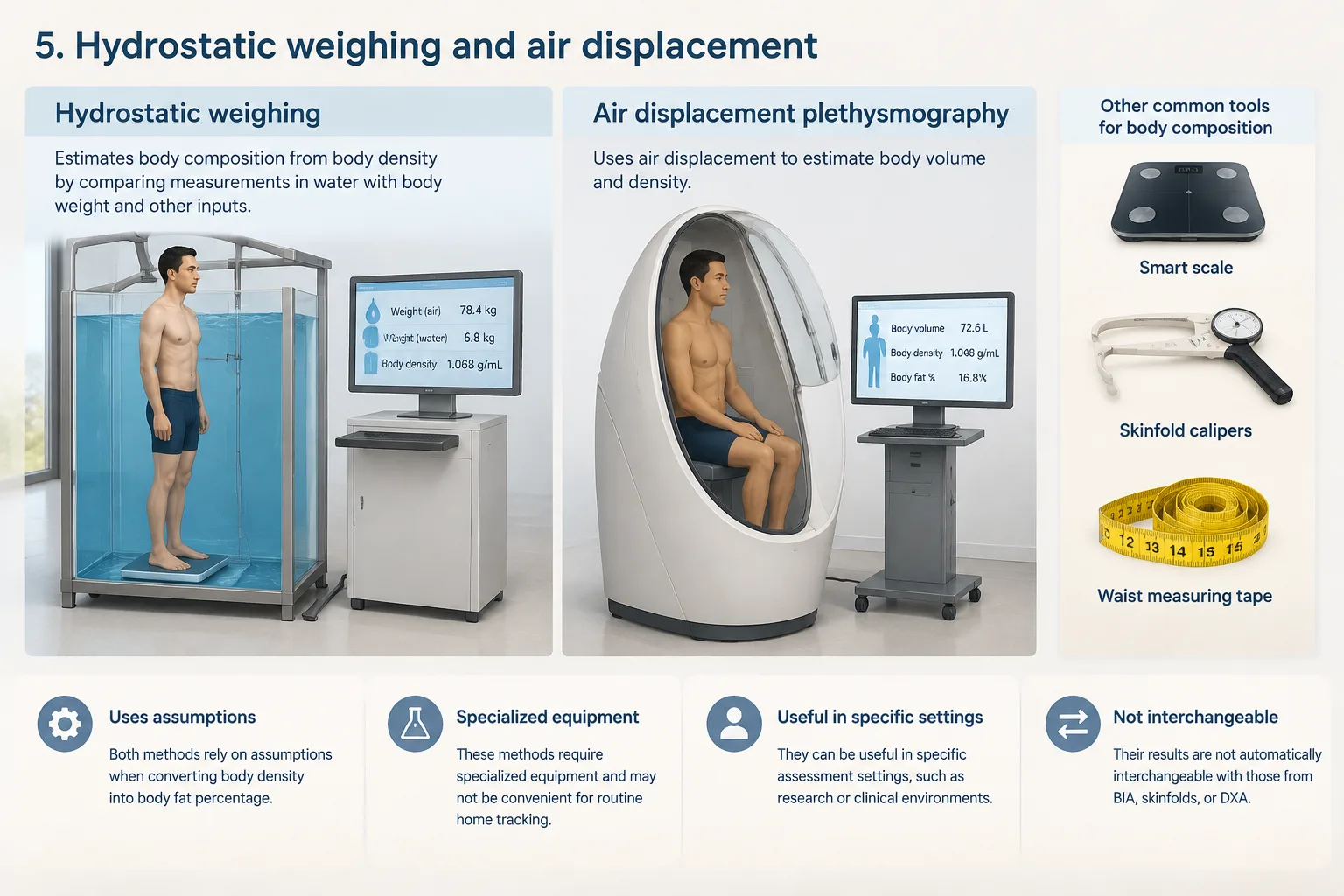
5. Hydrostatic weighing and air displacement
Hydrostatic weighing estimates body composition from body density by comparing measurements in water with body weight and other inputs. Air displacement plethysmography uses air displacement to estimate body volume and density. Both methods rely on assumptions when converting body density into body fat percentage.
These methods require specialized equipment and may not be convenient for routine home tracking. They can be useful in specific assessment settings, but their results are not automatically interchangeable with those from BIA, skinfolds, or DXA.
How to Use a Body Fat Calculator
An online body fat calculator can help organize measurements, perform calculations, and interpret results within the limits of its method. Before entering information, identify whether the calculator uses known fat mass, body measurements, a circumference-based formula, or a different estimation approach.
Follow these steps:
- Choose the right calculation method. Use a direct percentage formula if you already have an estimate of fat mass. If you only know your height, weight, age, and circumferences, select a calculator that explicitly supports the measurements you have.
- Gather the required measurements. Use a reliable scale and a measuring tape where needed. Follow the calculator's instructions for units and measurement locations.
- Enter values carefully. Check whether the tool expects pounds or kilograms, inches or centimeters, and whether percentages should be entered as whole numbers or decimals.
- Calculate the result. Review the displayed percentage and the method used to generate it. A result based on an estimate should remain identified as an estimate.
- Record the measurement conditions. Note the date, device, time of day, and any relevant changes in routine that might affect the result.
- Compare like with like. When monitoring progress, use the same method and similar conditions rather than comparing measurements from different devices as if they were identical.
- Consider the broader context. Interpret body fat percentage alongside physical function, waist circumference, health history, and other relevant measures.
You can use the BMI calculator for a height-and-weight screening measure and the FFMI calculator to explore fat-free mass relative to height. The ideal weight calculator provides another reference point, but ideal-weight estimates are not direct measures of body fat or individualized medical recommendations.
Common Mistakes and Measurement Limitations
Treating estimates as exact measurements
A reading such as 19.7% can look highly precise, but the decimal place does not demonstrate that the method is accurate to that level. Device algorithms, hydration, and measurement technique can all affect the result. Reported precision and actual measurement accuracy are different concepts.
Comparing results from different devices
One scale may report a different body fat percentage from another because the devices use different sensors, equations, or assumptions. This does not necessarily mean that one device is broken. When consistency is the goal, choose a method and use it repeatedly under comparable conditions.
Assuming BMI and body fat percentage mean the same thing
BMI is calculated from weight and height. It does not directly measure body fat, distinguish fat from muscle, or show where fat is stored. Body fat percentage estimates the share of body mass that is fat. The measures can complement each other, but one cannot be substituted for the other.
Focusing only on a single reading
Daily fluctuations may reflect water balance, recent meals, exercise, or device variability rather than a meaningful change in fat mass. If you track body composition, look at measurements over time and consider whether the observed change is larger than the usual variation in your chosen method.
Using a general chart as a diagnosis
A reference table can provide context but cannot diagnose a health condition. Body fat percentage alone does not establish metabolic health, cardiovascular risk, or the cause of a change in weight. Seek professional guidance if a result raises concerns or if you have a medical condition that affects body composition.
Understanding Body Fat Percentage Alongside Other Health Measures
Body fat percentage is most useful when it answers a specific question. Someone monitoring strength training may want to understand changes in lean mass. Another person may want a broader picture of body composition as part of a health assessment. The appropriate method and interpretation depend on that purpose.
Consider these complementary measures:
- Body weight: Shows total mass but does not identify how much comes from fat, muscle, or water.
- BMI: Relates weight to height and can be used as a population-level screening measure, with limitations for highly muscular individuals and other groups.
- Waist circumference: Provides information about abdominal size and can complement other measures of health risk.
- Fat-free mass: Includes all body mass that is not classified as fat; it is not synonymous with skeletal muscle.
- Physical function and clinical indicators: Fitness, blood pressure, blood glucose, lipid levels, and medical history can provide important context beyond body composition.
No single metric captures every aspect of health. A more informative assessment combines suitable measurements with an understanding of how they were obtained and what they can reasonably show.
If you are using a calculator to follow changes, keep a simple record of the date, method, and result. A consistent measurement history is generally more useful than repeatedly switching methods in pursuit of one supposedly perfect number.
Frequently Asked Questions
What is a healthy body fat percentage for men?
A healthy body fat percentage for men depends on age, activity level, measurement method, and individual health. ACE's general adult male categories place the fitness category at 14–17% and the average category at 18–24%, but these are broad classifications rather than universal medical targets. Use them as context, not as a diagnosis or a requirement that every man should meet.
What is a healthy body fat percentage for men by age?
Body composition often changes with age, but there is no single age-based percentage that is ideal for every man. The meaning of a result depends on the reference system, measurement method, health status, and physical function. When consulting a men body fat chart, check its source and definitions instead of assuming that a particular age band establishes an individual's health status.
How do I calculate my body fat percentage at home?
If you know your estimated fat mass and total weight, divide fat mass by total weight and multiply by 100. For example, 30 pounds of fat divided by 150 pounds of total body weight equals 20%. If you do not know fat mass, a consumer body composition device or a suitable calculator may estimate it from other measurements, but the result will depend on the method and its assumptions.
Is a body fat scale accurate for men?
A body fat scale estimates body composition, usually through bioelectrical impedance and an equation. Its result can be affected by hydration, recent exercise, food intake, and the device's algorithm. It may be useful for following trends when used consistently, but it should not be assumed to provide a definitive measurement or be directly interchangeable with a clinical assessment.
Is body fat percentage better than BMI?
Neither measure is universally better because they answer different questions. BMI uses height and weight, while body fat percentage estimates the proportion of body mass made up of fat. Body fat percentage may add useful information about composition, but it also has measurement uncertainty. Interpreting both alongside waist circumference and other health indicators provides more context than relying on either number alone.
Use a Calculator to Understand Your Measurements
A body fat estimate is a starting point for understanding body composition, not a verdict on health. Choose a calculation method that matches your available measurements, check the assumptions, and compare results consistently. If you need additional context, combine body composition information with BMI, waist circumference, and appropriate clinical indicators.
Start with the BMI calculator, explore the FFMI calculator, or review the ideal weight calculator to compare related measurements. These tools can help with calculations and general understanding, but they do not replace individualized advice from a qualified healthcare professional.
The most useful result is one you can interpret accurately, understand the limitations of, and apply sensibly to your own circumstances.
Looking for more tools?
Try our free Free Calculators