calories
How Many Calories Should I Eat a Day?
Learn how many calories you should eat a day using calorie needs formulas, examples, and practical steps. Understand maintenance calories, activity levels, and limitations.
How many calories should I eat a day? The answer depends on your age, body size, sex, activity level, and personal goals. A calorie estimate helps you understand your daily energy needs for maintaining weight, gaining weight, or losing weight. Use the calorie calculator to get a personalized estimate based on your information.
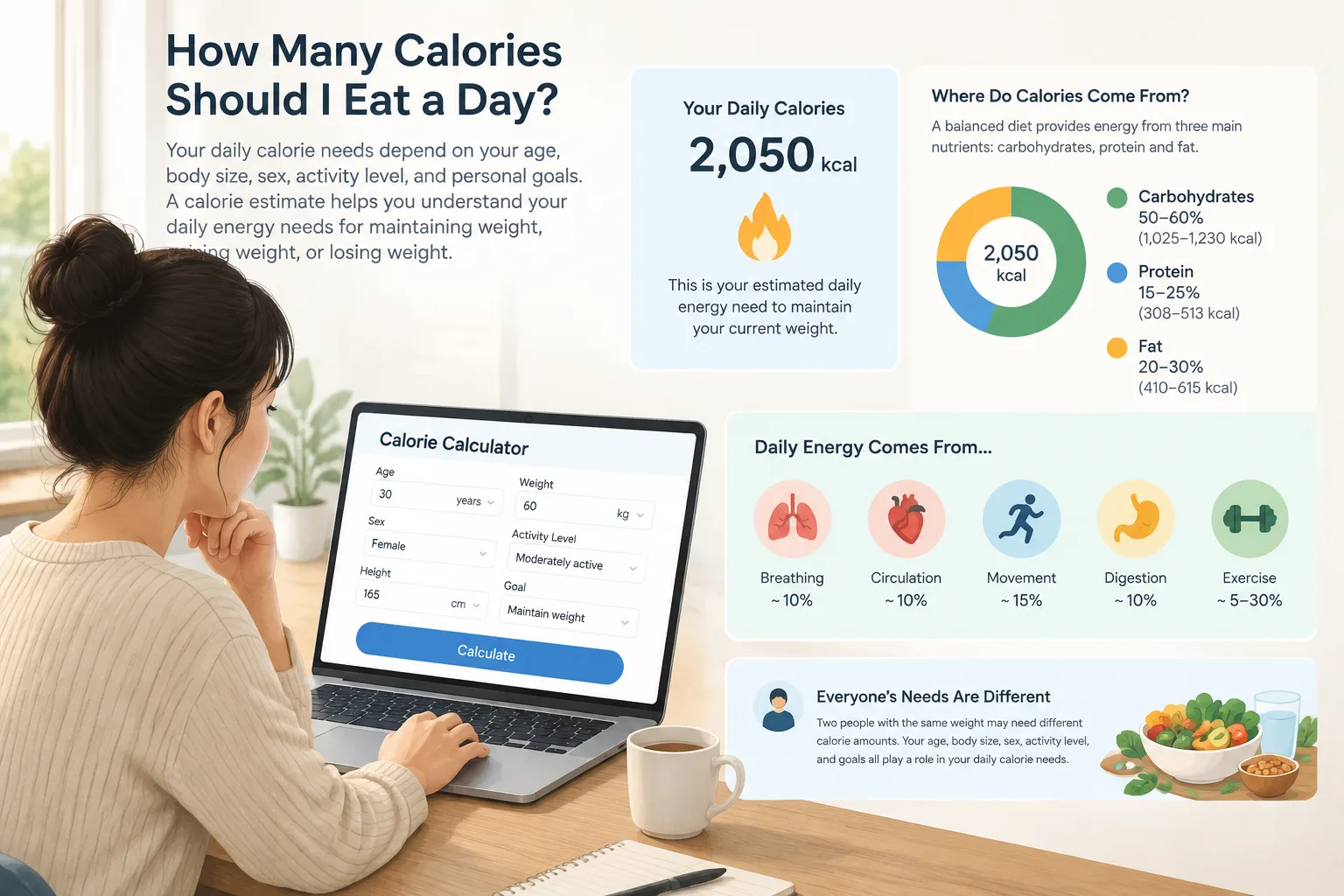
What Are Daily Calorie Needs?
Daily calorie needs are the amount of energy your body uses in a typical day. Calories come from food and drinks, while your body uses energy for basic functions such as breathing, circulation, movement, digestion, and exercise.
The number of calories a person needs is different for everyone. Two people with the same weight may need different amounts of energy because they may have different heights, ages, muscle levels, jobs, exercise habits, or health goals.
A common way to estimate calorie needs is to calculate your Basal Metabolic Rate (BMR) and then adjust it based on activity. BMR represents the calories your body needs at rest to support essential functions.
Your estimated daily calorie requirement is often called Total Daily Energy Expenditure (TDEE). It includes your resting energy needs plus calories used through physical activity and normal daily movement.
How Many Calories Should I Eat a Day? Understanding the Calculation
Step 1: Calculate Basal Metabolic Rate (BMR)
One commonly used method for estimating BMR is the Mifflin-St Jeor equation. The formula differs slightly by sex category:
Where:
- (W) = body weight in kilograms
- (H) = height in centimeters
- (A) = age in years
For example, a 30-year-old woman who weighs 65 kg and is 165 cm tall would have an estimated BMR of:
The estimated BMR is about 1,370 calories per day.
This number is only an estimate of resting energy needs. It does not represent the total calories needed during a full day.
Step 2: Adjust for Activity Level
To estimate TDEE, multiply BMR by an activity factor:
Common activity factors include:
- Sedentary: (1.2) (little structured exercise)
- Lightly active: (1.375) (light exercise or active daily routine)
- Moderately active: (1.55) (regular moderate exercise)
- Very active: (1.725) (hard exercise or physically demanding work)
- Extra active: (1.9) (very high activity levels)
Using the example above, if the person is moderately active:
The estimated daily calorie requirement is about 2,124 calories.
You can check your own estimate faster with the health calorie calculator, which applies the same type of calculation process.
Calories for Different Goals
Maintaining Weight
If your goal is to maintain your current weight, your calorie intake generally needs to be close to your TDEE. For example, someone with a TDEE of about 2,100 calories may maintain their weight when their average intake is around that level.
Actual results can vary because calorie estimates are based on averages. Changes in body composition, hormones, sleep, stress, and daily movement can influence energy use.
Losing Weight
Weight loss usually involves consuming fewer calories than your body uses over time. Some people create a calorie deficit by reducing food intake, increasing activity, or combining both approaches.
A calorie deficit is not a guarantee of a specific result because body weight changes depend on many factors. Calorie calculators provide estimates that can help with planning, but they cannot predict exact outcomes.
Gaining Weight
People who want to gain weight often need a consistent calorie intake above their estimated daily needs. The quality of food choices and overall nutrition are also important considerations.
A calorie number alone does not describe the balance of protein, carbohydrates, fats, vitamins, and minerals in a diet.
How to Use a Daily Calorie Calculator
A calorie calculator can simplify the estimation process. Follow these steps:
- Enter your age, height, weight, and relevant personal details.
- Select your usual activity level.
- Review the estimated daily calorie range.
- Compare the estimate with your current eating habits and goals.
- Adjust gradually while monitoring how your body responds.
For additional health measurements, you can also explore the BMI calculator or ideal weight calculator to understand other common body measurements.
Remember that these tools are designed to provide general information. They do not replace advice from qualified healthcare professionals.
Common Mistakes and Limitations
Mistake 1: Treating the Number as Exact
A calorie estimate is not a precise measurement of your metabolism. It is a starting point based on population-based formulas.
Your real energy needs may be higher or lower depending on factors such as muscle mass, activity patterns, and individual biology.
Mistake 2: Ignoring Activity Changes
Your calorie needs can change when your routine changes. A person who starts exercising regularly may need a different estimate than when they had a mostly inactive lifestyle.
Mistake 3: Focusing Only on Calories
Calories are important, but food quality also matters. A balanced eating pattern includes adequate nutrients and a variety of foods that support overall health.
Mistake 4: Using Calorie Numbers Without Considering Health Conditions
Certain medical conditions, medications, pregnancy, recovery needs, and eating concerns may require personalized guidance. A general calculator may not account for these situations.
Frequently Asked Questions
How many calories should I eat a day to lose weight?
The number depends on your current calorie needs, activity level, body characteristics, and goals. A calculator can estimate your maintenance calories first, then you can discuss appropriate adjustments with a qualified professional if needed.
How many calories should I eat a day to maintain my weight?
Maintenance calories are usually close to your TDEE, which includes your resting energy needs and daily activity. Since TDEE varies between individuals, a calculator provides an estimate rather than an exact number.
Do men and women need different calories per day?
Men and women often have different estimated calorie needs because average body composition, size, and metabolic factors can differ. However, individual variation is significant, so personal measurements are more useful than general averages.
Can a calorie calculator tell me exactly how much I should eat?
No. A calorie calculator provides an estimate based on the information entered. It is a helpful planning tool, but real calorie needs can change over time and may require adjustment based on personal results.
Should I count every calorie I eat?
Some people find calorie tracking useful for understanding eating patterns, while others prefer different approaches. The best method depends on personal preferences, goals, and circumstances.
Try a Calorie Calculator
Estimating your daily calorie needs is easier when you use a tool that applies the formula consistently. Try the calorie calculator on Calculator Lists to get a quick estimate and better understand your daily energy requirements.
Looking for more tools?
Try our free Free Calculators