Financial
Investment Calculator Guide: Which Calculator Fits Your Money Goal
An investment calculator is a free online tool that projects how a starting balance plus regular contributions could grow over a chosen time horizon at an assumed rate of return. This guide explains what these tools actually compute, shows the formulas behind the numbers with worked examples you can check by hand, and helps you choose the right calculator for a lump sum, a monthly savings plan, a retirement target or a withdrawal strategy.

What an investment calculator actually does
Most investment calculators are the same engine behind different front doors. You supply four inputs:
- A starting amount (present value)
- A regular contribution and how often it is added
- An assumed rate of return
- A time horizon
The calculator returns a projected future value. Everything else it displays — the growth curve, the year-by-year table, the split between money you contributed and money the calculation attributes to growth — is derived from that one result.
It is worth being precise about what this is and is not. An investment calculator is a deterministic projection tool, not a forecast. It has no opinion about markets. If you enter 8%, it will not question you. The output is only as useful as the assumption you feed it, which is why the rate and the time horizon deserve more scrutiny than the final number.
It is also not the same as every other finance tool. An ROI calculator works backwards from a result you already have. A retirement calculator adds a withdrawal phase and a target. A SIP calculator assumes fixed recurring contributions, while a SWP calculator models systematic withdrawals. Choosing the right one is mostly a question of which direction you are calculating in.
The formulas behind every investment calculator
Knowing the underlying math lets you reproduce any calculator's output in a spreadsheet and see exactly which assumptions it is making.
1. Compound growth on a lump sum
Here is the starting amount, is the annual rate written as a decimal, is the number of compounding periods per year, and is the number of years. This is the same formula used by a standard compound interest calculator.
2. Adding regular contributions
is the amount added each period. This version assumes contributions arrive at the end of each period, which is the ordinary annuity convention. If they arrive at the start, multiply the second term by . That small difference is worth roughly one extra period of interest, which adds up over decades.
3. Real return after inflation
where is the inflation rate. For quick mental arithmetic, is close enough when inflation is low.
4. The doubling-time shortcut
The rule of 72 estimates how long money takes to double:
where is the annual percentage rate. At 6%, that gives 12 years; the exact figure is about 11.9 years.
Worked examples you can check yourself
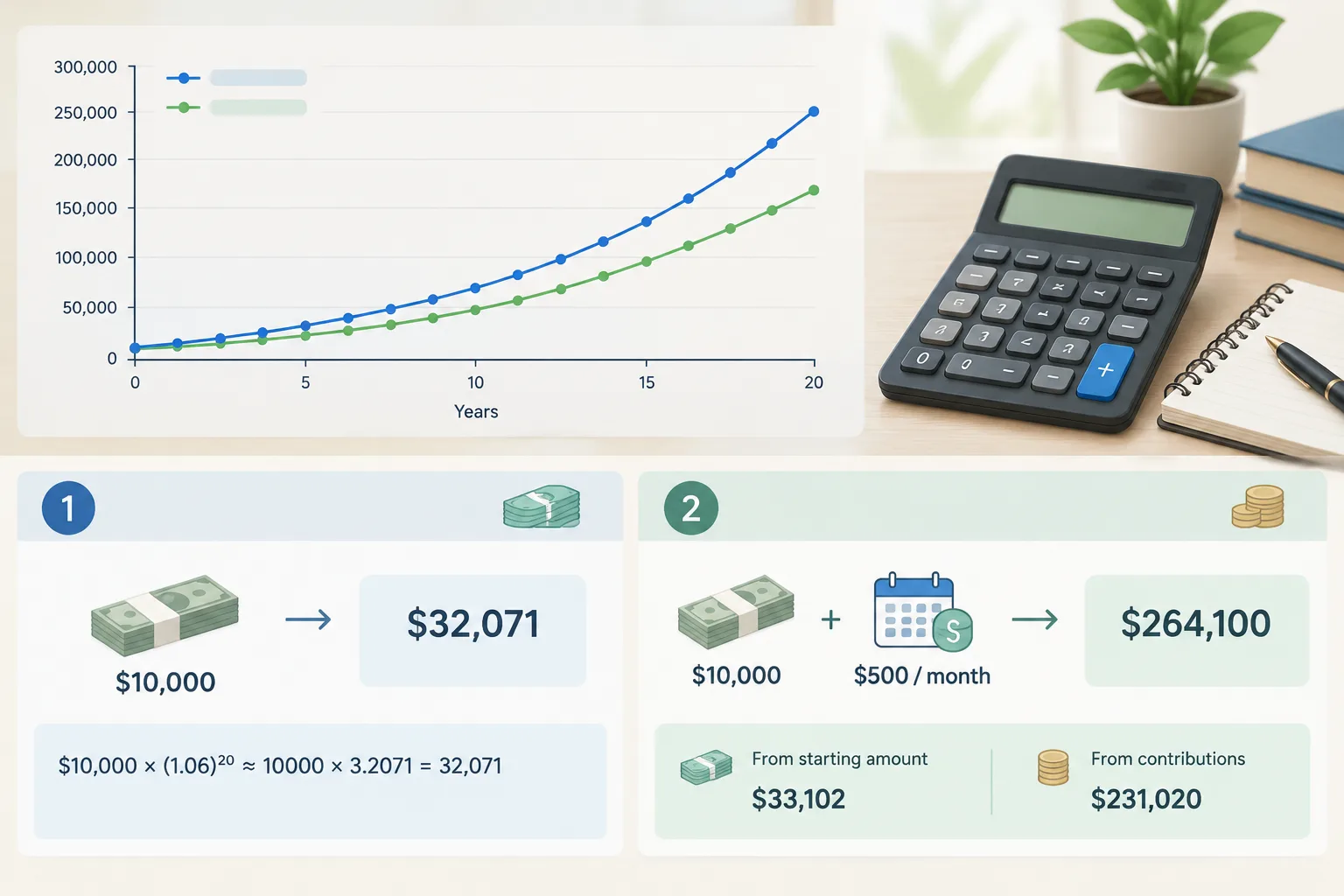
Example 1 — Lump sum only. $10,000 set aside for 20 years at 6% compounded annually.
Example 2 — Lump sum plus monthly contributions. The same $10,000, plus $500 added at the end of every month, at a 6% nominal rate compounded monthly, for 20 years. Here , and :
Since , the starting amount becomes about $33,102 and the contributions add roughly , for a total near $264,100. Note how much of that came from contributions rather than from the starting balance.
Example 3 — The same money in today's purchasing power. Take the $32,071 from Example 1 and assume inflation of 2.5% over the same 20 years:
The nominal figure grew; the inflation-adjusted figure grew far less. Both numbers are correct, and mixing them up is the single most common error in this area.
Which investment calculator fits your money goal
Different questions need different tools. Match the goal on the left to the calculator that answers it:
- "What will this sum become?" — a future value calculator handles a lump sum with optional deposits and shows the year-by-year balance.
- "How does compounding build up over time?" — a compound interest calculator breaks the growth into periods so you can see the effect of frequency.
- "How did an investment I already made perform?" — a ROI calculator works backwards from a known outcome rather than projecting forward.
- "Will I have enough to stop working?" — a retirement calculator adds a withdrawal phase, a target and a time horizon that includes the drawdown years.
- "I invest a fixed amount every month." — a SIP calculator is built for recurring equal contributions.
- "I need to draw a steady income down." — a SWP calculator models systematic withdrawals and shows how long a balance may last.
- "What is a future amount worth today?" — a present value calculator discounts a future sum back to the present.
If you only want one starting point, the future value tool covers the widest range of savings questions, and the compound interest tool is the best companion for understanding why the curve bends the way it does.
Step-by-step: how to run a calculation you can trust
- State the goal as a number and a date. "$250,000 by 2045" is a calculation. "More money" is not.
- Decide what you are modelling. A one-off lump sum, a contribution stream, or both. Mixing these up changes the answer substantially.
- Enter the starting amount exactly as it is today, not as you hope it will be after some future deposit.
- Match the compounding frequency to the stated rate. A 6% annual rate compounded monthly is not identical to a 6% effective annual rate. Most calculators let you set this, and the field is easy to overlook.
- Run three scenarios rather than one. A lower, middle and higher rate show you the range of outcomes instead of a single false precision figure.
- Account for costs that reduce your return. If the calculator has a fee field, use it. If it does not, subtract an assumed annual cost from the rate you enter.
- Look at the inflation-adjusted result. If the tool does not offer one, divide the nominal figure by yourself.
- Re-run the numbers when something changes — a raise, a new contribution amount, or a change in time horizon. A projection is a snapshot, not a plan carved in stone.
Common mistakes and where calculators stop being useful
- Mixing nominal and real dollars. A headline number of $500,000 in 30 years is not $500,000 of today's spending power.
- Ignoring fees. A recurring annual fee reduces the end value more than most people expect, because it compounds against you the same way returns compound for you.
- Assuming a constant rate. Real returns vary year to year. A smooth curve is a simplification, not a description of any particular account.
- Getting contribution timing wrong. Start-of-period and end-of-period contributions produce different totals.
- Treating the output as a promise. The calculation is arithmetic. It is not a projection of what will happen, and it is not advice.
- Overlooking taxes on dividends, interest and withdrawals. Tax treatment depends on the account and jurisdiction, so a general-purpose calculator usually cannot handle it precisely.
- Dividing an annual rate by 12 and calling it a monthly rate. That is an approximation; the exact periodic rate from an effective annual rate involves a root.
Where these tools stop being useful is volatility. They model a steady rate, so they cannot show sequence-of-returns risk, a bad first decade, or the difference between a lump sum invested all at once and one invested gradually. For questions like those, more specialised modelling is needed.

Frequently asked questions
Is there a free investment calculator online?
Yes. Calculator Lists hosts free financial calculators that run in the browser with no sign-up required, including a future value calculator, a compound interest calculator and an ROI calculator. Because the formulas are printed on each tool page, you can verify the math yourself rather than trusting a black box.
How do I calculate investment growth with monthly contributions?
Use the contribution formula: compound the starting amount, then add the future value of an ordinary annuity, which is . In practice, the easiest route is a future value calculator where you set the deposit amount to your monthly figure and the compounding frequency to monthly.
Which investment calculator is the most accurate?
The arithmetic is standard across reputable tools, so accuracy mostly depends on your inputs. What differs is features: whether a calculator handles inflation, fees, deposit timing and contribution frequency. A tool that shows its formula and its assumptions is more useful than one that hides them, even if both produce the same headline number.
Can an investment calculator predict my returns?
No. It applies a constant rate to a growing balance, which is a mathematical projection and not a forecast. Use the output to compare scenarios — different contribution amounts, different horizons — rather than to predict what an account will be worth on a specific date.
What is the difference between a compound interest calculator and an investment growth calculator?
The labels overlap heavily. Compound interest calculators tend to focus on frequency and period-by-period growth, while investment growth calculators usually add regular contributions, deposits and sometimes withdrawals. Some tools use the names interchangeably, so check the input fields rather than the title.
Do these calculators account for inflation?
Only if they include a real return or inflation field. When they do not, you can estimate the inflation-adjusted value by dividing the projected amount by , where is your assumed inflation rate and is the number of years. Many people find the real figure a more honest basis for planning.
Run your own numbers
Pick the calculator that matches the question you are actually asking: future value for savings projections, compound interest to see how frequency changes growth, ROI for reviewing past performance, and retirement when a drawdown phase is part of the picture. Every tool is free, every formula is visible, and nothing you enter leaves your browser.
This article is educational information about how calculators work. It is not investment advice, and it does not recommend any product or predict any market outcome.
Frequently asked questions
Is there a free investment calculator online?
Yes. Calculator Lists hosts free financial calculators that run in the browser with no sign-up required, including a future value calculator, a compound interest calculator and an ROI calculator. Because the formulas are printed on each tool page, you can verify the math yourself rather than trusting a black box.
How do I calculate investment growth with monthly contributions?
Use the contribution formula: compound the starting amount, then add the future value of an ordinary annuity, which is \(PMT \times \frac{(1+r/n)^{nt}-1}{r/n}\). In practice, the easiest route is a future value calculator where you set the deposit amount to your monthly figure and the compounding frequency to monthly.
Which investment calculator is the most accurate?
The arithmetic is standard across reputable tools, so accuracy mostly depends on your inputs. What differs is features: whether a calculator handles inflation, fees, deposit timing and contribution frequency. A tool that shows its formula and its assumptions is more useful than one that hides them, even if both produce the same headline number.
Can an investment calculator predict my returns?
No. It applies a constant rate to a growing balance, which is a mathematical projection and not a forecast. Use the output to compare scenarios — different contribution amounts, different horizons — rather than to predict what an account will be worth on a specific date.
What is the difference between a compound interest calculator and an investment growth calculator?
The labels overlap heavily. Compound interest calculators tend to focus on frequency and period-by-period growth, while investment growth calculators usually add regular contributions, deposits and sometimes withdrawals. Some tools use the names interchangeably, so check the input fields rather than the title.
Do these calculators account for inflation?
Only if they include a real return or inflation field. When they do not, you can estimate the inflation-adjusted value by dividing the projected amount by \((1+i)^{t}\), where \(i\) is your assumed inflation rate and \(t\) is the number of years. Many people find the real figure a more honest basis for planning.
Looking for more tools?
Try our free Financial Calculators