percentage off calculator
Percentage Off Calculator: Sale Prices Without the Guesswork
Learn how a percentage off calculator works, how to calculate discounts manually, and how to find sale prices with clear formulas, examples, and practical tips.
A percentage off calculator is a simple tool for finding the final price after a discount is applied. It calculates how much money is reduced from an original price and shows the amount you need to pay. Shoppers, students, businesses, and anyone comparing sale prices can use it to quickly check discounts without manual calculations.
What Is a Percentage Off Calculator?
A percentage off calculator determines the discounted price of an item by subtracting a percentage of the original price. It is commonly used during sales, promotions, price comparisons, and everyday budgeting.
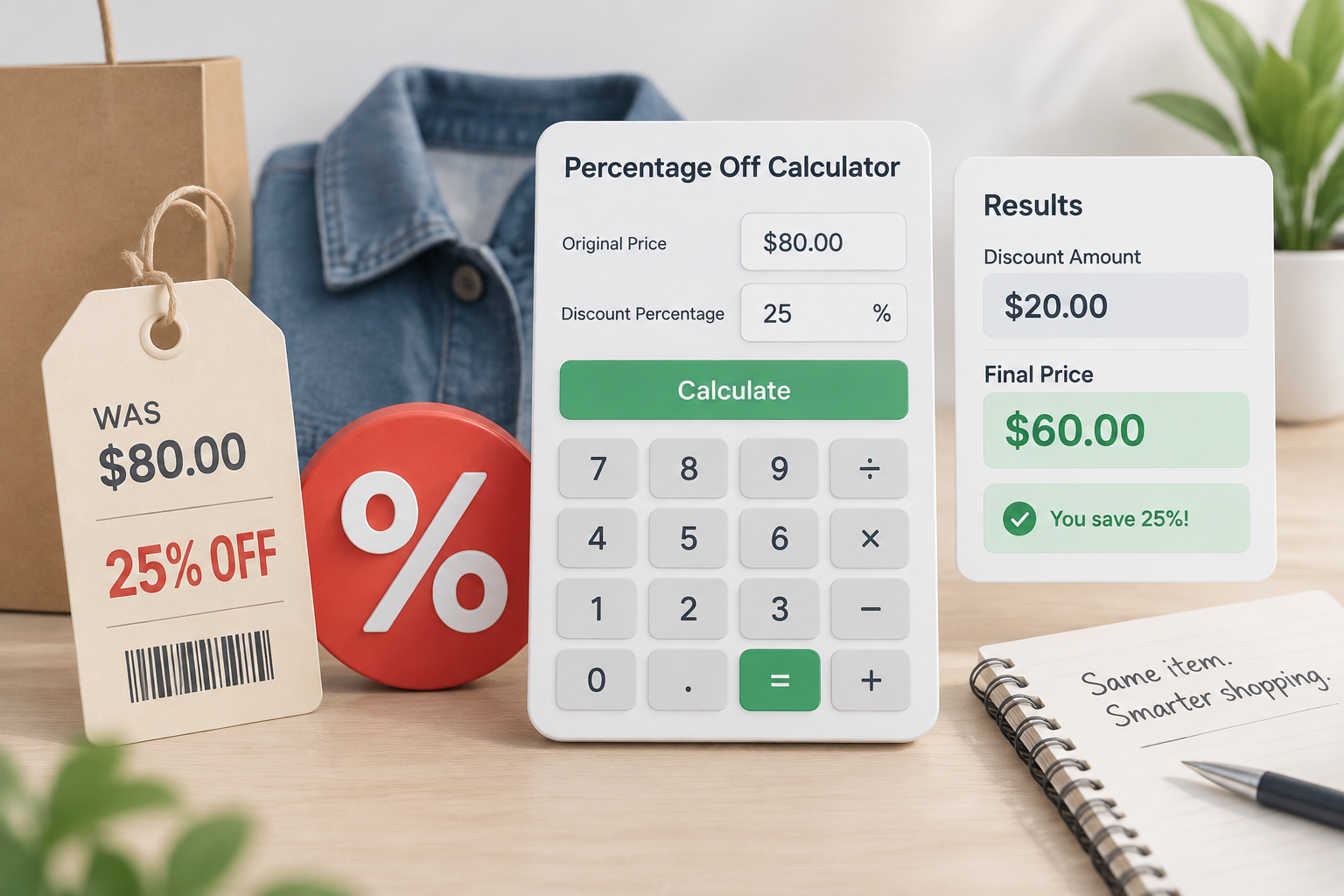
For example, if a jacket costs $80 and has a 25% discount, the calculator can show that the discount amount is $20 and the final price is $60.
The tool is useful because percentage calculations can become confusing when prices and discount rates change frequently. A calculator reduces the chance of mistakes and provides a quick way to verify sale prices.
You can also use related math tools, such as the percentage calculator, when you need to solve other percentage-based problems.
How Percentage Off Is Calculated
A percentage discount means a certain portion of the original price is removed.
Percentage Off Formula
The basic formulas are:
Discount amount = Original price × Discount percentage ÷ 100
Final price = Original price − Discount amount
The discount percentage represents the amount removed from the original price. The final price is the amount remaining after the discount is applied.
Example Calculation
Suppose an item has these values:
- Original price: $120
- Discount: 30%
First, calculate the discount amount:
Discount amount = 120 × 30 ÷ 100
Discount amount = 36
The discount saves $36.
Next, calculate the sale price:
Final price = 120 − 36
Final price = 84
The final price is $84.
Using the Discount Multiplier
Another way to calculate a discount is by using the remaining percentage.
If an item is 30% off, you pay 70% of the original price:
Final price = Original price × (1 − Discount percentage ÷ 100)Example:
Final price = 120 × (1 − 30 ÷ 100)
Final price = 120 × 0.70
Final price = 84
Both methods produce the same result.
How to Use a Percentage Off Calculator
Using a percentage off calculator usually takes only a few steps:
Step 1: Enter the Original Price
Input the starting price before any discount is applied. This is the amount the percentage reduction is based on.
Step 2: Enter the Discount Percentage
Add the discount rate shown in the promotion, such as 10%, 25%, or 50%.
Step 3: Review the Results
The calculator will show the discount amount and the final price after the reduction.
Step 4: Compare Different Discounts
If multiple stores offer different promotions, calculate each discounted price to compare the actual cost instead of relying only on the advertised percentage.
Calculator Lists provides free online tools designed for quick calculations. Use the relevant calculator tool whenever you want a fast and transparent result.
Common Percentage Discount Mistakes
Confusing Discount Amount With Final Price
A 20% discount does not mean the final price is 20% of the original amount. It means 20% is removed, so the buyer pays 80% of the original price.
For example:
- Original price: $100
- Discount: 20%
- Discount amount: $20
- Final price: $80
Applying Multiple Discounts Incorrectly
When an item has two separate discounts, the percentages are usually applied one after another rather than added together.
For example, a 20% discount followed by a 10% discount is not the same as a 30% discount.
Calculation:
100 × 0.80 × 0.90 = 72The final price is $72, which equals a 28% total reduction.
Forgetting Taxes or Additional Fees
A percentage off calculator normally calculates only the discount. Sales tax, shipping fees, service charges, or other costs may change the final amount paid.
Rounding Too Early
When calculating manually, rounding intermediate numbers can slightly change the result. Keeping exact values until the final step provides more accurate results.
When to Use a Percentage Off Calculator
A percentage off calculator can help in many everyday situations:
- Comparing sale prices while shopping
- Checking whether a promotion matches the advertised discount
- Calculating savings before making a purchase decision
- Learning percentage math concepts
- Estimating budget changes after price reductions
It is especially helpful when working with unusual prices or discounts that are difficult to calculate mentally.
Limitations of Percentage Off Calculations
A percentage discount calculation is based on a few assumptions:
- The discount applies directly to the original listed price.
- No additional fees or taxes are included unless added separately.
- The discount percentage is accurate and applies to the entire item price.
Real-world promotions may have conditions, such as minimum purchase requirements, excluded products, membership pricing, or limited-time rules. Always check the details of an offer before making a purchase decision.
Frequently Asked Questions
What is a percentage off calculator used for?
A percentage off calculator is used to find the amount saved and the final price after applying a discount. It helps users quickly calculate sale prices without doing the math manually.
How do I calculate 20% off a price?
To calculate 20% off, multiply the original price by 20 and divide by 100 to find the discount amount. Then subtract that amount from the original price.
For example, 20% off $50 is:
50 × 20 ÷ 100 = 10
50 − 10 = 40
The final price is $40.
Is a 50% discount the same as paying half price?
Yes. A 50% discount means half of the original price is removed, so the buyer pays the remaining 50%.
How is percent off different from percent increase?
Percent off reduces an original amount, while percent increase adds to an original amount. They use similar percentage formulas but move in opposite directions.
Can a percentage off calculator include taxes?
Most percentage off calculators only calculate the discount. Taxes and extra fees usually need to be added separately unless the tool specifically includes those options.
Use a percentage off calculator to make discount calculations faster, clearer, and easier to verify whenever you need to compare prices or understand sale offers.
Looking for more tools?
Try our free Free Calculators