triangle calculator
Triangle Calculator: Solve Any Triangle Step by Step
Learn how a triangle calculator works, explore triangle formulas, solve examples, and understand how to calculate sides and angles using geometry rules.
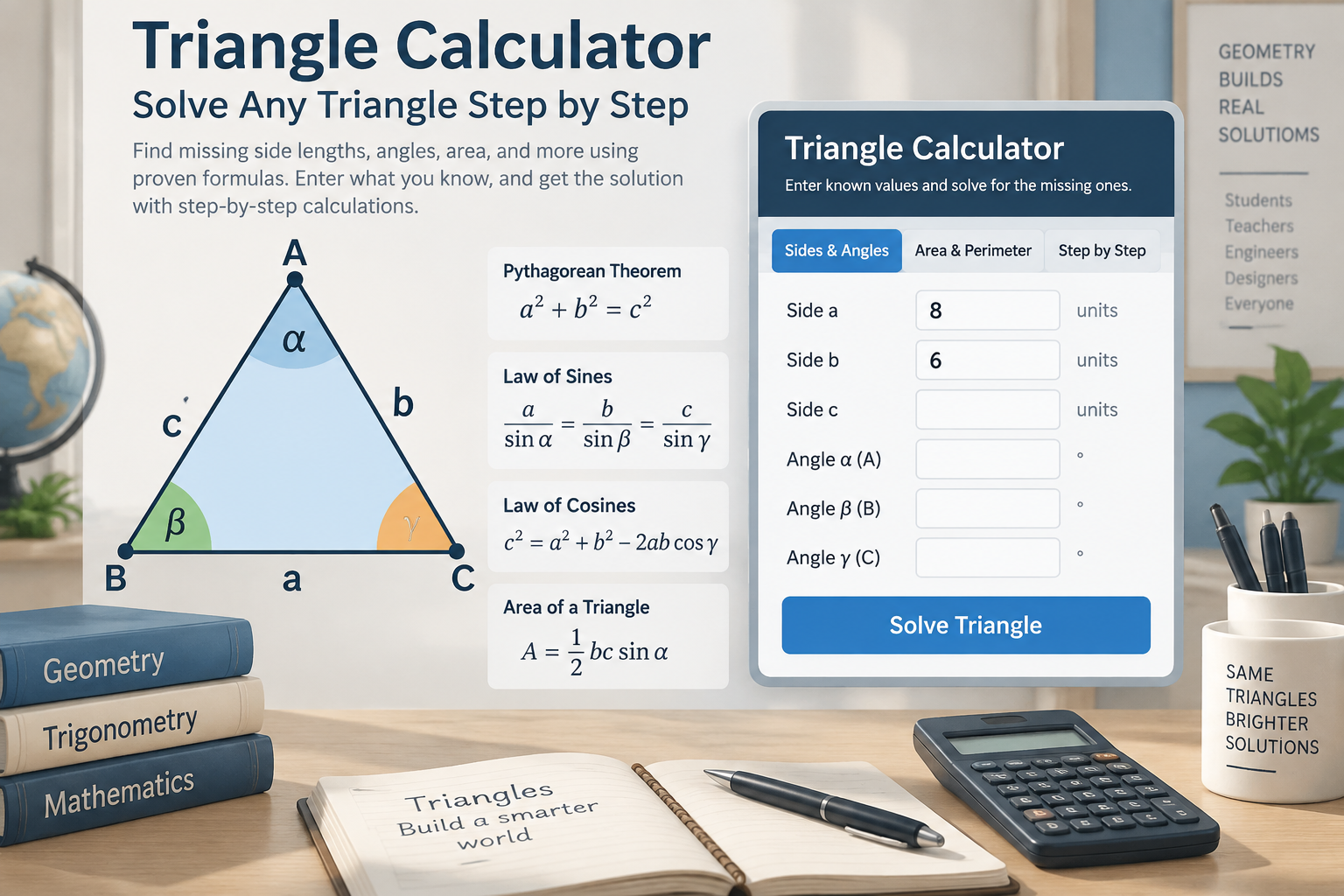
A triangle calculator is a free online tool that helps you find missing side lengths, angles, area, and other triangle measurements from known values. It is useful for students, teachers, engineers, designers, and anyone working with geometry. The calculator applies formulas such as the Pythagorean theorem, the law of sines, and the law of cosines to solve triangles accurately and show the calculation process.
What Is a Triangle Calculator?
A triangle calculator is a mathematical tool designed to solve problems involving triangles. A triangle has three sides and three angles, and the relationships between these measurements allow you to calculate unknown values when enough information is available.
Different triangle problems require different methods. A right triangle, which contains one 90-degree angle, can often be solved using simple formulas such as the Pythagorean theorem. Other triangles may require the law of sines or the law of cosines.
A triangle calculator can help users avoid manual calculation errors by applying the correct formula automatically. It is especially useful when measurements contain decimals or when multiple steps are needed.
You can use the Calculator Lists triangle calculator to enter known values and quickly calculate the remaining measurements.
Triangle Types and Calculation Methods
Right Triangles
A right triangle has one angle equal to 90 degrees. The side opposite the right angle is called the hypotenuse and is always the longest side.
For right triangles, the most common formula is the Pythagorean theorem:
a² + b² = c²
where:
- a and b are the two shorter sides
- c is the hypotenuse
For example, if a right triangle has sides of 3 units and 4 units, the hypotenuse can be calculated as:
c² = 3² + 4²
c² = 9 + 16
c² = 25
c = √25 = 5
The triangle sides are therefore 3, 4, and 5 units.
General Triangles
A general triangle does not have to contain a right angle. To solve these triangles, you may need the law of sines or the law of cosines.
The law of sines is useful when you know a side and its opposite angle, or when you have enough angle and side information to establish a relationship.
The formula is:
a / sin(A) = b / sin(B) = c / sin(C)
where:
- a, b, and c are side lengths
- A, B, and C are the opposite angles
The law of cosines is useful when you know two sides and the included angle, or when you know all three sides and need to find an angle.
The formula for finding a side is:
c² = a² + b² - 2ab cos(C)
Triangle Calculator Formulas Explained
A triangle calculator uses several core formulas depending on the information provided.
Pythagorean Theorem Formula
The Pythagorean theorem applies only to right triangles:
c = √(a² + b²)
Example:
Suppose a right triangle has:
- Side a = 6
- Side b = 8
The missing side is:
c = √(6² + 8²)
c = √(36 + 64)
c = √100
c = 10
The hypotenuse is 10 units.
Law of Sines Formula
The law of sines connects sides and opposite angles:
a / sin(A) = b / sin(B)
Example:
If:
- Side a = 10
- Angle A = 30 degrees
- Angle B = 45 degrees
Then side b can be calculated as:
b = 10 × sin(45°) / sin(30°)
Because sin(45°) is approximately 0.707 and sin(30°) is 0.5:
b ≈ 10 × 0.707 / 0.5
b ≈ 14.14
The missing side is approximately 14.14 units.
Triangle Area Formula
The area of a triangle can be calculated in several ways.
For base and height measurements:
Area = 1/2 × base × height
Example:
If the base is 12 units and the height is 5 units:
Area = 1/2 × 12 × 5
Area = 30 square units
When two sides and the included angle are known, another formula can be used:
Area = 1/2 × a × b × sin(C)
How to Use a Triangle Calculator
Using an online triangle calculator usually requires only a few simple steps.
Step 1: Identify the Triangle Information
Determine what measurements you already know. These may include:
- Side lengths
- Angles
- Height
- Base length
- Whether the triangle is a right triangle
Knowing the available information helps the calculator select the correct solving method.
Step 2: Enter Known Values
Input your measurements into the calculator fields. Make sure units are consistent. For example, do not mix centimeters and meters unless the calculator supports unit conversion.
Step 3: Review the Results
The calculator will provide missing values such as:
- Unknown side lengths
- Missing angles
- Area measurements
- Calculation details
Review the output to make sure the result matches the type of triangle you are solving.
Step 4: Check the Answer
For better accuracy, verify the result using basic geometry rules. For example, all triangle angles must add up to 180 degrees.
Common Mistakes and Limitations
Entering Incorrect Measurements
A triangle calculator can only produce accurate results when the input values are correct. A small measurement error can affect the final answer, especially in calculations involving angles.
Using the Wrong Formula
Different triangle situations require different formulas. The Pythagorean theorem should not be used for non-right triangles. Similarly, the law of sines requires enough known information to create a valid relationship.
Forgetting Unit Consistency
Always check measurement units before calculating. A triangle with one side measured in inches and another in centimeters may produce incorrect results unless the units are converted first.
Understanding Calculation Boundaries
A triangle cannot always be solved from limited information. For example, knowing only one side length is not enough to determine a unique triangle. A calculator can solve a triangle only when sufficient measurements are provided.
Triangle calculators are educational and computational tools. They help with understanding geometry and checking calculations, but they do not replace careful measurement or professional analysis in fields where exact dimensions are critical.
FAQ
What does a triangle calculator do?
A triangle calculator finds unknown triangle measurements, including side lengths, angles, and area, using geometry formulas. It determines the appropriate calculation method based on the values you provide.
How do I use a right triangle calculator?
A right triangle calculator usually requires two known measurements, such as two sides or one side and an angle. It then applies formulas like the Pythagorean theorem or trigonometric relationships to calculate missing values.
What is the difference between a triangle calculator and a law of sines calculator?
A triangle calculator is a general tool for solving different triangle problems. A law of sines calculator focuses specifically on calculations using the relationship between sides and their opposite angles.
Can a triangle calculator solve any triangle?
A triangle calculator can solve many types of triangles, including right triangles and general triangles, as long as enough information is provided. Some problems cannot be solved uniquely with incomplete measurements.
Why is my triangle calculation result incorrect?
Incorrect results often come from wrong inputs, mixed units, rounding differences, or using a formula that does not match the triangle type. Check the measurements and calculation method before trying again.
Try the Triangle Calculator
For quick geometry calculations, use the Calculator Lists triangle calculator to solve sides, angles, and other triangle measurements with transparent formulas. It is a simple way to check homework, study geometry concepts, or complete practical measurement tasks.
Looking for more tools?
Try our free Free Calculators