Roth IRA
What Is a Roth IRA? A Complete Guide to Tax-Free Retirement Growth
Learn what a Roth IRA is, how contributions and tax-free withdrawals work, the 2026 income and contribution limits, and how it compares with a traditional IRA. Includes formulas and practical examples.
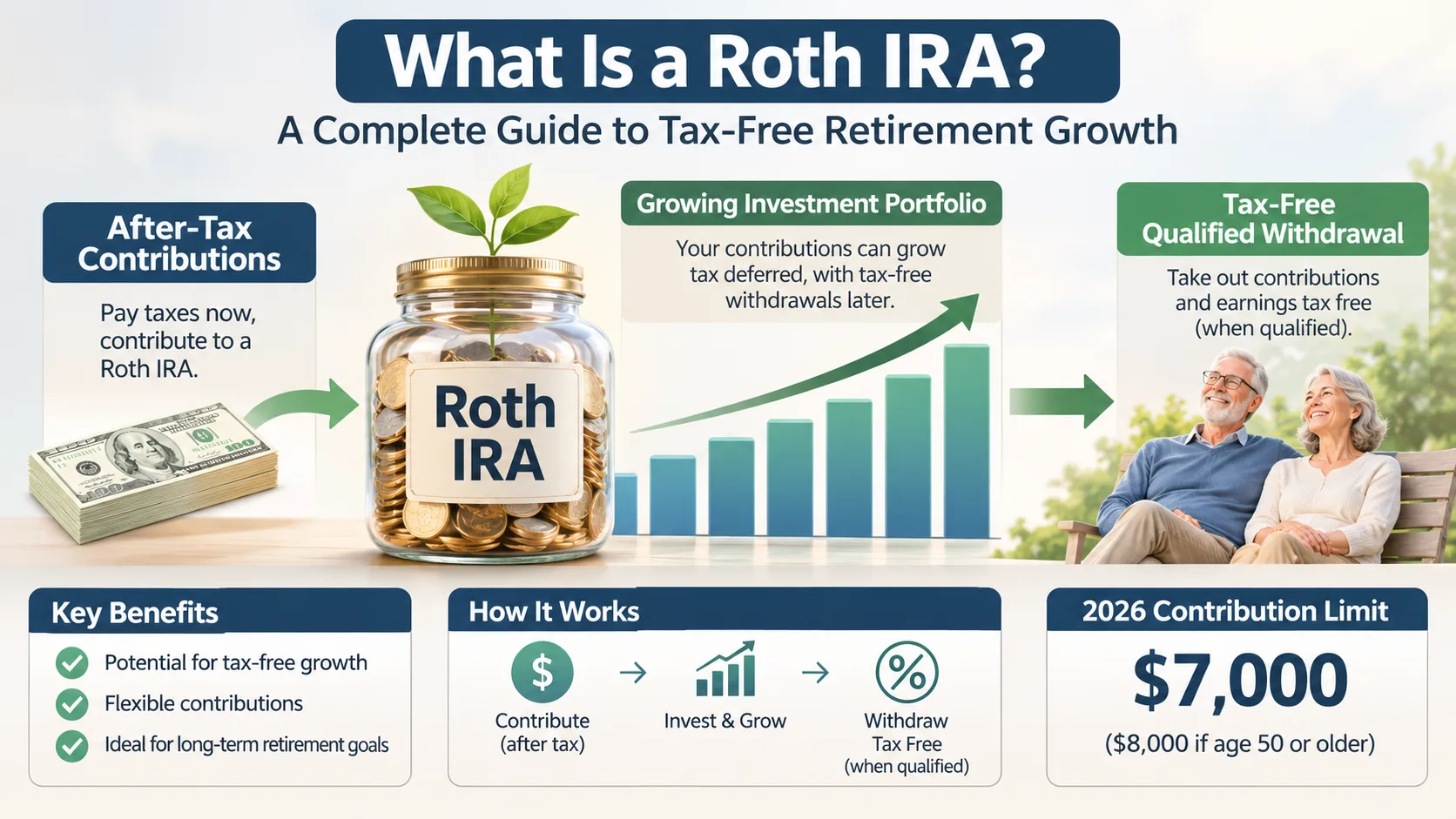
What is a Roth IRA, and why do people use one for retirement savings? A Roth IRA is an individual retirement account funded with money you have already paid taxes on. In return, qualified withdrawals of both contributions and investment earnings are tax-free. It is designed for eligible individuals who want to build retirement savings while potentially avoiding income taxes on future qualified withdrawals.
Understanding how a Roth IRA works can help you compare retirement account options, estimate long-term growth, and decide how much you may be eligible to contribute. This guide explains the rules, 2026 contribution limits, tax treatment, and differences between Roth and traditional IRAs.
What Is a Roth IRA?
A Roth IRA is a tax-advantaged retirement savings account established under United States tax law. Unlike a traditional IRA, which may offer an upfront tax deduction for eligible contributions, a Roth IRA uses after-tax money.
The main feature is its tax treatment. You contribute money that has already been included in your taxable income. If you meet the IRS requirements for qualified distributions, you can withdraw your investment earnings without paying federal income tax on them.
For example, imagine you contribute $5,000 to a Roth IRA over time. Your investments eventually grow to $12,000. If your withdrawal qualifies under IRS rules, the entire $12,000 can generally be withdrawn free of federal income tax.
A Roth IRA is an account, not an investment itself. Depending on the financial institution and account options, the money inside may be invested in eligible assets such as mutual funds, exchange-traded funds, stocks, or other investments. The account's tax treatment does not eliminate investment risk.
Who can use a Roth IRA?
People with eligible taxable compensation may contribute to a Roth IRA, subject to annual contribution and income restrictions.
Eligible compensation generally includes wages, salaries, commissions, and qualifying self-employment income. Investment income, such as interest and dividends, generally does not count as compensation for this purpose.
There is no upper age limit for making Roth IRA contributions if you meet the applicable requirements. However, your income, filing status, and available compensation determine how much you can contribute.
How Does a Roth IRA Work?
A Roth IRA works through three basic stages: contributing after-tax money, investing the account balance, and withdrawing money under the applicable tax rules.
1. Make contributions with after-tax income
You contribute money from income on which you have already paid taxes. Unlike qualifying traditional IRA contributions, Roth IRA contributions are not deductible on your federal income tax return.
Your contributions are subject to an annual limit. You also need sufficient eligible compensation, and your modified adjusted gross income (MAGI) may reduce or eliminate your permitted contribution.
2. Invest the account balance
After depositing money, you can select investments offered by your IRA provider. The account's value may increase or decrease depending on investment performance, fees, and market conditions.
The potential advantage is that investment earnings can accumulate without annual federal income tax on interest, dividends, or realized gains inside the Roth IRA.
This does not mean that every investment will grow. A Roth IRA can experience losses, and tax advantages do not protect the account against market risk.
3. Withdraw money under IRS rules
You can generally withdraw your regular Roth IRA contributions at any time without federal income tax or the 10% additional early-distribution tax. However, withdrawals involving conversions and investment earnings have different rules.
To receive a qualified distribution of earnings, you generally must satisfy both of these requirements:
- The five-tax-year period beginning with the first tax year for which you made a contribution to a Roth IRA established for your benefit must have passed.
- The distribution must occur after you reach age 59½, or qualify under an applicable exception, such as disability or death. Certain qualified first-home distributions are also covered by special rules, subject to a $10,000 lifetime limit.
When both requirements are met, qualified distributions are generally free from federal income tax.
Roth IRA Contribution Limits for 2026
The IRS sets annual IRA contribution limits and income eligibility ranges. These figures are important because the maximum amount you can contribute depends on your age, compensation, tax filing status, and MAGI.
For the 2026 tax year, the combined annual contribution limit for traditional and Roth IRAs is:
| Age | Maximum annual contribution |
|---|---|
| Under age 50 | $7,500 |
| Age 50 or older | $8,600 |
The additional $1,100 available to individuals aged 50 or older is a catch-up contribution.
These are combined IRA limits, not separate limits for each account. For example, if you contribute $3,000 to a traditional IRA during 2026, you generally have only $4,500 of the standard $7,500 limit remaining for your Roth IRA if you are under age 50.
2026 Roth IRA income limits
Your MAGI determines whether you can make a full contribution, a reduced contribution, or no direct Roth IRA contribution.
| Tax filing status | Full contribution below | Partial contribution range | No direct contribution at or above |
|---|---|---|---|
| Single or head of household | $153,000 | $153,000–$168,000 | $168,000 |
| Married filing jointly | $242,000 | $242,000–$252,000 | $252,000 |
| Married filing separately, if you lived with your spouse during the year | $0 | $0–$10,000 | $10,000 |
The age-based contribution maximums still apply within the full-contribution ranges. The reduced contribution amount depends on your MAGI and other applicable IRS calculations.
If you are married filing separately and did not live with your spouse at any time during the year, different income treatment applies. Consult the IRS contribution worksheets rather than assuming the standard married-filing-separately range applies to your circumstances.
How to calculate a reduced Roth IRA contribution
For a simplified illustration, the phase-out calculation can be represented as:
Where:
- (L) = applicable annual contribution maximum.
- (U) = upper income limit of the phase-out range.
- (M) = your MAGI.
- (L_i) = lower income limit of the phase-out range.
Consider a single taxpayer under age 50 with a MAGI of $160,000 in 2026.
The relevant income range is $153,000 to $168,000, and the standard annual contribution maximum is $7,500.
Substituting the values:
The simplified calculation produces a potential contribution of $4,000. Actual IRS calculations may require additional rounding and worksheet instructions, so use the applicable IRS worksheet to establish the final permitted amount.
You can also use the Roth IRA Calculator to explore contribution amounts and potential account growth using your own assumptions.
How Much Can a Roth IRA Grow Over Time?
One reason people consider Roth IRAs is the possibility of long-term compound growth.
Compound growth occurs when investment returns remain invested and potentially generate additional returns over time. A Roth IRA's tax treatment can make qualified withdrawals of those earnings tax-free.
For a simplified account with a single initial contribution and a constant annual growth rate, the future value formula is:
Where:
- (FV) = future account value.
- (P) = initial contribution.
- (r) = assumed annual growth rate expressed as a decimal.
- (t) = number of years.
Compound growth example
Suppose you deposit $5,000 into a Roth IRA and assume an annual growth rate of 6% for 20 years. Assume no additional deposits, fees, or withdrawals.
The calculation is:
Under these hypothetical assumptions, the initial $5,000 would grow to approximately $16,035.68.
The estimated growth is approximately $11,035.68. If the eventual withdrawal qualifies under Roth IRA rules, the earnings can generally be withdrawn without federal income tax.
This is a mathematical illustration, not a forecast. Actual investment returns fluctuate, and account fees, investment losses, and changes in contributions can affect the final balance.
For more scenarios, try the Compound Interest Calculator. You can change the initial amount, time period, and assumed growth rate to see how different inputs affect the result.
Roth IRA vs. Traditional IRA: What Is the Difference?
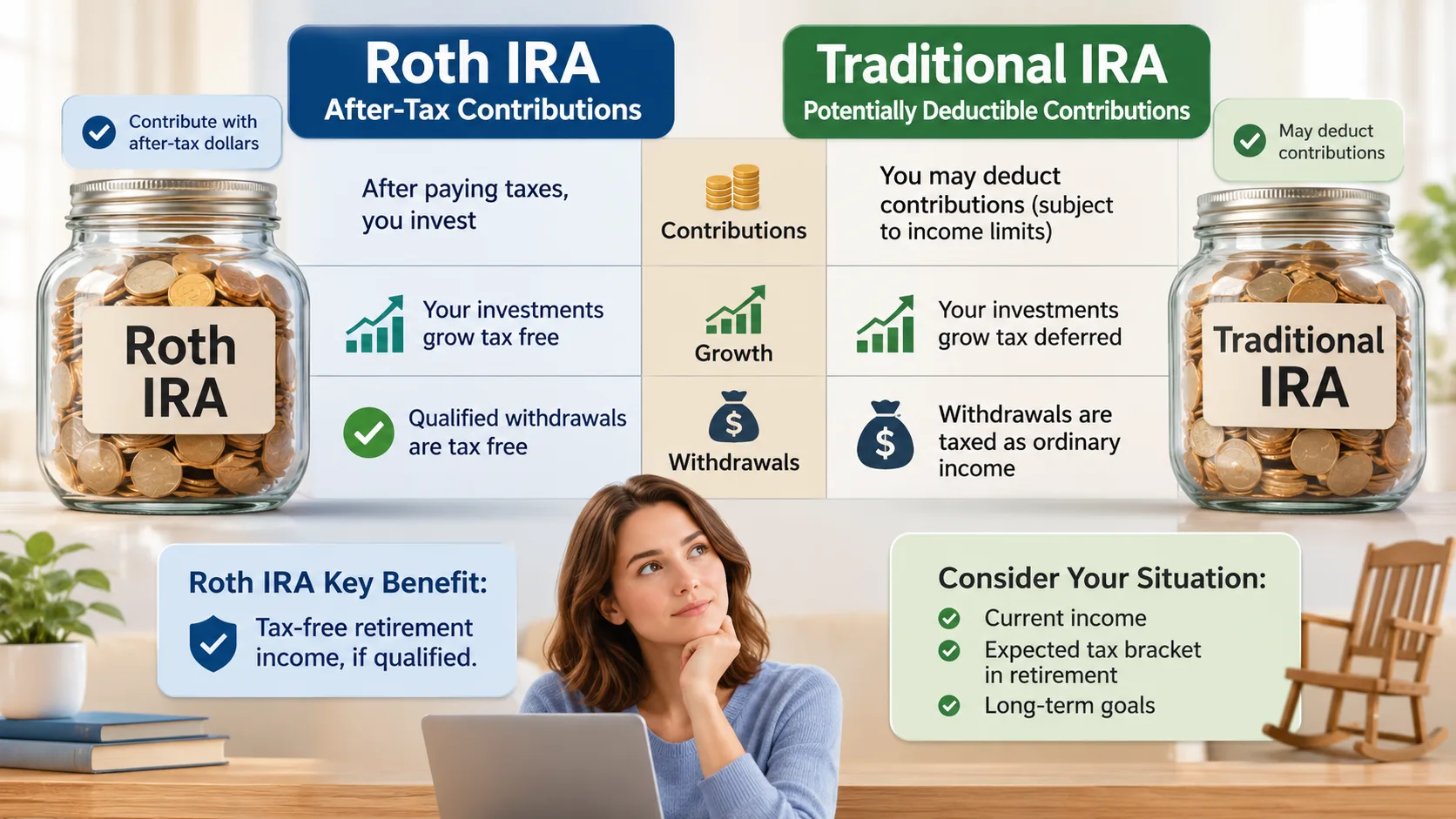
Both Roth and traditional IRAs offer tax advantages for retirement savings, but their tax treatment differs.
| Feature | Roth IRA | Traditional IRA |
|---|---|---|
| Contributions | Made with after-tax money | May be deductible, depending on eligibility |
| Tax deduction when contributing | No | Potentially available |
| Investment growth | Generally tax-deferred inside the account | Generally tax-deferred inside the account |
| Qualified retirement withdrawals | Generally tax-free | Generally taxable as ordinary income to the extent not previously taxed |
| Required minimum distributions for original owner | None during the owner's lifetime | Generally required beginning at the applicable age |
| Income restrictions on direct contributions | Yes | No general income ceiling for making contributions, but compensation and other rules apply |
When might a Roth IRA be worth considering?
A Roth IRA may be worth considering if you prefer paying taxes on contributions now in exchange for the possibility of tax-free qualified withdrawals later.
It can also be relevant if you expect your future taxable income or tax rate to be higher than your current level. However, predicting future tax rates is uncertain.
When might a traditional IRA be worth considering?
A traditional IRA may be worth considering if you qualify for a current tax deduction and value reducing taxable income in the contribution year.
The eventual tax treatment depends on whether contributions were deductible and whether the account contains after-tax amounts. Traditional IRA withdrawals are not necessarily entirely taxable in every situation.
Neither account is automatically better. Your current income, expected retirement income, tax circumstances, and financial goals all matter.
For a broader retirement savings projection, explore the Retirement Calculator.
Roth IRA Withdrawal Rules and Common Mistakes
Understanding withdrawal rules is just as important as understanding contribution limits. Different types of money inside a Roth IRA can receive different tax treatment when withdrawn.
Regular contributions can generally be withdrawn first
IRS distribution ordering rules generally treat regular Roth IRA contributions as distributed before conversion amounts and investment earnings.
This means that withdrawing an amount equal to your cumulative regular contributions is generally different from withdrawing investment earnings. The rules aggregate Roth IRAs for these purposes, and conversion-related distributions have additional considerations.
The five-year rule is important
The five-year period for determining whether a Roth IRA distribution is qualified generally begins on January 1 of the tax year for which you first made a contribution to a Roth IRA established for your benefit.
For example, if your first Roth IRA contribution is designated for tax year 2026, the five-year period generally begins on January 1, 2026. It does not necessarily begin on the date you opened the account or transferred the money.
Conversions have separate five-year considerations for the potential 10% additional tax on certain early distributions. Do not assume that satisfying one five-year rule automatically satisfies every other Roth IRA withdrawal rule.
Excess contributions can create additional taxes
Contributing more than the permitted amount can result in a 6% excise tax on excess contributions for each year the excess remains in the account, subject to applicable correction rules.
Check your combined traditional and Roth IRA contributions, compensation, and income eligibility before making deposits.
Roth IRAs do not have lifetime required minimum distributions for the original owner
Unlike traditional IRAs, Roth IRAs generally do not require the original account owner to take required minimum distributions during their lifetime.
This does not mean inherited Roth IRAs have no distribution requirements. Beneficiaries generally must follow applicable inherited-account rules.
How to Estimate Your Roth IRA Savings
You do not need to make complicated calculations to start understanding your potential retirement savings. A few basic inputs can help you build an estimate.
- Determine your contribution eligibility. Check your annual compensation, filing status, and modified adjusted gross income.
- Identify your annual contribution maximum. For 2026, use $7,500 if you are under 50 or $8,600 if you are 50 or older, subject to the combined IRA limit and other eligibility requirements.
- Choose an estimated annual contribution. Use an amount that fits your available income and financial circumstances.
- Select a hypothetical annual growth rate. Treat this as an assumption for calculation purposes, not a promised investment return.
- Set your savings period. The number of years can have a significant effect on the compound-growth estimate.
- Calculate the projected account value. Use a compound-interest or Roth IRA calculator to compare different contribution and growth assumptions.
- Review the withdrawal requirements. Remember that tax-free earnings withdrawals generally require a qualified distribution.
The Roth IRA Calculator can help you explore how contributions and assumed growth affect a potential retirement balance. You can also compare the results with the Future Value Calculator to understand the mathematics behind long-term savings.
Frequently Asked Questions About What Is a Roth IRA
1. What is a Roth IRA in simple terms?
A Roth IRA is a retirement savings account funded with after-tax money. You do not receive a federal income tax deduction for regular contributions, but qualified withdrawals of contributions and investment earnings are generally tax-free. It is subject to annual contribution limits, compensation requirements, and income eligibility rules.
2. How much can I contribute to a Roth IRA in 2026?
The 2026 annual IRA contribution limit is $7,500 for individuals under age 50 and $8,600 for individuals aged 50 or older. These limits apply collectively to your traditional and Roth IRA contributions. Your permitted Roth IRA contribution may be lower if your income falls within the applicable phase-out range.
3. Can I withdraw money from a Roth IRA at any time?
Regular Roth IRA contributions can generally be withdrawn at any time without federal income tax or the 10% additional early-distribution tax. However, conversions and investment earnings follow different rules. Withdrawals that are not qualified distributions may result in income taxes or additional taxes, depending on the circumstances.
4. Is a Roth IRA better than a traditional IRA?
Neither account is universally better. A Roth IRA may appeal to people who prefer paying taxes now and potentially receiving tax-free qualified withdrawals later. A traditional IRA may appeal to people who qualify for an upfront deduction. Your current tax situation, future income, and retirement plans should guide the comparison.
5. Do Roth IRA earnings grow tax-free?
Roth IRA investments can grow without annual federal income tax on account earnings. However, tax-free treatment of withdrawals generally depends on meeting the qualified distribution requirements, including the applicable five-tax-year period and an eligible distribution event. Investment growth itself is not guaranteed.
Final Thoughts
A Roth IRA is a retirement savings account that exchanges an upfront tax deduction for the possibility of tax-free qualified withdrawals later. Its main advantages include tax-free qualified distributions, flexible access to regular contributions, and no lifetime required minimum distributions for the original owner.
The most important considerations are contribution eligibility, annual limits, investment risk, and withdrawal requirements. For 2026, the standard annual contribution limit is $7,500, increasing to $8,600 for eligible individuals aged 50 or older.
Before making a contribution, check the latest IRS rules and calculate your eligibility. Use the Calculator Lists Roth IRA Calculator to explore potential savings scenarios and understand how different contribution amounts and time periods can affect your projected retirement balance.
A clear understanding of the rules can help you evaluate whether a Roth IRA fits into your broader retirement savings plan.
Looking for more tools?
Try our free Free Calculators