significant figures rules
Significant Figures Rules Explained: Counting, Rounding and Common Traps
Significant figures rules explained: which digits count, how to round, and how the rules differ for addition, subtraction, multiplication and division.
Significant figures rules decide how many digits in a measured number are real. They tell you how to count digits, how to round a result, and why addition and multiplication follow different rules. This guide covers the counting rules, the rounding procedure with worked numbers, the two arithmetic rules, and the traps that cause most errors. It is written for students, lab workers, and anyone who wants to verify a result with a significant figures calculator.
What Significant Figures Represent
A significant figure is a digit that carries information about how precisely a quantity was measured. If you measure a length with a ruler marked in millimetres, you read the millimetres with confidence and estimate one further digit. The confident digits plus that one estimated digit are the significant figures.
This is why raw calculator output can be misleading. A device may display 25.91505, but if the inputs were only good to two digits, most of those digits are arithmetic residue rather than measurement information. Reporting precision is a bookkeeping convention that stops you from claiming more certainty than your instrument can support.
The rules matter in three situations:
- Recording a measurement in a lab notebook or dataset.
- Reporting the result of a calculation.
- Checking someone else's numbers, such as on a homework set or a data sheet.
They are not a full uncertainty analysis. They are a fast, conventional shorthand used in classrooms, labs, and technical writing.
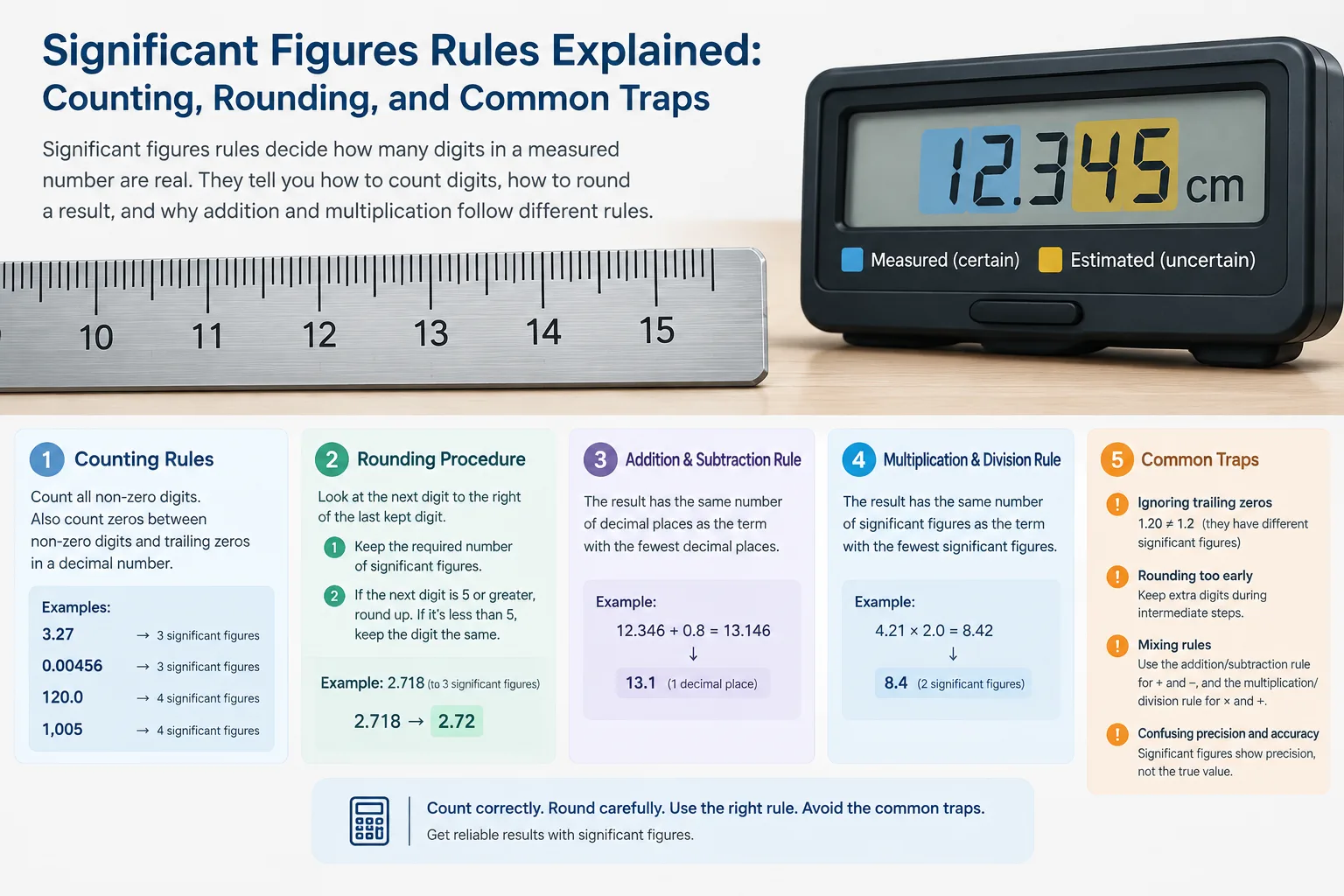
The Five Core Counting Rules
Counting is where most mistakes happen, so work through the rules in order.
Rule 1: All non-zero digits are significant
Digits 1 through 9 always count. The number has three significant figures.
Rule 2: Zeros between non-zero digits are significant
A zero trapped between significant digits is part of the measured value. has four significant figures, and has four.
Rule 3: Leading zeros are never significant
Leading zeros only position the decimal point. has two significant figures, and has two — the trailing zero counts, the leading zeros do not.
Rule 4: Trailing zeros after a decimal point are significant
When a number contains a decimal point, zeros at the end show that the measurement was made to that place. has four significant figures, and has two.
Rule 5: Trailing zeros in a whole number are ambiguous
might have two, three, or four significant figures. Written plainly, the number does not say which. Scientific notation removes the ambiguity:
A scientific calculator is useful for rewriting ambiguous values in notation form before you count.
Exact numbers are not measurements
Counted items such as 12 eggs, defined conversions such as 1 inch = 2.54 cm, and constants in formulas are exact. They carry unlimited significant figures and never reduce the precision of a result.
Counting Significant Figures: Worked Examples
| Number | Significant figures | Reason |
|---|---|---|
| 823 | 3 | all digits non-zero |
| 80.5 | 3 | interior zero counts |
| 0.0071 | 2 | leading zeros ignored |
| 1002 | 4 | interior zeros count |
| 4.500 | 4 | trailing zeros after a decimal point count |
| 1500 | 2, 3 or 4 | ambiguous without scientific notation |
| 0.006030 | 4 | leading zeros ignored; interior and trailing zeros count |
The pattern is simple: drop leading zeros, then keep everything else unless trailing zeros appear in a whole number with no decimal point.
Rounding to a Given Number of Significant Figures
Rounding to significant figures means keeping the first meaningful digits and discarding the rest. Locate the position of the -th significant digit, then look at the digit immediately to its right.
The whole procedure can be written as one scaled rounding step:
Here is the value, is the number of significant figures you want, and rounds down to the nearest integer.
Example A: round 12345 to 3 significant figures.
- , which rounds to
The result is , and it is clearer to write so that the three significant figures are obvious.
Example B: round 0.0045678 to 3 significant figures.
- , which rounds to
The result is .
Example C: round 3.14159 to 4 significant figures. The first four significant digits are 3, 1, 4, 1, and the next digit is 5. Rounding up gives .
The halfway case
When the digit being dropped is exactly 5 with nothing after it, school conventions usually round the last kept digit up. Software sometimes uses round-half-to-even instead, so the same input can produce two defensible answers. Note which convention you used when the difference matters.
Adding and Subtracting: Count Decimal Places
For addition and subtraction, the limit comes from the position of the last significant digit rather than the digit count:
Worked example:
- has 2 decimal places
- has 3 decimal places
- has 1 decimal place
- The minimum is 1 decimal place, so rounds to
The reasoning is that a measurement uncertain in the tenths place cannot become more precise simply because a finer measurement was added to it.
Multiplying and Dividing: Count Significant Figures
Multiplication and division depend on relative precision, so the result keeps the smallest significant-figure count among the inputs:
Worked example:
- Raw product:
- has 6 significant figures and has 2
- The result keeps 2 significant figures:
Worked example:
- Raw quotient:
- Inputs have 3 and 2 significant figures
- The result keeps 2 significant figures:
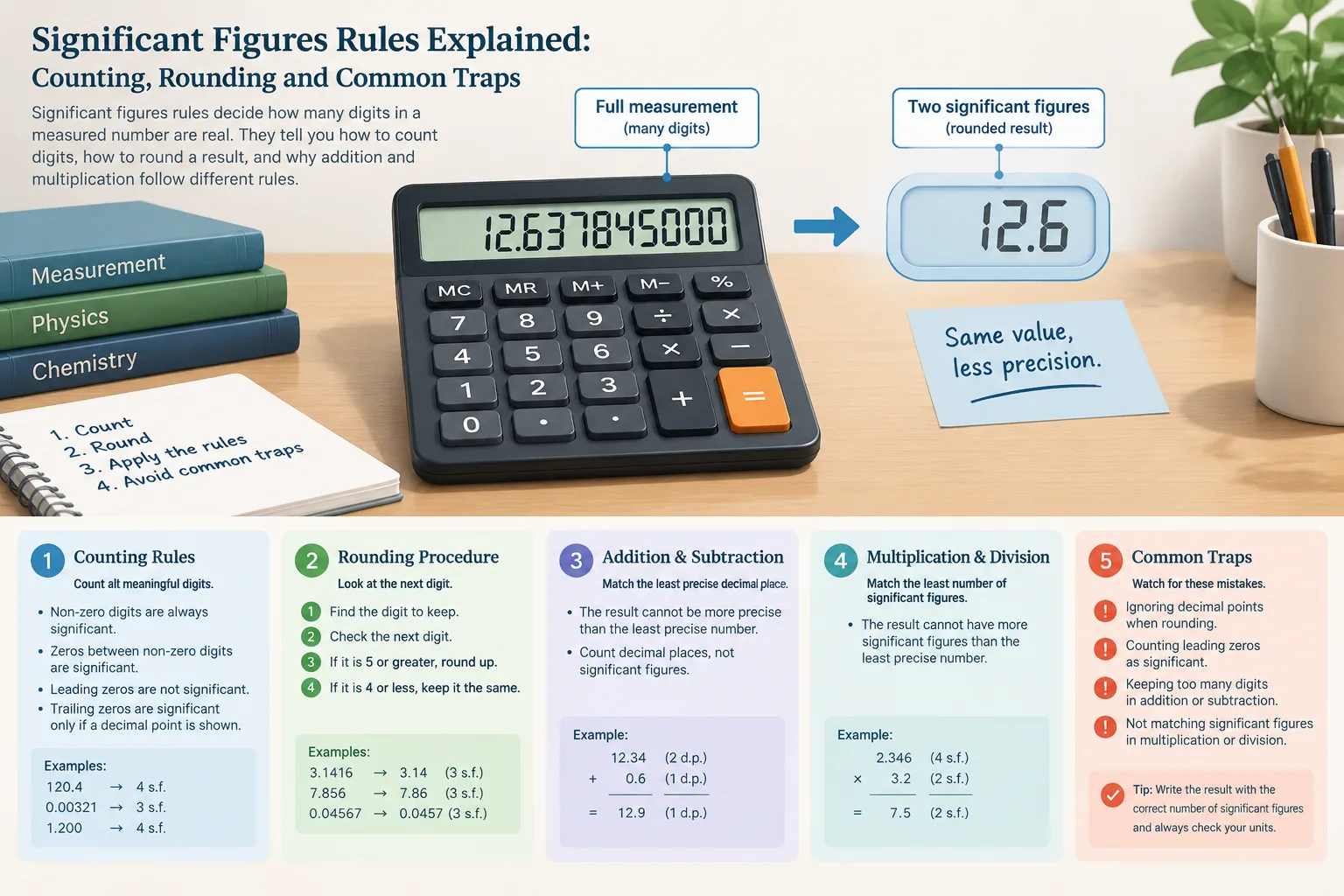
The underlying reason is that relative uncertainties combine approximately additively under multiplication:
The input with the fewest significant figures has the largest relative uncertainty, so it dominates the result.
Mixed operation chains
Carry the full calculation, keep one or two guard digits in intermediate steps, and round only the final answer. Rounding early can shift the last digit. Decide which rule governs at each stage: significant figures through the multiplicative parts, decimal places for the additive parts.
Steps for Using the Significant Figures Calculator
- Separate measurements from exact values. Constants, counted items, and defined conversions do not limit precision.
- Enter the expression as written, including the order of operations.
- Choose whether you want a digit count only or a rounded result at a set number of significant figures.
- Compare the count the tool reports for each input with your own count from the five rules.
- Read the rounded output and note how many significant figures it keeps.
- Rewrite the answer in scientific notation if trailing zeros would otherwise be ambiguous.
- Sanity-check the answer: decimal places for addition and subtraction, significant figures for multiplication and division.
The significant figures calculator covers counting, rounding, and the operation-based rules, so it works as a checking tool rather than a replacement for understanding. If your problem involves a change expressed as a ratio, the percentage calculator can help with the arithmetic; percentage factors are exact and add no measurement information.
Common Traps and Edge Cases
- Counting leading zeros. has two significant figures, not five.
- Assuming trailing zeros in whole numbers count. Write if you mean three significant figures.
- Rounding more than once. Round only the final answer of a multi-step calculation.
- Swapping the two arithmetic rules. Decimal places for addition and subtraction, significant figures for multiplication and division.
- Treating exact numbers as limiting. The 2 in , or a defined conversion factor, never reduces the precision of a result.
- Assuming every 5 rounds up. Round-half-to-even appears in some software.
- Trusting every displayed digit. A digital readout can show more digits than the sensor actually resolves.
- Forgetting logarithms. Keep as many decimal places in a logarithm's mantissa as there were significant figures in the input.
- Unit conversion confusion. Tools such as the lbs to kilos converter return an arithmetic result, but the input measurement still sets the precision.
Where Significant Figure Rules Stop Being Enough
Significant figures are a convention, not a full error analysis. They do not replace:
- An uncertainty budget built from instrument specifications and repeated readings.
- Calibration records that establish what an instrument's digits actually mean.
- Standard error when you are describing the uncertainty of a mean from a sample.
Use significant figures when you need a conventional, defensible way to report a measurement. Use formal uncertainty propagation when a decision depends on the size of the error bar.
FAQ
How many significant figures does 0.00450 have?
Three. The leading zeros are placeholders only, while the 4, the 5, and the trailing zero after the decimal point all count.
Do leading zeros count as significant figures?
No. Leading zeros exist only to position the decimal point, so has two significant figures and has two.
How many significant figures does 1500 have?
It is ambiguous: two, three, or four, depending on how the value was measured. Plain does not record that information. Write , , or to state it explicitly.
What are the significant figures rules for addition versus multiplication?
For addition and subtraction, round the answer to the fewest decimal places among the inputs. For multiplication and division, round to the fewest significant figures among the inputs. The two rules are not interchangeable.
Do exact numbers count toward significant figures?
No. Exact numbers — counted objects, defined conversions, and formula constants — have unlimited significant figures and never limit a calculated result. Only measured quantities do.
Ready to check a value? Run it through the significant figures calculator to confirm the count and see the correctly rounded answer.
Looking for more tools?
Try our free Free Calculators