Take Home Pay
Take-Home Pay by State: How Taxes Change Your Actual Salary
See how take-home pay by state differs across America. Compare Alabama, Seattle, Wisconsin, New Jersey, and Indiana, understand federal and state payroll taxes, and estimate your after-tax income with practical examples.
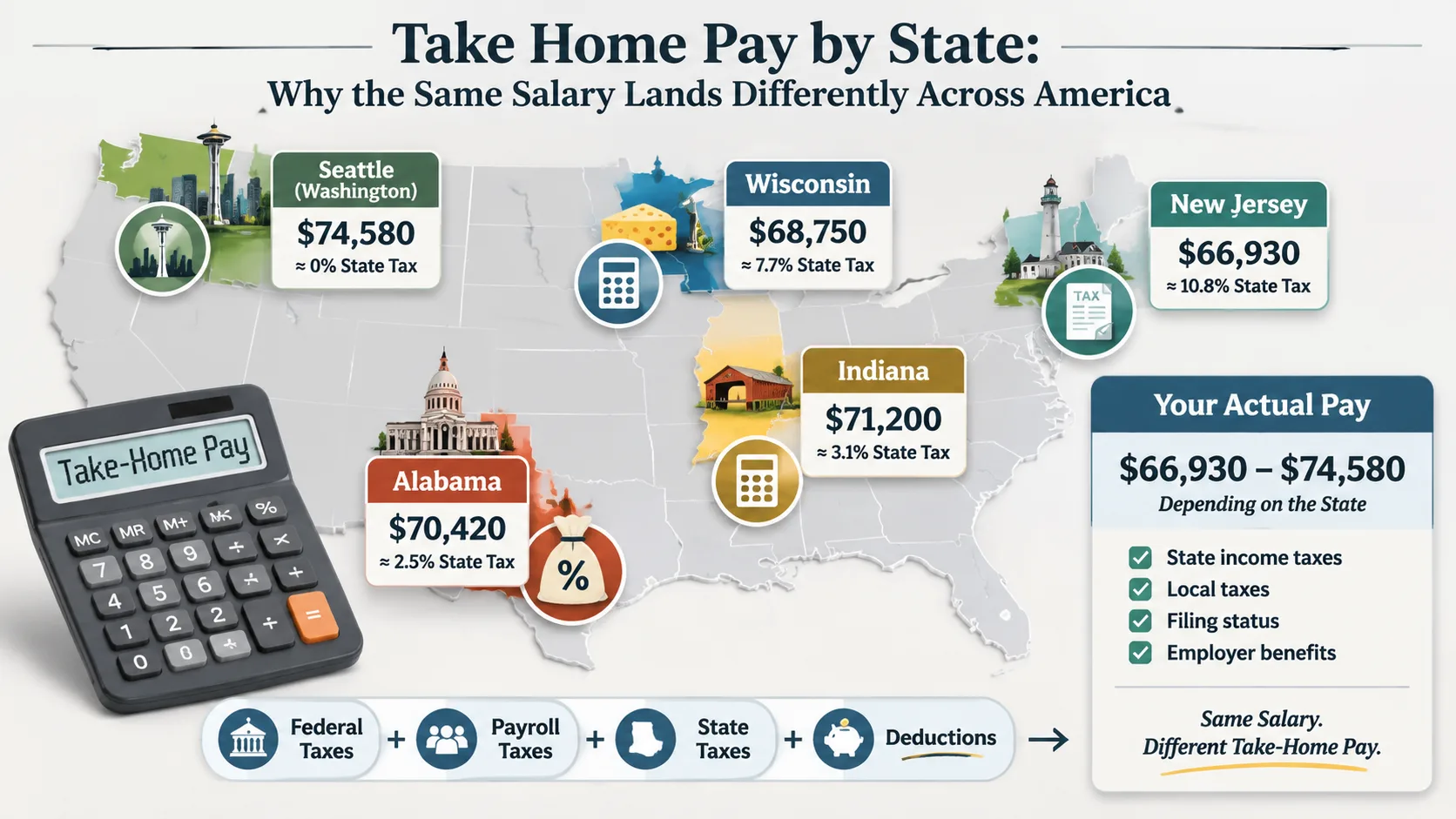
Take-home pay by state explains how much of your gross salary remains after taxes and payroll deductions. Even when two employees earn the same annual salary, their actual paychecks can differ because of state income taxes, local taxes, filing status, and employer benefits. Understanding these differences helps employees compare job offers, estimate monthly budgets, and make informed relocation decisions.
The key is to calculate federal taxes, payroll taxes, state taxes, and personal deductions separately rather than assuming that your annual salary equals your spending money.
What Does Take-Home Pay Mean?
Take-home pay, also called net pay, is the amount of money an employee receives after applicable taxes and other paycheck deductions have been subtracted from gross earnings.
Gross pay is your total compensation before deductions. Net pay is the amount deposited into your bank account or provided through a physical paycheck.
For example, an employee earning $80,000 annually does not necessarily receive $80,000 in spendable income. Federal income tax, Social Security, Medicare, state income tax, health insurance premiums, and retirement contributions can reduce that amount.
The difference between gross and net pay becomes particularly important when comparing jobs in different states.
The main factors affecting your paycheck
Several components determine your final take-home pay:
- Federal income tax: A federal tax based on taxable income, filing status, and applicable deductions and credits.
- Social Security tax: An employee payroll tax that generally applies at 6.2% of covered wages up to the annual wage limit.
- Medicare tax: An employee payroll tax generally applied at 1.45% of covered wages, without the Social Security wage limit.
- State income tax: A tax imposed by some states on individual income. Rates and calculation methods vary.
- Local income tax: Certain cities, counties, and other local jurisdictions impose additional income taxes.
- Voluntary deductions: Health insurance, retirement contributions, flexible spending accounts, and other employee benefits can reduce paycheck deposits.
These deductions do not all follow the same rules. Some reduce taxable income, while others are calculated directly from wages.
How to Calculate Take-Home Pay by State
The basic calculation is straightforward: start with gross income and subtract applicable taxes and deductions.
The take-home pay formula
For a more detailed estimate, calculate each component independently.
Step 1: Calculate federal taxable income.
For an employee using the standard deduction, a simplified calculation is:
For 2026, the federal standard deduction is $16,100 for single filers and $32,200 for married couples filing jointly, subject to eligibility and applicable tax rules.
Step 2: Calculate federal income tax.
Federal income tax uses progressive brackets. Each portion of taxable income is taxed at its corresponding marginal rate rather than applying the highest bracket rate to all earnings.
Step 3: Calculate Social Security and Medicare taxes.
For most employees in 2026:
Additional Medicare Tax may apply when wages exceed the applicable threshold.
Step 4: Include state and local income taxes.
Apply the relevant state tax rules, filing status, taxable income adjustments, and local tax rates. Do not assume that every state taxes wages in the same way.
Step 5: Subtract other paycheck deductions.
Include employee health insurance premiums, retirement plan contributions, and other applicable deductions. Consider whether each deduction is pre-tax or post-tax.
Example: An employee earning $80,000 annually
Suppose a single employee earns $80,000 in 2026, uses the $16,100 federal standard deduction, and has no additional federal adjustments or credits.
The simplified federal taxable income is:
Using the 2026 single-filer federal income tax brackets:
- First $12,400 at 10% = $1,240.
- Next $38,000 at 12% = $4,560.
- Remaining $13,500 at 22% = $2,970.
Total estimated federal income tax:
For payroll taxes, assuming all $80,000 is covered by Social Security and Medicare:
Total employee payroll taxes:
The remaining income before state taxes and other deductions is:
That equals approximately $5,425.83 per month.
This is not the final take-home amount. State and local taxes, insurance premiums, retirement contributions, credits, and other individual circumstances can change the result. The example illustrates the calculation method, not a universal paycheck estimate.
Take-Home Pay by State: Five Important Comparisons
State income tax policies can create meaningful differences between employees with similar salaries. The following locations illustrate several different approaches to taxing individual earnings.
1. Alabama: Understanding the Take-Home Pay Calculator Alabama Search
Alabama has a graduated individual income tax with three principal marginal rates: 2%, 4%, and 5%.
For single filers, the state applies:
- 2% on the first $500 of taxable income.
- 4% on the next $2,500.
- 5% on taxable income above $3,000.
Married couples filing jointly have different bracket thresholds.
This means an Alabama employee must account for both federal and state income taxes, in addition to applicable payroll taxes.
When using a take-home pay calculator Alabama residents should enter their annual salary, filing status, and other relevant deductions. State-specific adjustments and exemptions can affect the final state tax calculation.
For example, an employee with $60,000 in gross wages should not simply multiply the entire salary by 5%. The 5% rate applies only to the relevant portion of taxable income above the applicable threshold.
2. Seattle, Washington: Why Location Still Matters Without State Income Tax
Seattle is an interesting comparison because Washington does not currently impose an individual state income tax on wages.
For a traditional employee earning a salary in Seattle, this generally means there is no Washington individual wage income tax to subtract from the paycheck.
However, that does not mean employees keep their entire gross salary. Federal income tax, Social Security, Medicare, insurance premiums, and retirement contributions still affect net pay.
A take-home pay calculator Seattle employees use should also distinguish between employee taxes and business taxes. For example, Washington's business and occupation tax is generally a business-level tax, not an ordinary employee wage withholding.
Washington has also enacted a new income tax scheduled to take effect on January 1, 2028, for individuals and married couples filing jointly with annual adjusted gross income exceeding $1 million. This future change should not be treated as a current 2026 wage tax.
3. Wisconsin: Progressive Income Tax Brackets
Wisconsin uses a graduated individual income tax system. Its 2026 tax rates for single filers range from 3.50% to 7.65%, depending on taxable income.
The applicable rate increases as taxable income moves through the state brackets. Married couples filing jointly have different thresholds.
This makes the take-home pay calculator Wisconsin employees use especially dependent on filing status and taxable income.
For example, two Wisconsin employees earning different salaries may face different marginal state income tax rates. However, a higher marginal rate does not mean that every dollar of their income is taxed at that higher rate.
Wisconsin employees should also consider federal withholding and payroll taxes when estimating their actual paycheck.
4. New Jersey: Progressive Taxes and Filing Status
New Jersey also uses a graduated income tax system, known as the Gross Income Tax.
The applicable tax depends on income, filing status, and the state's tax rules. Consequently, an NJ take-home pay calculator needs more information than annual salary alone.
New Jersey also has filing thresholds. For the circumstances described by the state tax authority, single filers and married individuals filing separately with annual income of $10,000 or less generally pay no Gross Income Tax. The corresponding threshold for married couples filing jointly and heads of household is $20,000.
These thresholds should not be confused with an exemption from federal income tax or payroll taxes.
Employees comparing New Jersey with Washington, for example, should separate state income tax from the other deductions that affect their paychecks.
5. Indiana: State Income Tax Plus County Taxes
Indiana provides another distinct example because its individual income tax is accompanied by local income taxes.
The Indiana state individual adjusted gross income tax rate for 2026 is 2.95%.
However, the total income tax burden can be higher because county income taxes also apply. Their rates vary by county and depend on applicable residency or employment rules.
A take-home pay calculator Indiana employees use should therefore account for the relevant county, rather than applying the state rate alone.
For example, two employees with the same gross salary may have different local income tax obligations if they are subject to different county tax rates.
This is particularly important when comparing Indianapolis-area employment with jobs elsewhere in Indiana.
Why the Same Salary Produces Different Paychecks
State tax rates are only one part of the comparison. Several other factors explain why employees with identical gross salaries can receive different amounts.
Filing status
Federal and state tax calculations can depend on whether someone files as single, married filing jointly, married filing separately, or head of household.
A married employee may have different tax brackets and deductions from a single employee earning the same salary.
Pre-tax retirement contributions
Contributions to eligible traditional employer-sponsored retirement plans can reduce current federal taxable income. Depending on the contribution type and applicable rules, they may also affect state taxable income.
For instance, an employee contributing $4,000 annually to an eligible traditional retirement plan may have lower current federal taxable wages or income than an otherwise similar employee who does not contribute.
However, retirement contributions are not necessarily excluded from Social Security and Medicare wages. Their tax treatment depends on the specific plan and contribution type.
Health insurance and other benefits
Employer-sponsored health insurance premiums may be deducted from gross pay. Qualifying pre-tax premiums generally receive different tax treatment from after-tax deductions.
Other deductions may include health savings account contributions, flexible spending accounts, and supplemental insurance.
Bonuses and additional compensation
Bonuses, commissions, and overtime can affect paycheck withholding. A larger withholding amount on a particular paycheck does not necessarily mean the entire annual income is subject to a higher marginal tax rate.
For additional details, see our guide to bonus take-home pay and taxes.
How to Use a Take-Home Pay Calculator
A take-home pay calculator makes state comparisons easier by organizing the main components of your paycheck.
Follow these steps to estimate your net income.
Step 1: Enter your gross salary
Start with your annual salary before deductions. If you are paid hourly, convert your expected hourly earnings into an annual estimate using your normal working schedule.
For example, someone earning $30 per hour and working 40 hours per week for 52 weeks has estimated annual gross earnings of:
This assumes paid work throughout all 52 weeks without unpaid leave or overtime adjustments.
Step 2: Select your state
Choose your actual work and tax location. If the calculator supports local tax information, select your city or county as well.
Step 3: Choose your filing status
Select the appropriate federal filing status. Include any relevant state-specific filing information where requested.
Step 4: Enter deductions and contributions
Add eligible retirement contributions, health insurance premiums, and other deductions. Avoid entering the same deduction twice.
Step 5: Select your pay frequency
Choose weekly, biweekly, semimonthly, or monthly pay. This helps convert annual estimated net income into an expected paycheck amount.
Step 6: Review your estimated net pay
Compare gross pay, federal taxes, payroll taxes, state taxes, and other deductions. Check the assumptions behind each result before using it for budgeting or salary negotiations.
To begin, try the Calculator Lists Take-Home Pay Calculator. You can also explore our financial calculators for other personal finance calculations.
Common Mistakes When Comparing Take-Home Pay by State
Even a well-designed calculator can produce misleading estimates when the input information is incomplete.
Confusing marginal and effective tax rates
A marginal tax rate applies to the next portion of taxable income within a particular bracket. An effective tax rate represents total tax divided by the relevant income measure.
For example, if someone pays $8,000 in income tax on $80,000 of income, the effective rate using gross income as the denominator is 10%. This does not mean that every dollar was taxed at 10%.
Assuming a state with no income tax has no payroll deductions
Washington does not currently impose an individual income tax, but employees still pay applicable federal income taxes and payroll taxes. Other deductions can also reduce their deposits.
Using the state rate without checking local taxes
Indiana demonstrates why county taxes matter. A state-only calculation may overestimate net pay if applicable local income taxes are omitted.
Treating withholding as final tax liability
Payroll withholding is an estimated prepayment toward annual tax obligations. Your final tax liability is determined through the applicable tax return and may differ from the amounts withheld during the year.
Ignoring the difference between work and residence locations
Remote employees, commuters, and people who move during a tax year may face additional tax considerations. The state where income is earned and the employee's residency can both matter.
Frequently Asked Questions About Take-Home Pay by State
1. How do I calculate take-home pay by state?
Start with gross annual income, calculate federal income tax, subtract Social Security and Medicare taxes, and include applicable state and local income taxes. Then account for insurance premiums, retirement contributions, and other deductions. Your filing status and work or residence location can change the result.
2. Which state has no individual income tax on wages?
Washington currently has no individual income tax on wages. However, employees still pay applicable federal income taxes and payroll taxes. Other states also have no broad individual wage income tax, but their tax policies and other employee deductions differ. Always check current state rules before comparing salaries.
3. How much is $80,000 a year after taxes in Alabama?
There is no single answer for every Alabama employee. The result depends on federal filing status, federal taxable income, Alabama taxable income, exemptions, payroll taxes, and other deductions. For a useful estimate, enter your $80,000 salary and personal tax information into a take-home pay calculator configured for Alabama.
4. Does Seattle have state income tax on salary?
Washington does not currently impose an individual state income tax on wages, including ordinary employee salary in Seattle. Federal income tax, Social Security, Medicare, and other applicable deductions still reduce take-home pay. A separate high-income tax has been enacted for qualifying income beginning in 2028.
5. Why is my paycheck different from my annual salary divided by 12?
Your annual salary is gross income, while your monthly paycheck reflects taxes and other deductions. Pay frequency, benefit premiums, retirement contributions, and payroll withholding adjustments can all affect the deposited amount. Some employees also receive bonuses or variable compensation that changes individual pay periods.
6. Does Indiana charge county income tax in addition to state income tax?
Yes. Indiana imposes a state individual income tax and county income taxes. County rates vary, so the correct estimate requires the relevant county and applicable residency or employment information. Using only the statewide rate may result in an inaccurate net pay estimate.
7. Is take-home pay the same as taxable income?
No. Taxable income is the amount used to calculate certain income taxes after applicable adjustments and deductions. Take-home pay is the money remaining after taxes and paycheck deductions. The two figures measure different things and should not be used interchangeably.
Estimate Your Salary After Taxes
Understanding take-home pay by state gives you a clearer picture of what an advertised salary actually means for your budget. Federal taxes, payroll taxes, state policies, local income taxes, and personal deductions all influence the final amount.
Whether you are evaluating an Alabama job offer, comparing Seattle with Wisconsin, reviewing a New Jersey paycheck, or considering employment in Indiana, a state-aware estimate is more useful than looking at gross salary alone.
Use the free Take-Home Pay Calculator from Calculator Lists to estimate your after-tax income. Enter your salary and relevant details, review the calculation, and use the result as a starting point for practical financial planning.
Looking for more tools?
Try our free Free Calculators