calorie deficit
What Is a Calorie Deficit and How Big Should Yours Be?
Learn what a calorie deficit is, how to calculate it, how it affects body weight changes, and how to use a calorie calculator with transparent formulas and examples.
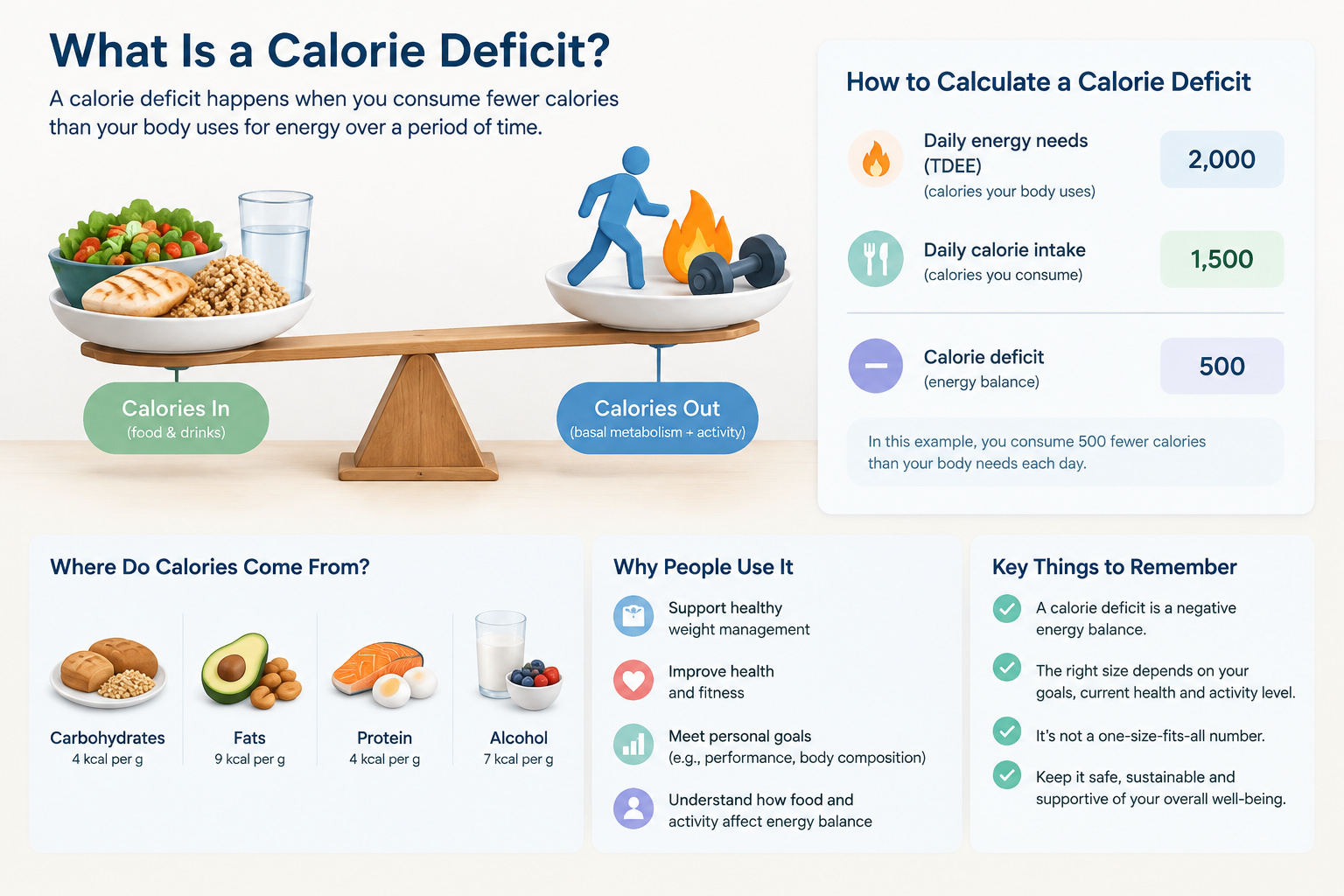
A calorie deficit happens when you consume fewer calories than your body uses for energy over a period of time. It is a simple energy balance concept used by people who want to understand changes in body weight. A calorie deficit can be estimated by comparing daily calorie intake with daily energy needs. This guide explains what a calorie deficit is, how to calculate it, who may use the calculation, and how to interpret the result responsibly.
What Is a Calorie Deficit?
A calorie deficit means the difference between the calories your body needs and the calories you consume is negative. Calories are a unit of energy from food and drinks. Your body uses energy for basic functions such as breathing, circulation, movement, and daily activities.
The basic idea is:
- If calorie intake is higher than energy use, there is a calorie surplus.
- If calorie intake and energy use are similar, there is calorie balance.
- If calorie intake is lower than energy use, there is a calorie deficit.
People commonly use calorie deficit calculations to understand how food intake and activity levels relate to energy balance. A calculator can make the process easier by estimating daily calorie needs and comparing them with a selected intake target.
You can use the Calorie Calculator on Calculator Lists to estimate calorie values with a consistent formula-based approach.
How Is a Calorie Deficit Calculated?
A calorie deficit is calculated by subtracting your daily calorie intake from your daily calorie expenditure.
Where:
- Daily Energy Expenditure is the estimated number of calories your body uses in a day.
- Daily Calorie Intake is the number of calories consumed from food and beverages.
For example, suppose a person estimates their daily energy expenditure as 2,400 calories and their daily calorie intake is 2,000 calories.
The estimated calorie deficit is 400 calories per day.
This calculation is a simplified estimate. Actual energy needs can change because of factors such as body composition, activity level, age, health conditions, and changes in routine.
Understanding Daily Energy Expenditure
Before calculating a calorie deficit, you need an estimate of how much energy your body uses. This is often called total daily energy expenditure (TDEE).
TDEE is influenced by several components:
Basal Metabolic Rate
Basal metabolic rate (BMR) is the estimated energy your body uses at rest to maintain essential functions. It is affected by factors including body size, age, sex, and body composition.
Physical Activity
Movement and exercise increase energy use. Someone with a physically active job may have a different daily energy expenditure than someone who spends most of the day sitting.
Food Processing
The body also uses energy to digest and process food. This component varies depending on food choices and overall intake.
Because these factors differ between individuals, calorie deficit results should be viewed as estimates rather than exact measurements.
How to Calculate a Calorie Deficit Step by Step
Step 1: Estimate Your Daily Calorie Needs
Start by estimating your daily energy expenditure. A calorie calculator can help organize inputs such as age, body weight, height, and activity level.
For example:
- Estimated daily energy expenditure: 2,500 calories
- Desired daily intake: 2,100 calories
Step 2: Apply the Calorie Deficit Formula
Use the formula:
Substitute the example values:
The estimated deficit is 400 calories per day.
Step 3: Review the Result Over Time
A single day's calculation does not describe long-term changes. Body weight and energy balance can naturally vary because of water changes, digestion, activity differences, and other factors.
For people tracking nutrition patterns, reviewing averages over time may provide a clearer picture than focusing on one measurement.
How a Calorie Deficit Relates to Body Weight Changes
A calorie deficit represents an energy difference, but the relationship between calories and body weight is not perfectly linear. The body adapts to changes in energy intake and expenditure, and individual responses vary.
A commonly used estimate is that a larger accumulated calorie deficit may correspond with changes in body weight over time. However, this is only a general approximation and does not account for changes in body composition, metabolism, hydration, or other biological factors.
The calculation is most useful as a planning and education tool rather than a guarantee of a specific outcome.
Who Can Use a Calorie Deficit Calculator?
A calorie deficit calculator can be useful for:
- People learning about energy balance.
- Individuals tracking food intake and activity patterns.
- Fitness enthusiasts organizing nutrition information.
- Anyone who wants a clearer estimate of calorie relationships.
However, calorie needs differ widely between people. Individuals with specific health concerns, medical conditions, pregnancy-related nutrition needs, or specialized dietary requirements should consider professional guidance.
Common Calorie Deficit Mistakes and Limitations
Mistake 1: Treating the Estimate as an Exact Number
A calorie calculator provides an estimate based on available information. It cannot perfectly measure every factor affecting energy use.
Mistake 2: Ignoring Activity Changes
Daily movement can change from day to day. A calculation based on one activity level may become less accurate if routines change.
Mistake 3: Focusing Only on Calories
Calories are one part of nutrition. Food choices, nutrient intake, eating patterns, and personal health factors also influence overall well-being.
Mistake 4: Expecting Identical Results Between People
Two people with the same estimated calorie deficit may experience different changes because of differences in physiology and lifestyle.
How to Use the Calculator Lists Calorie Calculator
The Calculator Lists Calorie Calculator is designed to help users estimate calorie-related values using a clear calculation process.
To use a calorie calculator:
- Enter the required personal information requested by the tool.
- Select an appropriate activity level if available.
- Review the estimated daily calorie value.
- Compare calorie intake and estimated energy use.
- Use the result as general information for understanding energy balance.
The calculator is intended as an educational tool. It does not replace professional medical advice or create a personalized treatment plan.
FAQ
What is a calorie deficit in simple terms?
A calorie deficit means your body uses more calories for energy than you consume from food and drinks during a period of time. The difference between energy use and intake is the calorie deficit.
How do I calculate my calorie deficit?
Calculate your estimated daily energy expenditure, subtract your daily calorie intake, and the result is your estimated calorie deficit. The formula is:
How many calories should my deficit be?
There is no single calorie deficit that applies to everyone. The appropriate amount depends on individual factors such as health status, activity level, goals, and nutritional needs. A calculator can provide an estimate, but it should be interpreted with context.
Does a calorie deficit always mean weight loss?
A calorie deficit represents an energy difference, but actual body weight changes can vary because of many factors, including water balance, body composition changes, and natural fluctuations.
Can I use a calorie deficit calculator every day?
A calorie calculator can be used regularly to understand patterns, but daily estimates should be treated as guidance rather than exact measurements. Reviewing longer-term trends is often more informative.
Use a Calorie Calculator to Understand Your Energy Balance
A calorie deficit is a straightforward calculation that compares energy intake with energy use. By understanding the formula, assumptions, and limitations, you can better interpret calorie estimates and make informed decisions about nutrition tracking. Try the Calculator Lists Calorie Calculator to explore your estimated calorie information with a transparent calculation approach.
Looking for more tools?
Try our free Free Calculators