mortgage calculator
Mortgage Recast Calculator: Lower Payments Without Refinancing
Learn how a mortgage recast calculator estimates new monthly payments after a large principal payment. Understand the formula, steps, examples, limits, and how recasting differs from refinancing.
A mortgage recast calculator estimates how your monthly mortgage payment may change after you make a large one-time payment toward your loan principal. It is designed for homeowners who want to understand how a recast may reduce payments without replacing their existing mortgage. The calculator uses your remaining loan balance, interest rate, remaining term, and new principal balance to show an estimated payment amount. It is useful for homeowners comparing options, planning cash use, or learning how a mortgage recast works.
What Is a Mortgage Recast?
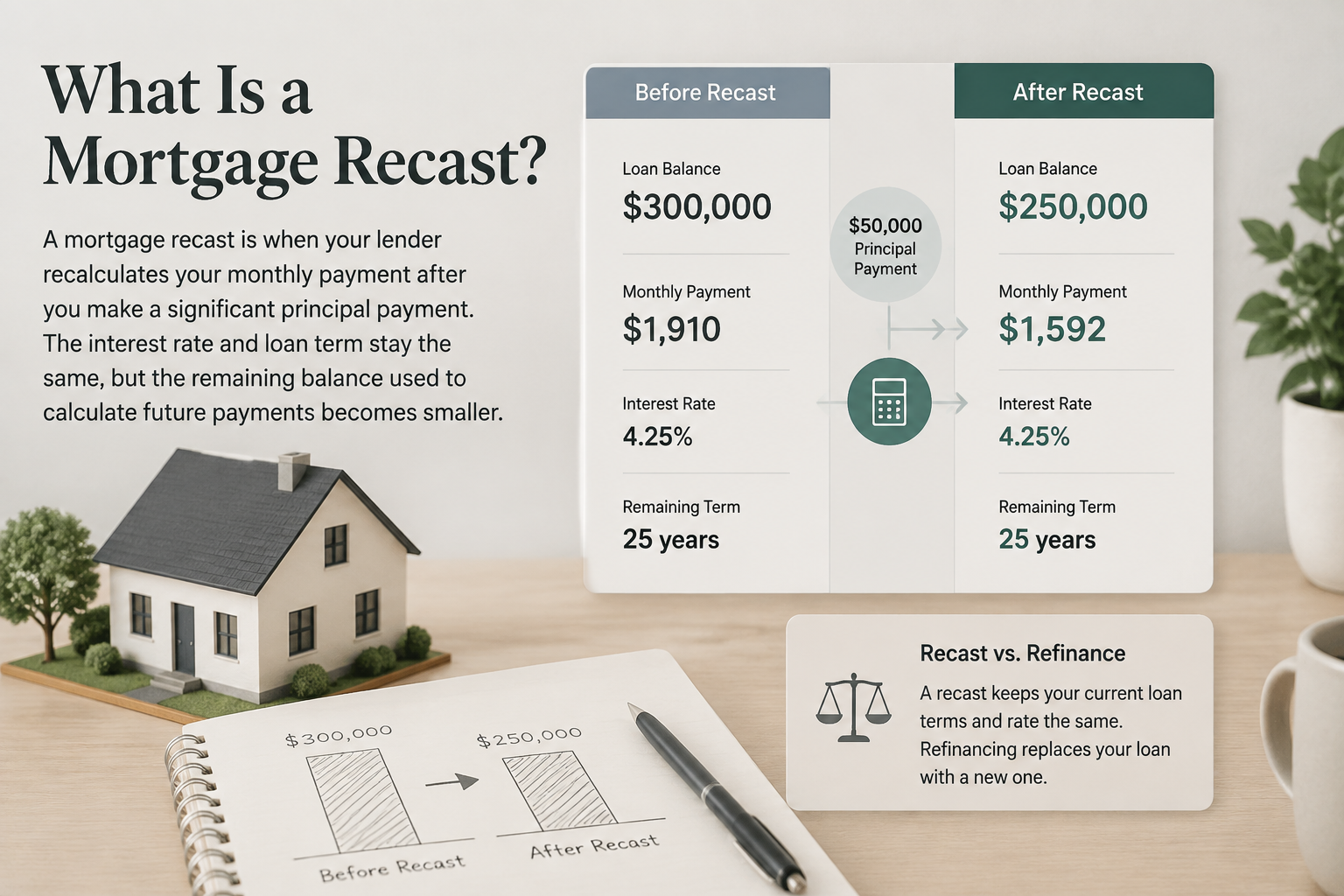
A mortgage recast, sometimes called a mortgage re-amortization, is a process where a lender recalculates your monthly payment after you make a significant principal payment. The interest rate and loan term usually stay the same, but the remaining balance used to calculate future payments becomes smaller.
For example, imagine a homeowner has a mortgage balance of $300,000. After several years, they make a $50,000 principal payment. If the lender allows a recast, the new payment calculation may use a remaining balance of about $250,000 instead of $300,000. The homeowner keeps the same loan rather than starting a new mortgage.
A mortgage recast is different from refinancing. Refinancing replaces the existing mortgage with a new loan, which may involve a new interest rate, new loan term, closing costs, and qualification requirements. A recast usually changes the payment calculation while keeping the original loan agreement in place.
Homeowners often compare mortgage recast vs refinance when deciding how to manage a large payment, inheritance, bonus, or savings amount. The right option depends on personal circumstances, lender rules, costs, and financial goals.
How Does a Mortgage Recast Work?
When a lender approves a recast, the remaining loan balance is reduced by the extra principal payment. The lender then calculates a new monthly payment based on:
- The updated principal balance
- The existing interest rate
- The remaining loan term
- The loan repayment schedule
The interest rate generally does not change during a recast. This means the main reason for a lower payment is the smaller balance being spread over the remaining repayment period.
A recast does not erase interest that has already been paid, and it does not automatically shorten the loan term. It mainly changes the required monthly payment amount.
Mortgage Recast Calculator Formula
A mortgage recast calculator uses the standard fixed-rate mortgage payment formula with an updated loan balance.
The monthly payment formula is:
M = P × [r(1 + r)^n] / [(1 + r)^n - 1]
Where:
- M = monthly principal and interest payment
- P = remaining mortgage principal after the lump-sum payment
- r = monthly interest rate (annual interest rate divided by 12)
- n = number of remaining monthly payments
The formula assumes a fixed interest rate and regular monthly payments. It does not include property taxes, insurance, homeowners association fees, or other housing costs.
Mortgage Recast Calculation Example
Suppose a homeowner has these loan details:
- Remaining mortgage balance: $300,000
- Annual interest rate: 6%
- Remaining term: 25 years
- Extra principal payment: $50,000
First, calculate the new balance:
$300,000 - $50,000 = $250,000
Next, convert the annual interest rate to a monthly rate:
6% ÷ 12 = 0.5% per month
The remaining number of payments is:
25 × 12 = 300 monthly payments
Using the mortgage payment formula, the new estimated payment is calculated using the $250,000 balance instead of the original $300,000 balance.
A mortgage recast calculator performs these steps automatically and helps compare the estimated payment before and after the principal reduction.
How to Use a Mortgage Recast Calculator
Using a mortgage recast calculator usually requires only a few loan details.
Step 1: Enter Your Current Mortgage Balance
Enter the amount you still owe on the mortgage before making the additional principal payment. Use your latest loan statement when possible because the balance changes as payments are made.
Step 2: Add the Lump-Sum Payment Amount
Enter the amount you plan to apply toward principal. This could come from savings, a financial event, or another source. The calculator uses this amount to estimate the reduced balance.
Step 3: Enter Your Interest Rate
Add your current mortgage interest rate. A recast usually keeps the same rate, so this should match your existing loan terms.
Step 4: Enter the Remaining Loan Term
Provide the number of years or months left on the mortgage. A longer remaining term generally spreads payments over more months.
Step 5: Review the Estimated New Payment
The calculator shows an estimated payment based on the updated balance. You can compare the result with your current payment to understand the possible change.
For broader loan planning, you can also use the mortgage calculator or loan calculator to explore different repayment scenarios.
Mortgage Recast Requirements and Limitations
Mortgage recast requirements vary by lender and loan type. Some lenders require a minimum principal payment, a specific account history, or an application fee. Some mortgage programs may not allow recasting.
Before making a large principal payment, homeowners should confirm:
- Whether the lender offers mortgage recasting
- The minimum amount required for a recast
- Any administrative fees
- How the new payment will be calculated
- Whether the loan type is eligible
A calculator can estimate the mathematics, but it cannot confirm lender approval or contract terms.
A mortgage recast also may not be the best choice for every situation. A homeowner who wants a lower interest rate, a different loan structure, or access to home equity may need to evaluate other options. A homeowner who wants to reduce monthly payments while keeping the existing mortgage terms may find recasting worth researching.
Mortgage Recast vs Refinance
Mortgage recast and refinancing can both affect monthly payments, but they work differently.
A recast:
- Keeps the existing mortgage
- Usually keeps the same interest rate
- Uses a lower principal balance
- Often involves fewer changes than refinancing
A refinance:
- Creates a new mortgage
- May change the interest rate or loan term
- Can involve closing costs and approval requirements
- May provide different payment options
The better choice depends on the homeowner's goals, current mortgage terms, available cash, and lender options. A calculator can help compare payment estimates, but it does not replace reviewing the complete financial impact.
Common Mortgage Recast Mistakes
Assuming Every Mortgage Can Be Recast
Not all mortgages are eligible. Always check lender policies before planning around a recast.
Confusing a Recast With Paying Off the Loan Faster
A recast lowers the required payment by recalculating the loan. It does not automatically shorten the repayment timeline.
Ignoring Other Housing Costs
The mortgage payment shown by a recast calculator usually covers principal and interest only. Property taxes, insurance, and other costs may remain unchanged.
Using Estimates as Final Loan Terms
Calculator results are estimates. The lender's official calculation determines the actual payment after approval.
Frequently Asked Questions
What is a mortgage recast calculator?
A mortgage recast calculator is an online tool that estimates a new mortgage payment after a large principal payment. It uses the updated loan balance, interest rate, and remaining repayment period to calculate an estimated payment.
How does a mortgage recast work?
A mortgage recast works by reducing the loan balance with a lump-sum principal payment and recalculating the remaining payments. The interest rate and original mortgage usually remain unchanged.
Is a mortgage recast better than refinancing?
A mortgage recast and refinancing serve different purposes. A recast may be useful when a homeowner wants a lower payment without replacing the mortgage, while refinancing may be considered when changing loan terms or interest rates. Personal circumstances and lender rules determine which option fits a situation.
What are common mortgage recast requirements?
Common requirements may include an eligible loan type, a minimum principal payment, lender approval, and possible fees. Requirements vary, so homeowners should confirm details with their mortgage servicer.
Can I use a mortgage recast calculator before contacting my lender?
Yes. A calculator can help estimate possible payment changes before discussing options with a lender. It provides an educational estimate, not a guarantee of approval or final loan terms.
Use the Calculator Lists mortgage tools to explore payment scenarios, understand loan calculations, and make more informed questions when speaking with your lender.
Looking for more tools?
Try our free Free Calculators