2027 tax calculator
Tax Calculator 2027: Estimate Your Federal Taxes, Refund, and Take-Home Pay
Use a 2027 tax calculator to estimate federal income tax, taxable income, potential refunds, and take-home pay. Explore the latest IRS tax brackets, standard deductions, calculation examples, and withholding rules for 2027.
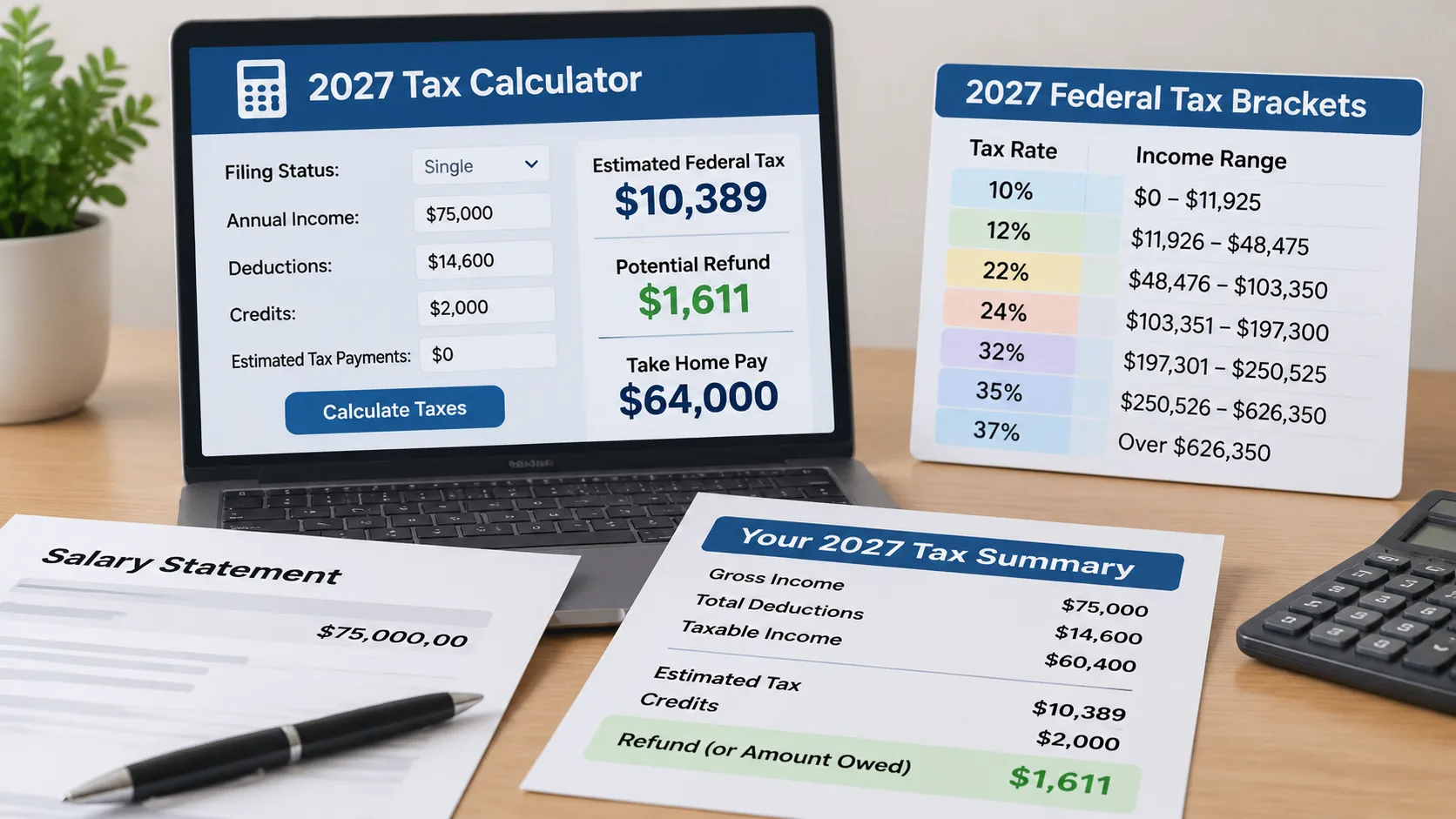
A tax calculator 2027 helps you estimate how much federal income tax you may owe on income earned during the 2027 calendar year, how much money you may receive as a refund, and how much you could keep after taxes. It uses your filing status, income, deductions, credits, and tax payments to produce an estimate. It is useful for employees, married couples, self-employed individuals, and anyone planning their 2027 finances.
The IRS has announced the federal income tax brackets and standard deduction amounts for tax year 2027. These rules generally apply to income earned in 2027 and reported on tax returns filed in 2028. Understanding the difference between your gross income, taxable income, estimated tax, and withholding is essential for interpreting the result correctly.
What Is a 2027 Tax Calculator?
A 2027 tax calculator is an online financial tool that estimates your federal income tax liability using the tax rules applicable to the 2027 tax year.
Your final tax liability depends on more than your annual salary. The calculation can also involve filing status, deductions, taxable interest, investment income, eligible credits, and other income sources.
A calculator generally helps answer three practical questions:
- How much federal income tax might I owe? It estimates your tax liability after applicable deductions and credits.
- Will I receive a tax refund? It compares your estimated liability with federal income tax already paid or withheld.
- How much income will I keep? It helps estimate the amount remaining after relevant taxes and deductions.
These results are estimates rather than finalized tax assessments. Your actual return may include additional rules, adjustments, or limitations that a basic calculator does not cover.
2027 Federal Income Tax Brackets
The United States uses a progressive federal income tax system. This means different portions of your taxable income are taxed at different rates. Entering a higher tax bracket does not mean all your income is suddenly taxed at the higher rate.
For tax year 2027, the seven federal marginal income tax rates remain 10%, 12%, 22%, 24%, 32%, 35%, and 37%.
The following table shows the 2027 federal income tax brackets for three common filing statuses.
| Tax rate | Single | Married filing jointly | Head of household |
|---|---|---|---|
| 10% | $0–$12,800 | $0–$25,600 | $0–$18,250 |
| 12% | $12,801–$52,025 | $25,601–$104,050 | $18,251–$69,650 |
| 22% | $52,026–$109,125 | $104,051–$218,250 | $69,651–$109,100 |
| 24% | $109,126–$208,325 | $218,251–$416,650 | $109,101–$208,300 |
| 32% | $208,326–$264,550 | $416,651–$529,100 | $208,301–$264,550 |
| 35% | $264,551–$661,375 | $529,101–$793,650 | $264,551–$661,350 |
| 37% | Over $661,375 | Over $793,650 | Over $661,350 |
These thresholds apply to taxable income, not necessarily your gross annual salary. The applicable filing status determines which column you should use.
2027 Standard Deduction Amounts
The standard deduction reduces the income subject to federal income tax. It is available without requiring taxpayers to list individual qualifying expenses.
The announced standard deduction amounts for 2027 are:
| Filing status | 2027 standard deduction |
|---|---|
| Single | $16,600 |
| Married filing jointly | $33,200 |
| Married filing separately | $16,600 |
| Head of household | $24,925 |
You generally compare the standard deduction with eligible itemized deductions when determining which approach applies to your return. Additional deductions may be available for certain taxpayers, depending on eligibility and applicable tax rules.
How to Calculate Federal Income Tax for 2027
Calculating federal income tax involves several stages. First, determine your total income. Next, subtract applicable adjustments and deductions to estimate taxable income. Then apply the progressive tax brackets and account for eligible credits and payments.
Step 1: Calculate Your Gross Annual Income
Start with your total income from relevant sources during 2027.
For example, assume a single employee earns:
- Annual salary: $75,000
- Additional taxable income: $5,000
- Total gross income: $80,000
Your gross income is $80,000 before applicable deductions and adjustments.
Step 2: Subtract Applicable Deductions
Assuming the employee qualifies for the full 2027 standard deduction of $16,600 and has no other adjustments, taxable income is:
For the example:
The estimated taxable income is $63,400.
Step 3: Apply the Progressive Tax Rates
Federal income tax is calculated separately for each portion of taxable income falling within a bracket.
For a single filer with $63,400 in taxable income, the calculation is:
- First $12,800 at 10% = $1,280
- Next $39,225 at 12% = $4,707
- Remaining $11,375 at 22% = $2,502.50
The estimated federal income tax before credits is:
The estimated tax liability is therefore $8,489.50 before applicable credits and other tax adjustments.
This example assumes ordinary taxable income, the standard deduction, and no additional tax provisions. Other income types may receive different tax treatment.
Step 4: Subtract Eligible Tax Credits
Tax credits reduce tax liability directly when the taxpayer qualifies for them. This differs from deductions, which generally reduce taxable income before tax is calculated.
Examples include qualifying child-related credits and other credits available under federal tax law.
The calculation can be represented as:
For example, if an eligible taxpayer has $8,489.50 in preliminary tax liability and qualifies for a hypothetical $1,000 credit, the resulting amount is:
This is an illustration, not an assumption that every taxpayer qualifies for that credit. Actual eligibility, refundable portions, and credit limitations depend on the relevant rules.
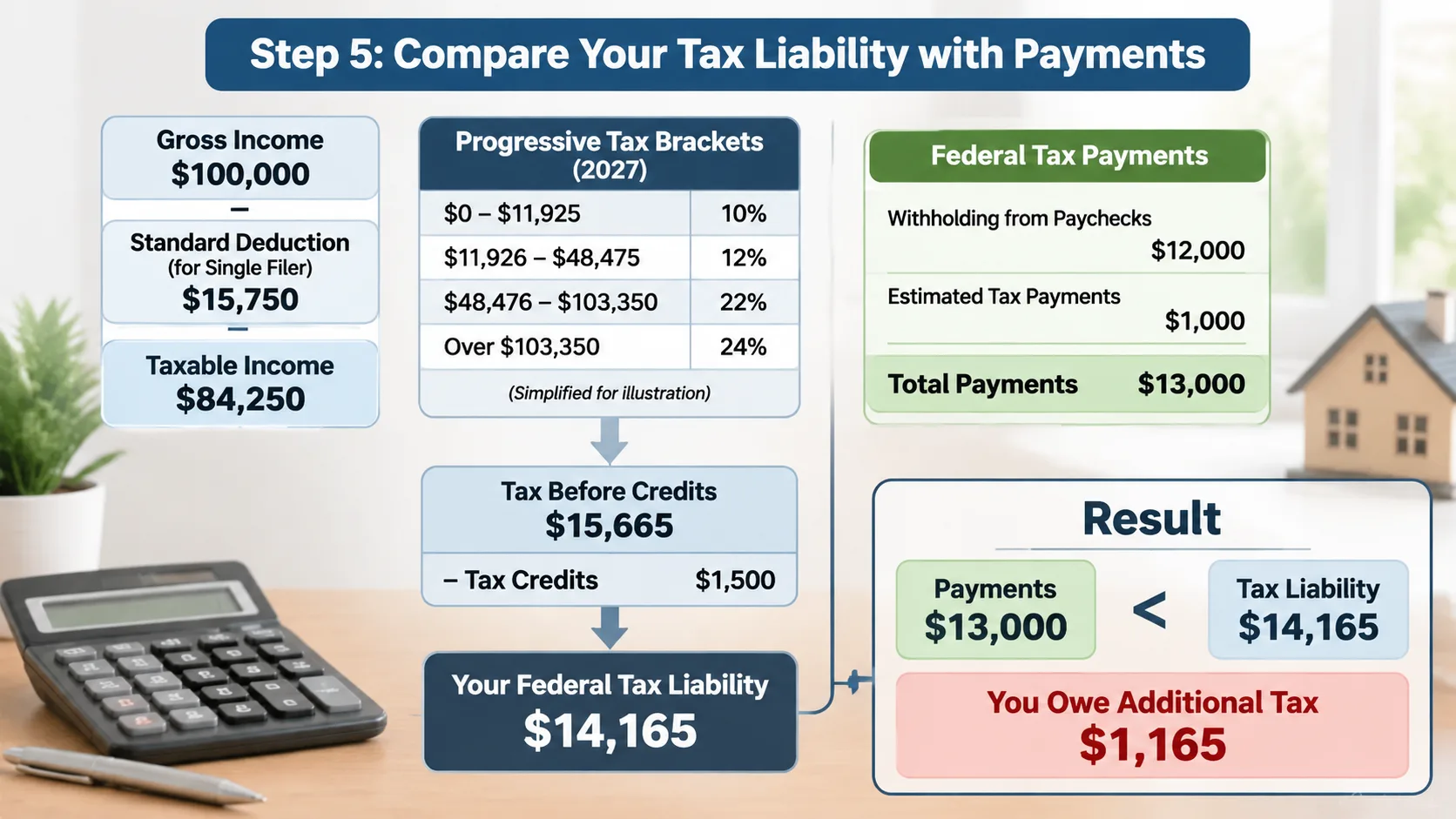
Step 5: Compare Tax Liability With Payments
Your refund or remaining tax balance depends on how much federal income tax you have already paid.
Suppose your adjusted tax liability is $7,489.50 and your federal income tax withholding totals $9,000.
The estimated refund is $1,510.50.
If your total payments are lower than your final tax liability, the difference represents an estimated amount due instead.
How to Use a 2027 Tax Calculator
An online tax calculator makes these calculations easier by organizing your information and applying the relevant tax brackets.
Follow these steps to estimate your 2027 federal taxes:
- Select your filing status. Choose single, married filing jointly, married filing separately, or head of household, as applicable.
- Enter your annual income. Include your expected wages and other relevant taxable income. Avoid counting the same income twice.
- Add applicable adjustments. Include eligible adjustments to income when supported by the calculator.
- Choose your deduction method. Enter the standard deduction or eligible itemized deductions, as appropriate.
- Include eligible tax credits. Provide information about credits you may qualify for, taking account of applicable limitations.
- Enter tax payments and withholding. Use your pay statements and estimated payment records to provide accurate figures.
- Review the results. Check estimated taxable income, tax liability, refund or balance due, and any displayed assumptions.
For additional financial planning, you can use the Take-Home Pay Calculator to explore how taxes affect your income after deductions and withholding.
How Much Is Your 2027 Take-Home Pay?
Take-home pay is the amount of money you receive after payroll deductions and applicable taxes. It is different from taxable income and is not necessarily equal to gross salary minus federal income tax alone.
Common payroll deductions include:
- Federal income tax withholding.
- Social Security tax.
- Medicare tax.
- State and local income taxes, where applicable.
- Employer-sponsored health insurance premiums and retirement contributions, depending on your payroll arrangements.
A simplified estimate can be expressed as:
For example, assume annual gross earnings of $80,000 and hypothetical combined payroll deductions of $18,000.
Estimated annual take-home pay would be $62,000, or approximately $5,166.67 per month if divided evenly across 12 months.
The $18,000 figure is illustrative rather than an actual tax calculation. Your result will depend on your withholding elections, payroll benefits, location, and personal circumstances.
Use the Federal Take-Home Pay Calculator to explore your estimated income after deductions.
Important Differences Between a Tax Refund and Tax Liability
A tax refund is not the same as a reduction in your actual tax liability. It generally represents an overpayment of taxes after your return accounts for the amounts owed and payments already made.
For example:
| Situation | Tax liability | Payments made | Result |
|---|---|---|---|
| Overpayment | $7,000 | $8,000 | $1,000 estimated refund |
| Exact payment | $7,000 | $7,000 | No refund or balance due |
| Underpayment | $7,000 | $6,000 | $1,000 estimated balance due |
A larger refund does not necessarily mean you paid less tax overall. It may simply mean more money was withheld from your paychecks throughout the year.
If you want to understand how your paycheck withholding affects your final tax outcome, the IRS provides an official Tax Withholding Estimator.
Common Tax Calculation Mistakes and Limitations
Even a well-designed 2027 tax calculator can produce misleading results when the information entered is incomplete or when the underlying assumptions do not match your circumstances.
Confusing Gross Income With Taxable Income
Gross income is not the same as taxable income. Deductions and qualifying adjustments may reduce the amount subject to federal income tax. Applying tax brackets directly to gross salary without accounting for deductions can overstate the estimated liability.
Assuming One Tax Rate Applies to All Income
The federal income tax system is progressive. Each rate applies only to the relevant portion of taxable income. A taxpayer in the 22% bracket does not necessarily pay 22% on every dollar earned.
Forgetting Other Income Sources
Freelance earnings, interest, dividends, rental income, and other sources may affect your overall tax calculation. Some income types are subject to different tax rules or additional taxes.
Mixing Federal and State Taxes
Federal income tax is separate from state and local taxes. A federal tax calculator cannot provide a complete picture of your overall tax burden unless it also accounts for applicable state and local rules.
Treating an Estimate as a Final Tax Return
A calculator may not account for every credit, limitation, special deduction, alternative minimum tax provision, or individual tax circumstance. Self-employed taxpayers may also need to consider self-employment tax and estimated payments.
For more detailed financial calculations, explore the Loan Calculator and Compound Interest Calculator to understand other factors affecting your financial planning.
When Should You Use a 2027 Tax Calculator?
A tax calculator can be useful at different points throughout the year, not only when preparing a tax return.
When starting a new job: Estimate how much of your salary may remain after federal taxes and payroll deductions.
When receiving a salary increase: Check how additional taxable income may affect your marginal tax bracket and overall tax liability.
When getting married: Compare the possible tax implications of different filing statuses using your combined household information.
When earning additional income: Estimate how freelance work, bonuses, investment income, or other earnings may affect your tax position.
When reviewing withholding: Compare expected tax liability with the amount projected to be withheld during the year.
Review your estimates after significant financial or household changes. Keeping your income and withholding information current can make projections more useful.
Frequently Asked Questions About the Tax Calculator 2027
1. What are the federal income tax brackets for 2027?
The 2027 federal income tax rates are 10%, 12%, 22%, 24%, 32%, 35%, and 37%. The applicable income thresholds depend on filing status. For example, the 10% bracket for single filers applies to taxable income up to $12,800, while the top 37% rate starts above $661,375.
2. What is the standard deduction for 2027?
The 2027 standard deduction is $16,600 for single filers and married individuals filing separately, $33,200 for married couples filing jointly, and $24,925 for heads of household. Additional deductions may apply to eligible taxpayers under separate provisions.
3. When will I file my 2027 tax return?
Income earned during the 2027 tax year is generally reported on a federal income tax return filed in 2028. The applicable filing deadline and any extensions depend on IRS rules and your individual circumstances.
4. How do I calculate my 2027 tax refund?
Estimate your final federal tax liability after applicable deductions and credits. Then subtract that liability from your total federal tax payments, including withholding and qualifying estimated payments. If payments exceed your liability, the difference is your estimated refund. Otherwise, you may have a balance due.
5. Does a higher tax bracket mean all my income is taxed at a higher rate?
No. Federal income tax uses marginal rates, meaning each rate applies only to the portion of taxable income within its bracket. Moving into a higher bracket does not automatically increase the tax rate on all your income.
6. Does the 2027 tax calculator include Social Security and Medicare taxes?
Not necessarily. A federal income tax estimate may exclude regular Social Security and Medicare payroll taxes. These taxes are calculated separately from ordinary federal income tax, although certain additional Medicare tax provisions may affect eligible higher-income taxpayers.
7. Can I use a 2027 tax calculator if I am self-employed?
Yes, you can use a calculator for an initial estimate if it supports your income and deductions. However, self-employed individuals may need to account for business expenses, self-employment tax, estimated tax payments, and other specific rules that a basic calculator may not include.
8. Is a 2027 tax calculator accurate enough to prepare my tax return?
A calculator can provide a useful planning estimate, but it is not a substitute for completing an accurate tax return. Results depend on the information entered and the features supported by the tool. Review current IRS guidance and consider qualified tax assistance when your circumstances involve complex income, deductions, or credits.
Estimate Your 2027 Taxes With Calculator Lists
Understanding your federal tax brackets, standard deduction, and withholding can make financial planning more straightforward. A 2027 tax calculator helps organize these figures into an estimated tax liability, potential refund, and take-home pay calculation.
Start with accurate income and filing information, review the assumptions behind your results, and update your estimates when your financial situation changes.
Use Calculator Lists' Take-Home Pay Calculator to explore how payroll deductions affect your income, or try the Financial Calculator for additional financial calculations. These free online tools can help you understand your numbers while keeping the underlying calculations transparent.
For final filing decisions, refer to current IRS instructions and applicable federal and state tax requirements.
Looking for more tools?
Try our free Free Calculators