scientific notation conversion
How to Do Scientific Notation: Convert, Multiply and Divide with Examples
Scientific notation is a way to write very large or very small numbers in a shorter form. This guide explains how to do scientific notation, how to convert numbers, how to multiply and divide values written this way, and how students, researchers, and anyone working with calculations can use the method correctly. You can check your results with the scientific calculator while practicing scientific notation conversion.
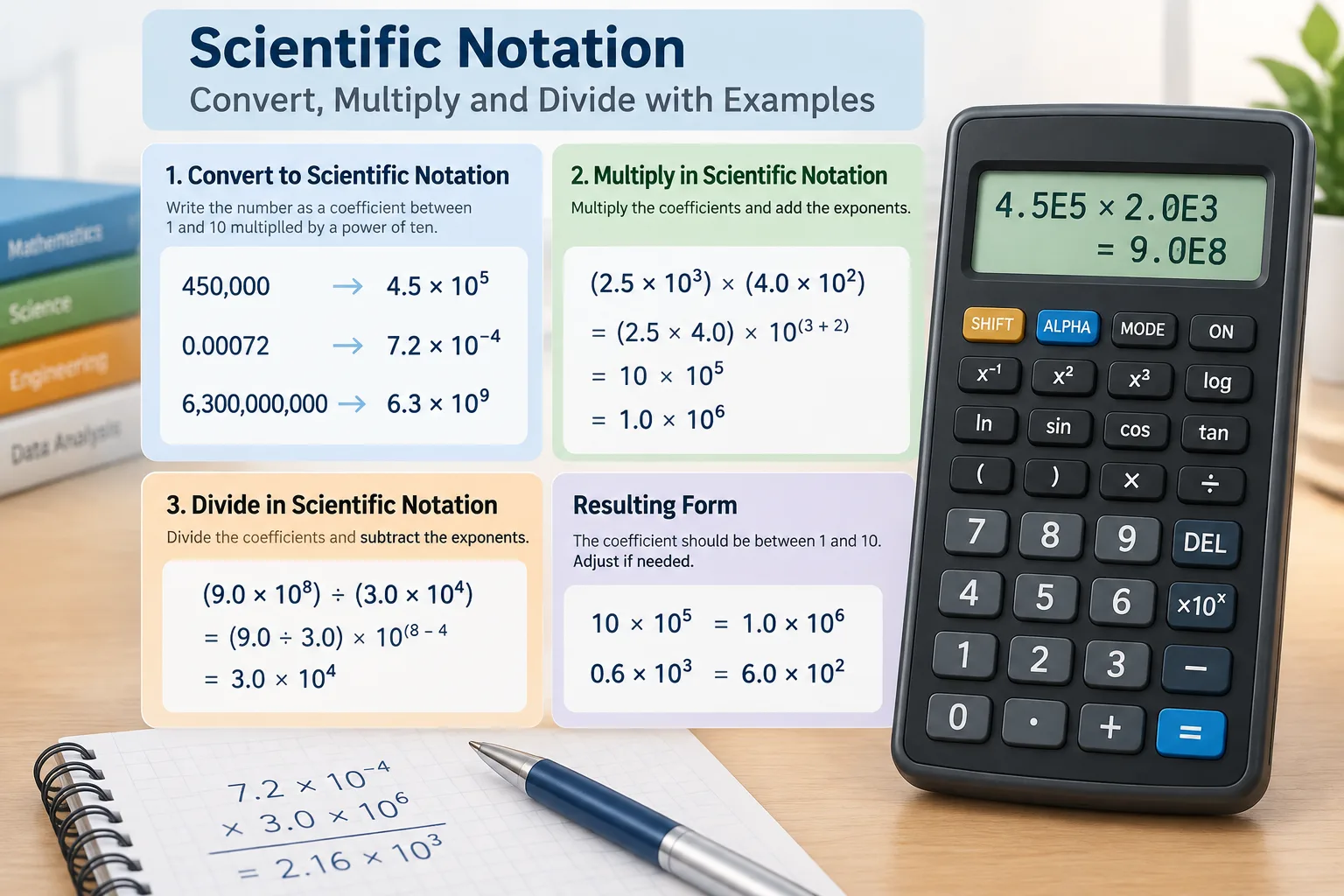
What Is Scientific Notation?
Scientific notation is a mathematical format that expresses a number as a coefficient multiplied by a power of ten. It is commonly used when numbers contain many digits, such as measurements in science, astronomy, engineering, and data analysis.
The general form is:
where (a) is a number greater than or equal to 1 and less than 10, and (n) is an integer that shows how many places the decimal point moves.
For example, the number 450000 can be written as:
The exponent is positive because the original number is larger than 10. Small numbers use negative exponents. For example:
Scientific notation makes calculations easier because it separates the meaningful digits from the size of the number.
How to Write Scientific Notation from Standard Form
Learning how to write scientific notation starts with moving the decimal point until only one non-zero digit remains on the left side.
Converting Large Numbers to Scientific Notation
For large numbers:
- Find the decimal point. If it is not shown, place it after the last digit.
- Move the decimal point left until the number is between 1 and 10.
- Count the number of moves.
- Write that count as a positive exponent.
Example:
Convert 72,000 to scientific notation.
Move the decimal point four places left:
The exponent is 4 because the decimal moved four positions.
Converting Small Numbers to Scientific Notation
For numbers smaller than 1:
- Move the decimal point right until the coefficient is between 1 and 10.
- Count the moves.
- Use a negative exponent.
Example:
Convert 0.0036 to scientific notation.
The decimal moves three places right:
The negative sign indicates that the original value is smaller than 1.
Scientific Notation Conversion Formula and Examples
Scientific notation conversion depends on powers of ten. Every movement of the decimal point changes the exponent by one.
For a number (N):
where (a) is the adjusted coefficient and (n) represents the decimal shift.
Example with a large number:
Original number: 5,600,000
Decimal movement: 6 places left
Example with a small number:
Original number: 0.000082
Decimal movement: 5 places right
When checking conversions, keep the coefficient between 1 and 10. A coefficient such as 56 × 10⁴ is not standard scientific notation because the coefficient is too large.
For related number formatting practice, you can also review the significant figures rules guide.
How to Multiply Numbers in Scientific Notation
Multiplying scientific notation values involves multiplying the coefficients and adding the exponents.
The formula is:
Example:
Calculate:
First multiply the coefficients:
Then add the exponents:
Result:
If the coefficient becomes 10 or greater, convert it back into standard scientific notation.
Example:
Because 32 is not between 1 and 10:
How to Divide Numbers in Scientific Notation
Division works by dividing coefficients and subtracting exponents.
The formula is:
Example:
Calculate:
Divide coefficients:
Subtract exponents:
Final answer:
A negative result in the exponent after division means the final number is smaller than 1.
Step-by-Step Guide: How to Do Scientific Notation Correctly
Follow these steps whenever you need to convert or calculate with scientific notation:
- Identify whether the number is large or small. This determines whether the exponent will be positive or negative.
- Move the decimal point until the coefficient is between 1 and 10.
- Count the number of decimal movements carefully.
- Assign a positive exponent for left movements and a negative exponent for right movements.
- Check that the coefficient follows scientific notation rules.
- Use multiplication and division rules when combining scientific notation values.
- Verify the result by converting it back to ordinary decimal form.
For additional math tools, explore the percentage calculator and other free calculation resources available on Calculator Lists.
Common Mistakes and Limits of Scientific Notation
Scientific notation is useful, but several mistakes can lead to incorrect results.
Mistake 1: Using the Wrong Exponent Sign
Moving the decimal left creates a positive exponent. Moving the decimal right creates a negative exponent.
Mistake 2: Forgetting to Normalize the Coefficient
The coefficient should normally be at least 1 and less than 10. A value like 25 × 10² should be rewritten as 2.5 × 10³.
Mistake 3: Adding Exponents During Division
When dividing scientific notation values, subtract exponents instead of adding them.
Mistake 4: Ignoring Significant Digits
Scientific notation can represent precision, but the number of digits shown should match the accuracy required by the calculation.
Scientific notation is a representation method, not a measurement system. The accuracy of the final result depends on the accuracy of the original numbers and the rules of the calculation being performed.
Who Uses Scientific Notation?
Scientific notation appears in many areas where numbers are extremely large or small.
Scientists use it for measurements such as microscopic distances and astronomical scales. Engineers use it for technical calculations. Students use it in mathematics, chemistry, physics, and statistics courses.
It is also useful for calculators and software because powers of ten provide a compact way to store and display values.
FAQ About How to Do Scientific Notation
What is the easiest way to do scientific notation?
The easiest way to do scientific notation is to move the decimal point until the first number is between 1 and 10, then count the moves and use that count as the exponent of 10. A left move creates a positive exponent, while a right move creates a negative exponent.
How do you write scientific notation for a large number?
To write scientific notation for a large number, move the decimal point to the left until one non-zero digit remains before it. The number of moves becomes a positive exponent. For example, 90000 becomes (9 \times 10^4).
How do you convert scientific notation back to normal numbers?
To convert scientific notation back to a regular number, move the decimal point according to the exponent. A positive exponent moves the decimal right, and a negative exponent moves it left.
How do you multiply scientific notation numbers?
To multiply scientific notation numbers, multiply the coefficients and add the exponents. After calculating, adjust the coefficient if it is not between 1 and 10.
How do you divide scientific notation numbers?
To divide scientific notation numbers, divide the coefficients and subtract the exponent of the denominator from the exponent of the numerator. Then normalize the result if needed.

Use the Calculator Lists scientific calculator to check scientific notation examples and practice conversions with quick calculations.
Looking for more tools?
Try our free Free Calculators