ovulation window
Ovulation Window Explained: When Does Ovulation Happen After Your Period?
Understand your ovulation window, how many days after your period ovulation may happen, and how to estimate fertile days using your menstrual cycle length. Learn the calculation, examples, tracking methods, and limitations.
The ovulation window is the period during a menstrual cycle when pregnancy is biologically possible. It generally includes the five days before ovulation and the day of ovulation itself. Ovulation often occurs approximately 14 days before the next period, rather than a fixed number of days after the previous period. Understanding this timing helps people learn about their menstrual cycle, estimate fertile days, and interpret results from an ovulation day calculator.
What Is the Ovulation Window?
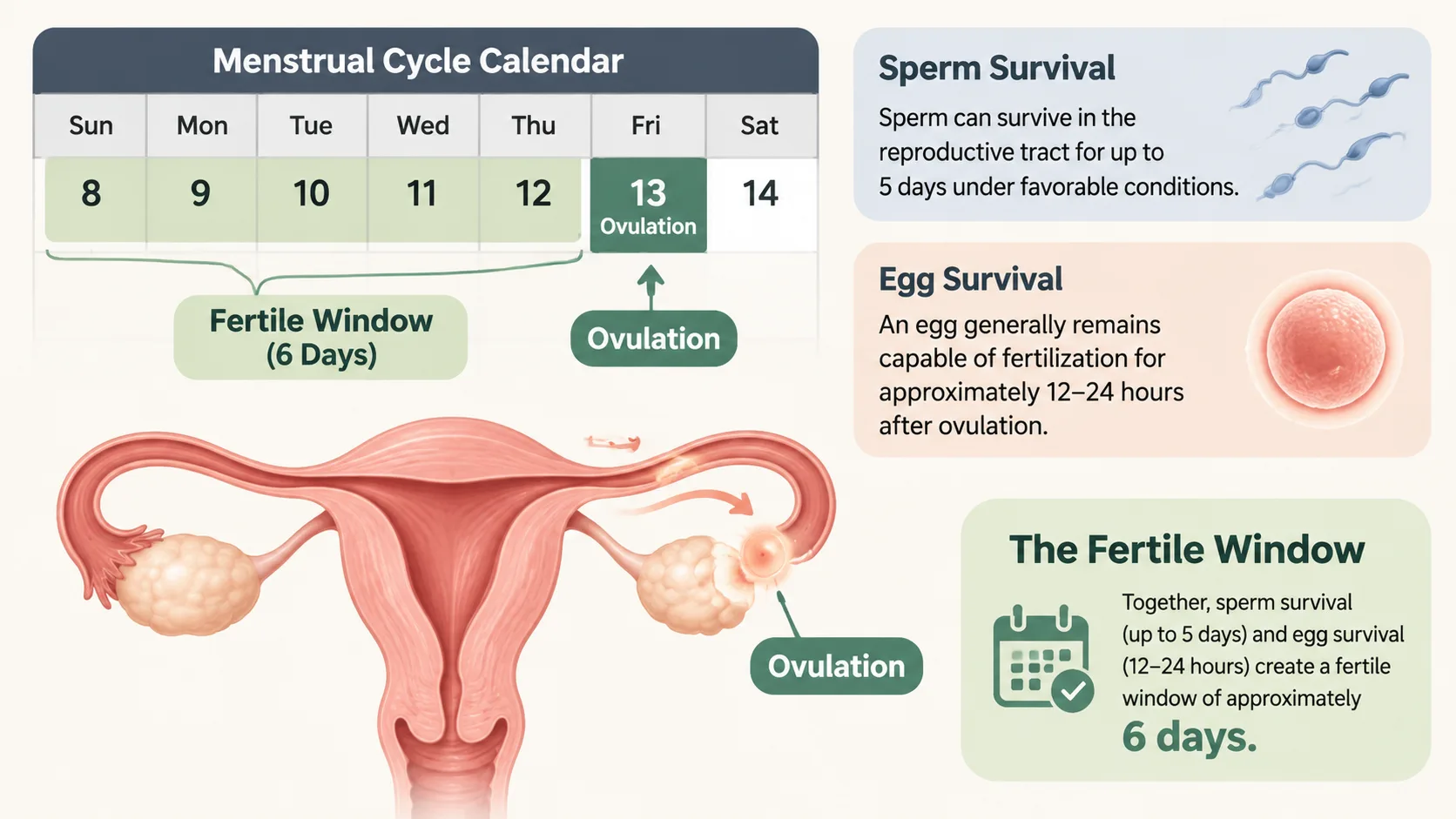
The ovulation window, also called the fertile window, describes the days when sperm may survive long enough to fertilize an egg or when an egg is available for fertilization.
Ovulation is the process in which an ovary releases a mature egg. The egg travels into a fallopian tube, where fertilization may occur if sperm are present.
Two biological timelines determine the approximate fertile window:
- Sperm survival: Sperm can survive in the reproductive tract for up to five days under favorable conditions.
- Egg survival: An egg generally remains capable of fertilization for approximately 12–24 hours after ovulation.
Together, these timelines create a fertile window of approximately six days: the five days before ovulation and the day ovulation occurs.
The likelihood of conception is not identical on every day of this window. The days immediately before ovulation and the day of ovulation are particularly important because sperm may already be present when the egg is released.
How Many Days After Your Period Is Ovulation?
There is no single answer for everyone. The timing depends mainly on the length of the menstrual cycle and the variation in the time between ovulation and the next period.
For example:
- A 28-day cycle: ovulation is often estimated around cycle day 14.
- A 30-day cycle: ovulation is often estimated around cycle day 16.
- A 32-day cycle: ovulation is often estimated around cycle day 18.
- A 26-day cycle: ovulation is often estimated around cycle day 12.
These are estimates based on an approximately 14-day luteal phase. They are not confirmed ovulation dates.
Cycle day 1 is the first day of menstrual bleeding. Therefore, if someone has a five-day period and a 28-day cycle, the estimated ovulation day is around nine days after bleeding ends.
However, a shorter cycle or earlier ovulation can make pregnancy biologically possible soon after a period finishes. The calendar alone cannot establish that days immediately following menstruation are infertile.
Understanding the Menstrual Cycle Phases
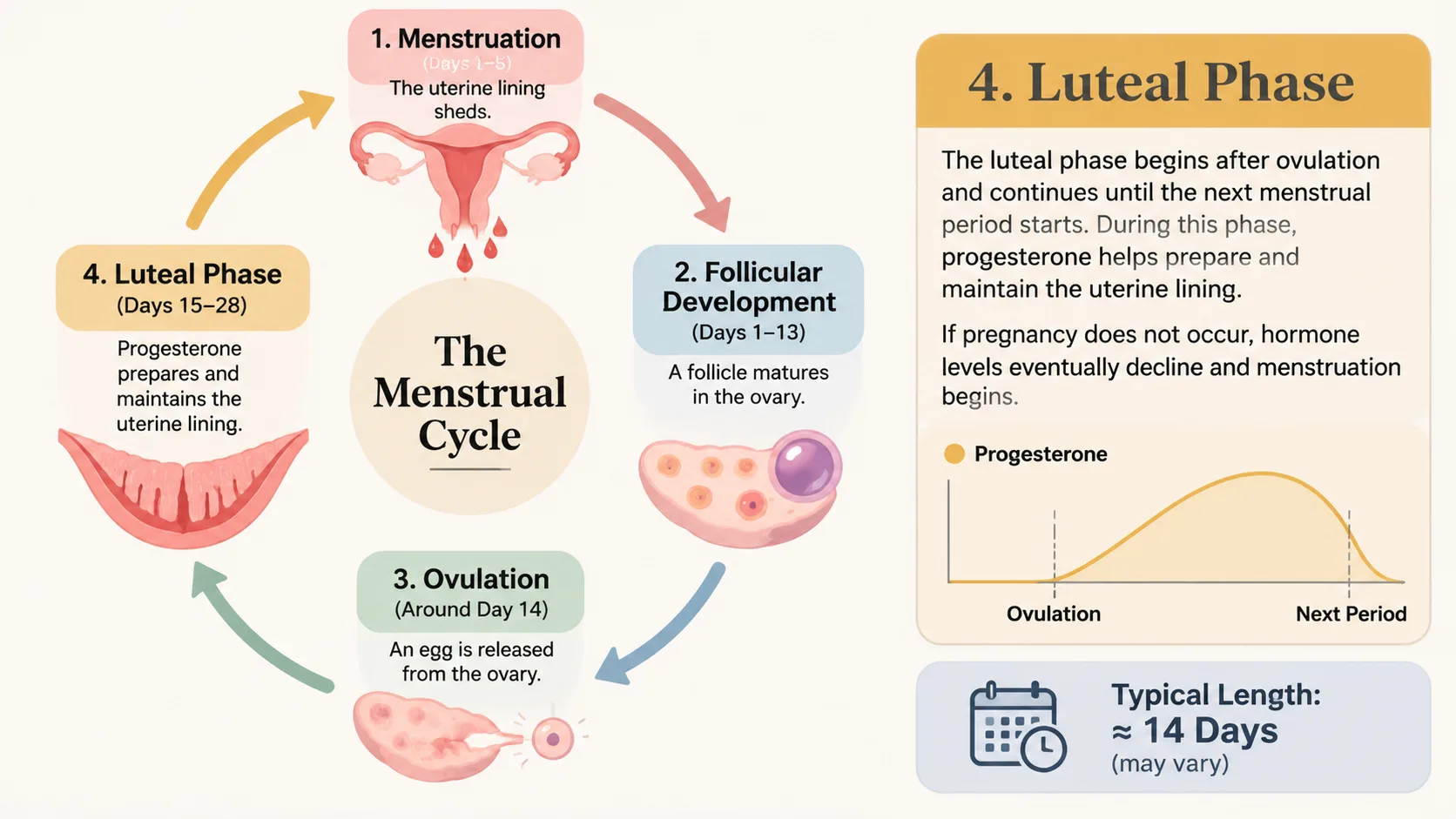
Understanding the menstrual cycle phases makes ovulation timing easier to interpret. A menstrual cycle is commonly divided into four stages.
1. Menstruation
Menstruation begins on cycle day 1. The uterus sheds its uterine lining, resulting in menstrual bleeding.
The length of menstrual bleeding varies between individuals. This phase does not determine the exact date of ovulation because the timing of ovulation depends on the broader cycle pattern.
2. Follicular Phase
The follicular phase starts on the first day of menstruation and continues until ovulation.
During this phase, hormones stimulate ovarian follicles to develop. Usually, one follicle becomes dominant and releases an egg when ovulation occurs.
The follicular phase can vary considerably in length. This is one reason why ovulation does not always happen on the same cycle day, even when someone usually has regular periods.
3. Ovulation Phase
Ovulation happens when the mature follicle releases an egg from an ovary.
A rise in luteinizing hormone (LH), commonly called the LH surge, helps trigger this process. Ovulation generally follows an LH surge within approximately 24–36 hours, although timing can vary.
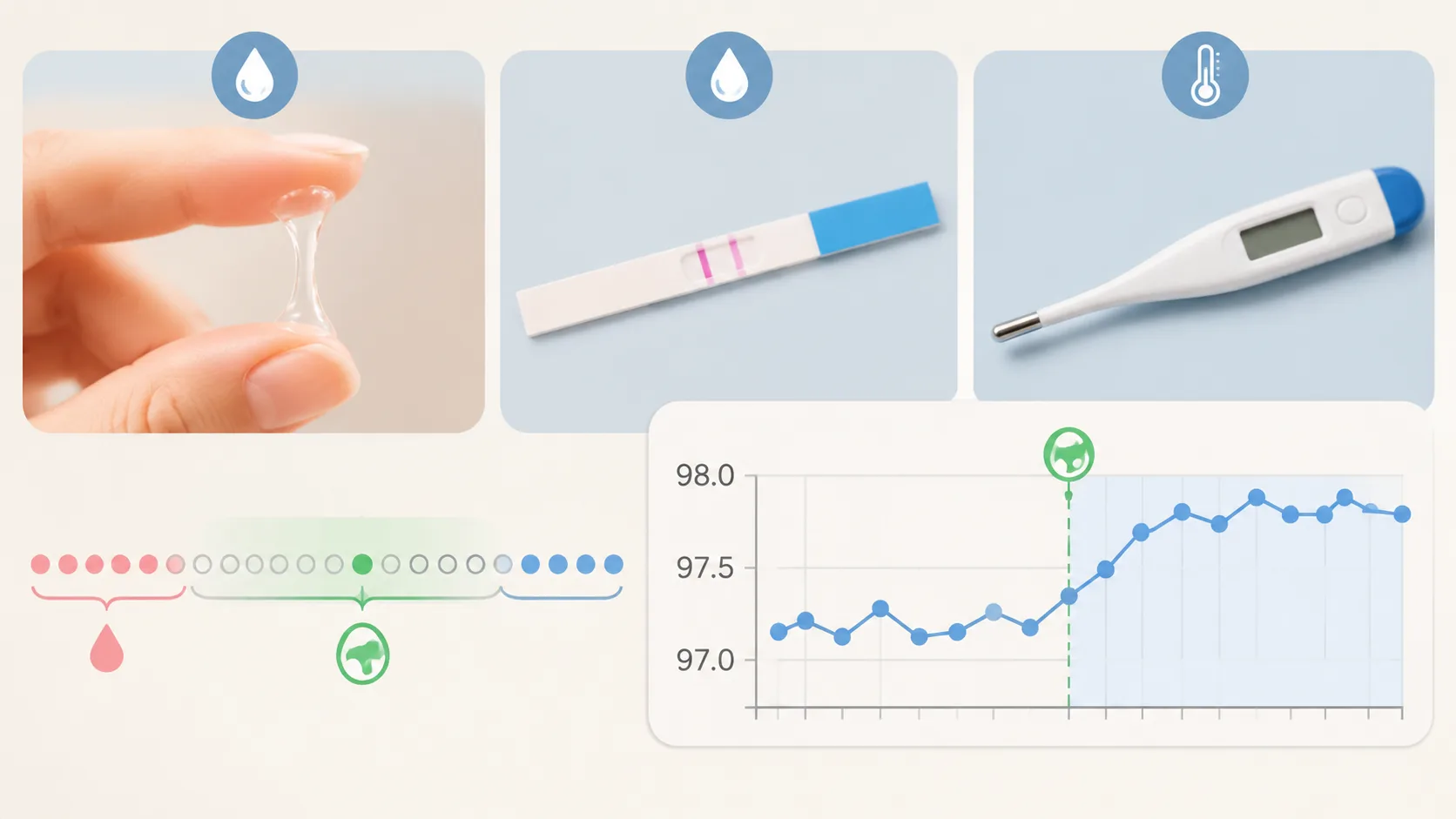
Some people notice changes in cervical mucus around this stage. It may become clearer, slippery, and stretchy, similar to raw egg white.
4. Luteal Phase
The luteal phase begins after ovulation and continues until the next menstrual period starts.
During this phase, progesterone helps prepare and maintain the uterine lining. If pregnancy does not occur, hormone levels eventually decline and menstruation begins.
This phase is often estimated to last approximately 14 days, although individual variation exists.
How to Calculate Your Ovulation Window
A calendar-based calculation provides a useful starting estimate. It uses the average menstrual cycle length and an assumed luteal phase of approximately 14 days.
The Ovulation Day Formula
The basic estimation formula is:
Here, cycle length is measured in days, starting with the first day of one period and ending the day before the next period begins.
Example: A 30-day menstrual cycle
Suppose your average menstrual cycle lasts 30 days.
The estimated ovulation date is cycle day 16.
This does not mean ovulation is guaranteed to happen on day 16. It is a calendar-based estimate using an assumed luteal phase.
The Fertile Window Formula
Once the estimated ovulation day is calculated, estimate the fertile window by counting backward five days and including ovulation day.
Here, represents the estimated ovulation cycle day.
Example: A 30-day cycle
- Estimated ovulation day: 16.
- Five days before ovulation: day 11.
- Estimated fertile window: cycle days 11–16.
This gives an approximate six-day window.
The calculation is useful for understanding the cycle, but it cannot confirm that ovulation actually occurred on the predicted day.
Example Ovulation Estimates for Different Cycle Lengths
| Cycle length | Estimated ovulation day | Estimated fertile window |
|---|---|---|
| 24 days | Day 10 | Days 5–10 |
| 26 days | Day 12 | Days 7–12 |
| 28 days | Day 14 | Days 9–14 |
| 30 days | Day 16 | Days 11–16 |
| 32 days | Day 18 | Days 13–18 |
| 35 days | Day 21 | Days 16–21 |
These examples assume an approximately 14-day luteal phase. Actual ovulation may occur earlier or later.
How to Use an Ovulation Day Calculator
An ovulation day calculator makes calendar-based estimates easier by applying the cycle-length formula automatically.
You generally need two pieces of information:
- The first day of your most recent menstrual period.
- Your average menstrual cycle length in days.
Follow these steps to understand an estimated ovulation window:
- Identify your last period start date. Count the first day of menstrual bleeding as cycle day 1.
- Determine your average cycle length. Review several previous cycles rather than relying on one cycle alone.
- Enter your information. Use the relevant dates and average cycle length in an ovulation calculator, if available.
- Calculate the estimated ovulation day. Subtract approximately 14 days from your cycle length.
- Identify the fertile window. Count backward five days from the estimated ovulation day and include ovulation day.
- Interpret the result as an estimate. Do not treat a calendar prediction as confirmation of ovulation or as proof that other days are infertile.
For additional cycle-related calculations, Calculator Lists also provides a due date calculator and an age calculator.
Signs That Ovulation May Be Approaching
Calendar calculations are only one way to understand the ovulation window. Other observations can provide additional information about changes throughout the menstrual cycle.
Changes in Cervical Mucus
Cervical mucus often changes in response to reproductive hormones.
Near ovulation, it may become:
- Clear or translucent.
- Stretchy between the fingers.
- Slippery or lubricative.
- More noticeable than at other times in the cycle.
These changes can indicate that ovulation may be approaching. However, cervical mucus observations do not confirm that an egg has been released.
Luteinizing Hormone Tests
Ovulation predictor kits measure luteinizing hormone in urine. A positive result generally indicates an LH surge, which commonly precedes ovulation by approximately one to two days.
These tests can provide more immediate information than a calendar estimate. However, an LH surge is indirect evidence and does not guarantee that ovulation occurred.
Basal Body Temperature
Basal body temperature is the body's resting temperature, usually measured immediately after waking.
After ovulation, progesterone can cause a small increase in basal body temperature. Tracking this change over multiple days may help identify a pattern consistent with ovulation.
Because the temperature increase generally happens after ovulation, this method is more useful for reviewing past cycle patterns than predicting the beginning of the fertile window.
Common Ovulation Window Mistakes and Limitations
Even a straightforward calculation can be misunderstood when normal biological variation is overlooked.
Assuming Everyone Ovulates on Day 14
Day 14 is a familiar reference point for a 28-day cycle, not a universal ovulation date.
Someone with a shorter or longer cycle may ovulate on a different day. Even people with similar average cycle lengths can have different ovulation patterns.
Counting From the Last Day of Your Period
Ovulation calculations normally start from the first day of menstrual bleeding, not the last day.
For example, in a 28-day cycle, the estimated ovulation day is cycle day 14. If menstruation lasts five days, that is approximately nine days after bleeding ends.
Confusing these two counting methods can shift an estimate significantly.
Assuming Regular Periods Guarantee Exact Ovulation Timing
Regular periods can make calendar estimates more useful, but they do not establish the exact ovulation date in an individual cycle.
Stress, illness, travel, changes in routine, and hormonal factors may influence cycle timing.
Treating the Calendar Method as Contraception
A predicted fertile window should not be used as a reliable way to identify guaranteed pregnancy-free days.
Ovulation can occur earlier or later than expected, and sperm can survive for several days. People who want to avoid pregnancy should consult reliable contraceptive information and a qualified healthcare professional rather than relying on a simple calendar estimate.
Expecting Every Cycle to Be Identical
Cycle length and ovulation timing can change from one month to another. An average based on previous periods may not accurately describe the current cycle.
If periods are consistently irregular, absent, or accompanied by concerning symptoms, a healthcare professional can help assess possible reasons.
When Should You Seek Professional Guidance?
General cycle tracking is useful for education, but some situations require individualized medical guidance.
Consider discussing your menstrual cycle with a healthcare professional if:
- Your periods are consistently irregular or frequently absent.
- You have significant changes in your usual menstrual pattern.
- You experience unusual bleeding or persistent pelvic pain.
- You are concerned about whether ovulation is occurring.
- You have questions about fertility or contraception.
A healthcare professional may review menstrual history and, when appropriate, discuss hormone testing, ovulation predictor kits, or ultrasound assessment.
For people seeking a pregnancy, fertility evaluation timing depends on age and medical history. A common guideline is to seek evaluation after 12 months of trying if younger than 35, or after six months if age 35 or older. Earlier consultation may be appropriate when there are known reproductive health concerns.
This article is educational information, not a diagnosis, fertility assessment, or substitute for professional medical advice.
Frequently Asked Questions About the Ovulation Window
1. How many days after my period is the ovulation window?
The timing depends on your menstrual cycle length. In a typical 28-day cycle, ovulation is estimated around cycle day 14, and the fertile window is approximately days 9–14. If your period lasts five days, this estimated window starts about four days after bleeding ends. Shorter cycles may have an earlier fertile window, so the estimate is not the same for everyone.
2. Can I ovulate immediately after my period?
Yes, early ovulation is possible, particularly with shorter menstrual cycles. Because sperm can survive in the reproductive tract for several days, pregnancy may be biologically possible following intercourse shortly after menstruation. The calendar cannot establish that the days immediately after a period are infertile.
3. How do I calculate my ovulation window with a 28-day cycle?
Subtract approximately 14 from 28 to estimate ovulation around cycle day 14. Then count backward five days. The estimated fertile window is cycle days 9–14. This method assumes an approximately 14-day luteal phase and should be treated as an estimate rather than a confirmed prediction.
4. Is ovulation always 14 days before my next period?
No. Approximately 14 days is a common estimation assumption, but the luteal phase varies between individuals and cycles. Ovulation can happen earlier or later than a calendar calculation suggests. Tracking menstrual history and other ovulation indicators may provide additional context, but no simple calculation confirms the exact date.
5. Can I get pregnant outside my predicted ovulation window?
Yes. The predicted window may be inaccurate because ovulation timing can change. Sperm can survive for several days, and an egg remains available for fertilization for a limited time after release. Therefore, a calendar estimate cannot reliably identify days when pregnancy is impossible or provide dependable contraception.
6. Does a positive ovulation test mean I have ovulated?
Not necessarily. A positive urine ovulation test usually indicates an LH surge, which commonly occurs before ovulation. It provides indirect evidence that ovulation may be approaching, but it does not prove that an egg was released. Some hormonal conditions can also affect test interpretation.
7. Can I have an ovulation window if my periods are irregular?
Yes, ovulation may still occur with irregular periods, but predicting its timing using average cycle length becomes more difficult. Calendar calculations are less dependable when cycle lengths change considerably. A healthcare professional can discuss appropriate ways to assess your individual menstrual pattern.
8. How long does the fertile window last?
The commonly described fertile window lasts approximately six days: the five days before ovulation and ovulation day. This estimate reflects sperm survival and the limited time an egg remains viable after release. The actual timing varies, so the six-day calendar range should not be treated as an exact biological boundary.
Understand Your Cycle With Clear Calculations
The ovulation window is easier to understand when you know how cycle length, ovulation timing, and the luteal phase relate to one another. A calendar-based estimate can provide a helpful starting point, while changes in cervical mucus, LH testing, and temperature tracking offer additional information.
Use the calculation examples in this guide to understand your estimated fertile days, and explore the health calculators available at Calculator Lists. Remember that an online calculator provides an estimate based on the information entered, not a medical confirmation of ovulation.
If you have questions about irregular cycles, fertility, or contraception, consult a qualified healthcare professional for advice based on your circumstances.
Looking for more tools?
Try our free Free Calculators