retirement age
Retirement Age Explained: Full Retirement Age by Birth Year
Full retirement age by birth year, what early claiming costs, and how delayed credits work — with worked examples and free calculators.
Your retirement age is not one single number, and knowing which one you mean changes every calculation that follows. In the U.S., "retirement age" usually refers to Social Security's full retirement age (FRA) — the age at which you receive 100% of your earned benefit. Your FRA depends on your birth year, and the date you actually claim adjusts that amount permanently. This guide shows the full retirement age by birth year, the exact early-claiming formula, delayed credits, and how to check your own scenario.
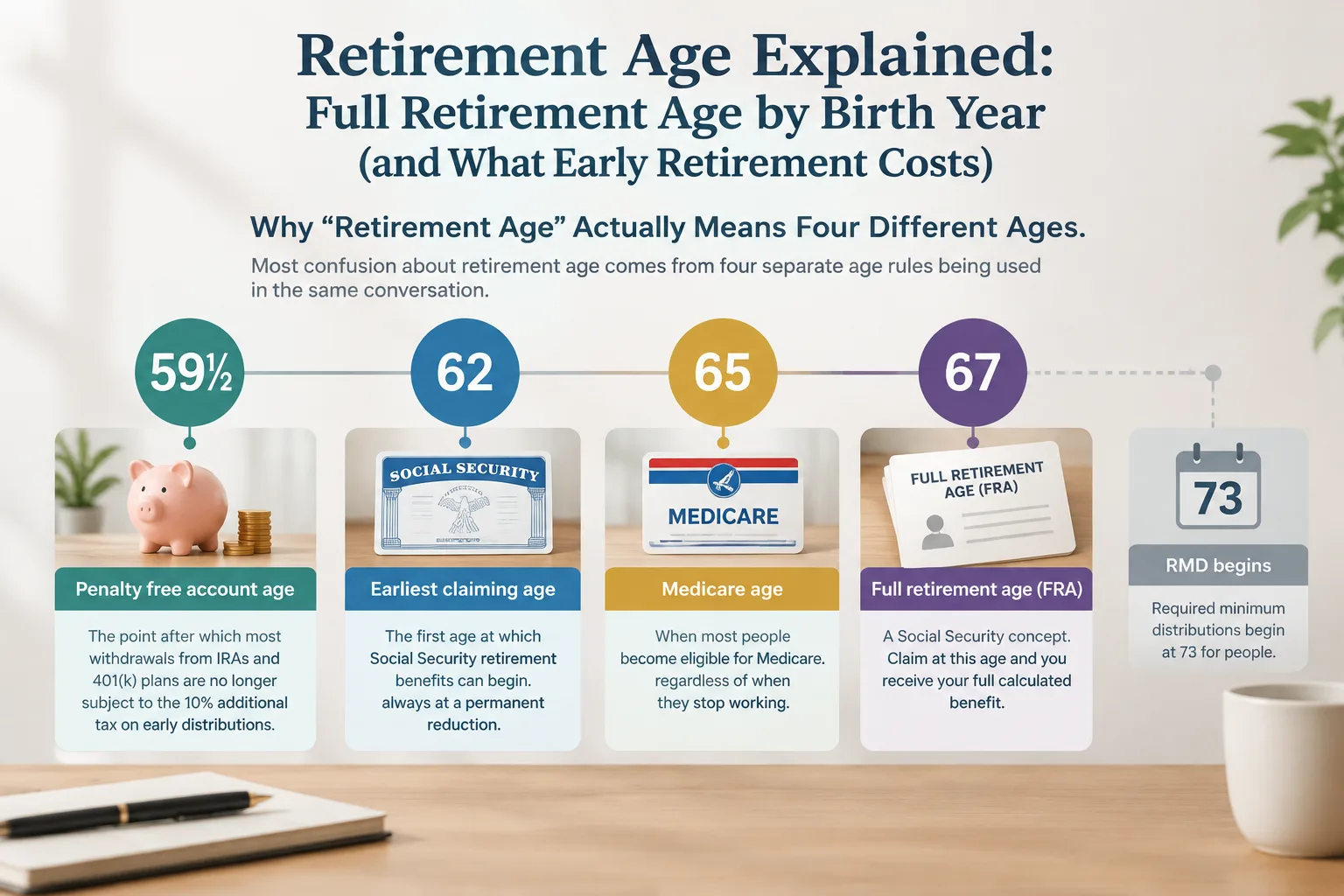
Why "Retirement Age" Actually Means Four Different Ages
Most confusion about retirement age comes from four separate age rules being used in the same conversation.
Full retirement age (FRA) — a Social Security concept. Claim at this age and you receive your full calculated benefit.
Earliest claiming age (62) — the first age at which Social Security retirement benefits can begin, always at a permanent reduction.
Medicare age (65) — when most people become eligible for Medicare, regardless of when they stop working.
Penalty-free account age (59½) — the point after which most withdrawals from IRAs and 401(k) plans are no longer subject to the 10% additional tax on early distributions. Separately, required minimum distributions begin at 73 for people who reach that age after 2022, rising to 75 in 2033.
None of these is a legal deadline to stop working. They are eligibility thresholds with different rules attached.
Full Retirement Age by Birth Year
The Social Security Administration publishes FRA as a schedule tied to birth year. The table below summarizes it.
| Birth year | Full retirement age |
|---|---|
| 1943–1954 | 66 |
| 1955 | 66 and 2 months |
| 1956 | 66 and 4 months |
| 1957 | 66 and 6 months |
| 1958 | 66 and 8 months |
| 1959 | 66 and 10 months |
| 1960 or later | 67 |
Two practical consequences follow from this table:
- If you were born in 1960 or later, your full retirement age is 67 — not 65, and not 66.
- Anyone born between 1955 and 1959 has an FRA that includes months, so the exact month you claim matters to the dollar.
Always confirm your personal FRA against your own Social Security statement, because your record reflects your own earnings history.
The Formula for Early Claiming Reductions
Claiming before FRA reduces your benefit by a fixed, permanent percentage. The reduction is not linear: the first 36 months are reduced faster than any additional months.
For a claim months before full retirement age:
Where is your benefit at full retirement age, is the total reduction, and is the number of months you claim early.
Worked example. Suppose your FRA is 67 and your benefit at 67 is USD 2,000 per month. You claim at 62, which is months early.
So the monthly benefit becomes USD 1,400 — a permanent reduction of USD 600 per month.
The same formula produces the standard outcome table for someone whose FRA is 67:
| Claim age | Months early | Reduction | Benefit on a USD 2,000 FRA benefit |
|---|---|---|---|
| 62 | 60 | 30.00% | 1,400 |
| 63 | 48 | 25.00% | 1,500 |
| 64 | 36 | 20.00% | 1,600 |
| 65 | 24 | 13.33% | 1,733 |
| 66 | 12 | 6.67% | 1,867 |
| 67 | 0 | 0% | 2,000 |
Cost-of-living adjustments apply to the reduced amount, so a 30% reduction stays roughly a 30% gap over time rather than a fixed 30% dollar gap.
Delayed Retirement Credits: Claiming After Full Retirement Age
Waiting past FRA increases your benefit through delayed retirement credits of per month, which equals 8% per year. The credits stop at age 70.
Where is the number of full years you delay past FRA, capped at three years for someone with an FRA of 67.
Worked example. Same USD 2,000 benefit at 67, claimed at 70:
That is USD 480 more per month than claiming at FRA, and USD 1,080 more per month than claiming at 62. Claiming at 71 or later adds nothing further.
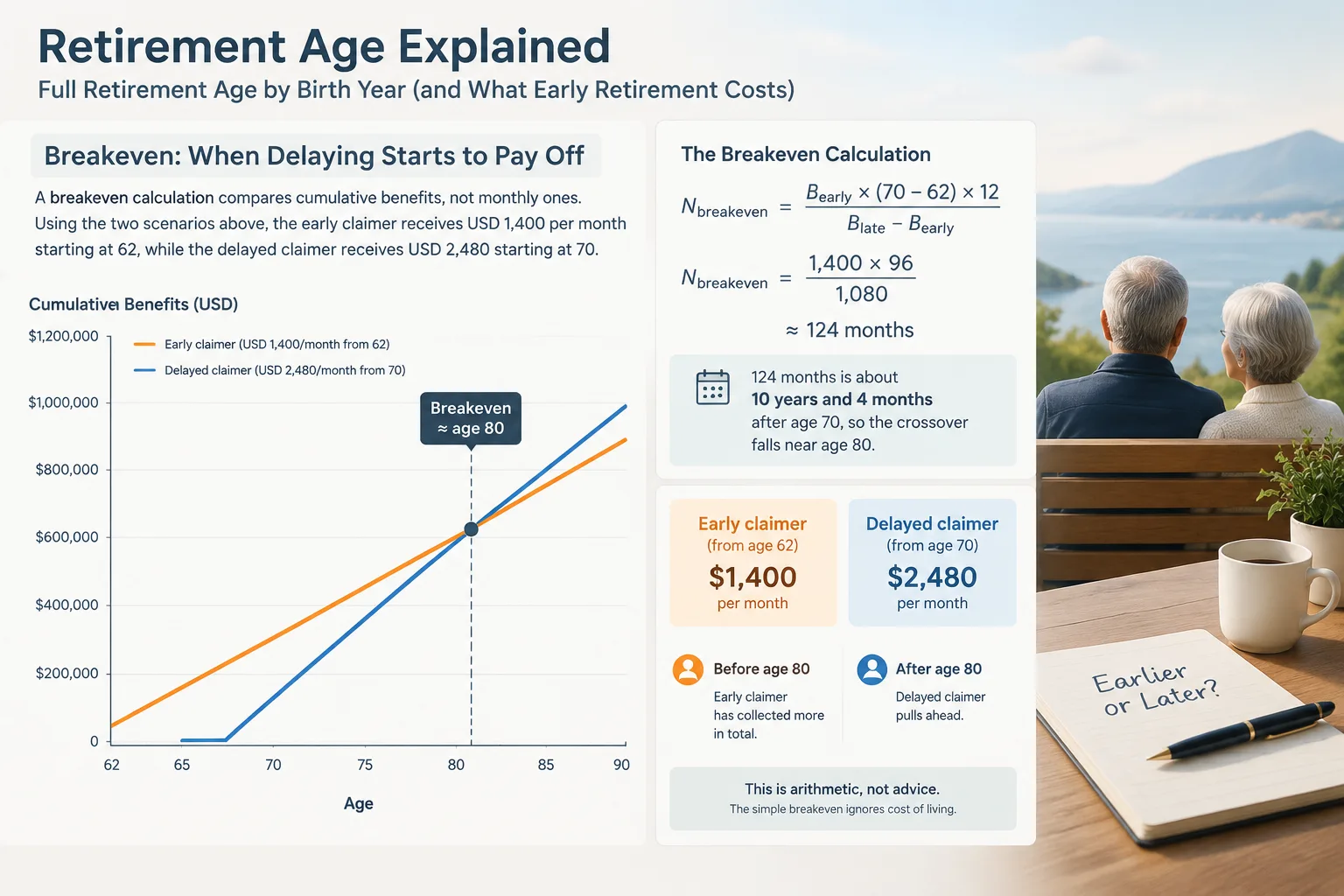
Breakeven: When Delaying Starts to Pay Off
A breakeven calculation compares cumulative benefits, not monthly ones. Using the two scenarios above, the early claimer receives USD 1,400 per month starting at 62, while the delayed claimer receives USD 2,480 starting at 70.
124 months is about 10 years and 4 months after age 70, so the crossover falls near age 80. Before that point, the early claimer has collected more in total; after it, the delayed claimer pulls ahead.
This is arithmetic, not advice. The simple breakeven ignores cost-of-living adjustments, taxes, how the money would otherwise be invested, and survivor benefits — all of which can shift the crossover. You can model those variables directly in the retirement calculator and compare scenarios side by side.
Other Ages That Change the Retirement Math
- 59½ — the point after which the 10% additional tax on early IRA and 401(k) distributions generally no longer applies, subject to plan rules and exceptions.
- 62 — earliest Social Security retirement benefit.
- 65 — Medicare eligibility for most people. Enrolling in Medicare does not require you to claim Social Security.
- FRA (66–67) — full Social Security benefit, with no early reduction.
- 70 — the last age at which delayed retirement credits accrue.
- 73 (rising to 75 in 2033) — required minimum distributions from most tax-deferred retirement accounts.
If you claim before FRA and keep working, the earnings test may temporarily withhold part of your benefit once earnings exceed an annual exempt amount that is adjusted each year. Withheld amounts are generally restored through a higher benefit after FRA, but the short-term cash flow change is real. An age calculator is a simple way to convert a birth date into exact age in months when you are mapping these thresholds onto a calendar.
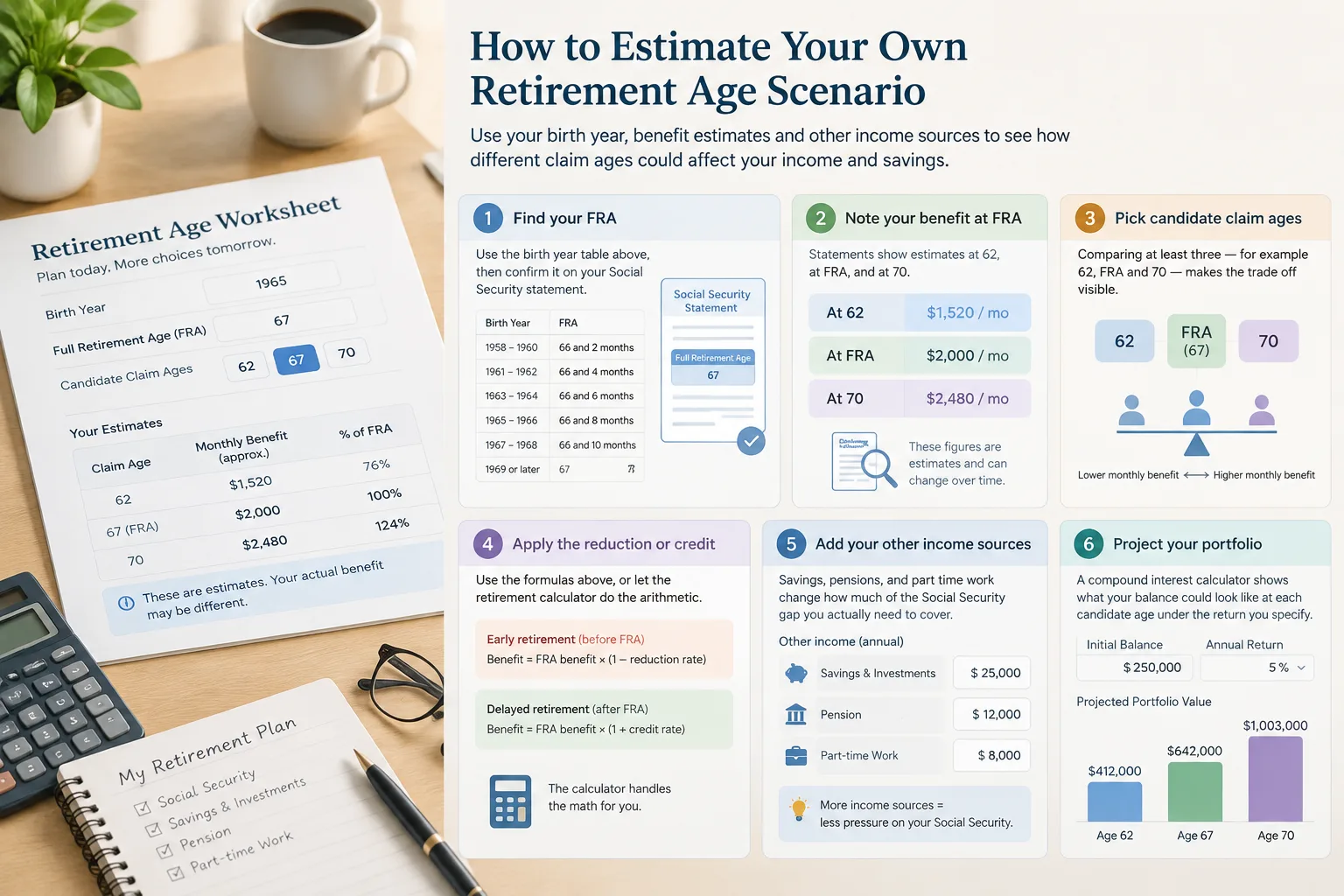
How to Estimate Your Own Retirement Age Scenario
- Find your FRA. Use the birth-year table above, then confirm it on your Social Security statement.
- Note your benefit at FRA. Statements show estimates at 62, at FRA, and at 70.
- Pick candidate claim ages. Comparing at least three — for example 62, FRA, and 70 — makes the trade-off visible.
- Apply the reduction or credit. Use the formulas above, or let the retirement calculator do the arithmetic.
- Add your other income sources. Savings, pensions, and part-time work change how much of the Social Security gap you actually need to cover.
- Project your portfolio. A compound interest calculator shows what your balance could look like at each candidate age under the return you specify.
- Stress-test the plan. Run a lower-return and a higher-spending scenario. If the plan holds in both, it is more robust.
- Check long-horizon milestones. If your existing balance could grow to your target without further contributions, the Coast FIRE calculator shows the gap between your current age and that point.
Common Mistakes and Where the Limits Are
Assuming 65 is the full retirement age. That applied to people born in 1937 or earlier. For anyone born in 1960 or later, it is 67.
Treating the early reduction as temporary. It applies to your base benefit permanently, and cost-of-living adjustments are calculated on the reduced amount.
Ignoring survivor benefits. For married couples, the higher earner's claiming decision affects the survivor benefit for the surviving spouse. Delaying can protect the survivor; claiming early reduces that protection. This is a household decision, not an individual one.
Forgetting taxes. Depending on combined income, up to 85% of Social Security benefits may be subject to federal income tax. State treatment varies.
Confusing an estimate with a plan. Calculator output is a projection based on the inputs you supply. It cannot account for future legislative changes, health events, or actual market returns.
Claiming without checking the earnings test. If you claim before FRA and continue working, benefits may be temporarily withheld once earnings exceed the annually adjusted exempt amount.
This article is educational. It explains how the rules work and how the arithmetic behaves; it does not recommend a claiming age for any individual. For decisions about your own record, the Social Security Administration and a qualified financial professional are the right sources.
FAQ
What is the full retirement age if I was born in 1965?
- Anyone born in 1960 or later has a full retirement age of 67 under the current schedule. People born from 1955 through 1959 have full retirement ages between 66 and 2 months and 66 and 10 months.
Can I claim Social Security at 62?
Yes. Age 62 is the earliest age at which retirement benefits can begin. Claiming then means a permanent reduction — 30% at 62 if your full retirement age is 67, based on the standard reduction formula.
How much is the early retirement age penalty?
The reduction is 5/9 of 1% per month for the first 36 months before full retirement age, plus 5/12 of 1% for each additional month. Claiming at 62 with an FRA of 67 means 60 months early and a 30% reduction.
Does my retirement age change if I keep working?
Your full retirement age does not change — it is set by birth year. However, if you claim before FRA and keep working, the earnings test may temporarily withhold benefits once your earnings exceed the annually adjusted exempt amount.
Is 65 still the retirement age?
Not for Social Security. Age 65 is the Medicare eligibility age for most people. For Social Security, full retirement age is 66 or 67 depending on birth year.
What happens if I claim after 70?
Nothing extra. Delayed retirement credits stop accruing at age 70, so claiming at 71 produces the same monthly amount as claiming at 70.
Check Your Own Numbers
Run your birth year, planned claim age, current savings, and expected spending through the retirement calculator to see how each choice changes your monthly income. To compare the accumulation side alongside it, the compound interest calculator and the Roth IRA calculator cover account-level growth. Once you can see that monthly number, the SWP calculator shows how withdrawals of that size hold up if you start early, and comparing two claiming ages in today's dollars is exactly what the present value calculator is for.
Looking for more tools?
Try our free Free Calculators