scientific calculator vs graphing calculator
Scientific Calculator vs Graphing Calculator: Which One Do You Actually Need
Learn the difference between scientific and graphing calculators, compare features, formulas, examples, and find out which calculator fits algebra, science, and high school math needs.
A scientific calculator vs graphing calculator comparison helps students, teachers, and anyone working with advanced math choose the right tool. A scientific calculator handles functions such as trigonometry, logarithms, exponents, and scientific notation. A graphing calculator adds visual features, equation plotting, tables, and more advanced exploration. This guide explains what each calculator does, how the calculations work, and who may benefit from each option.
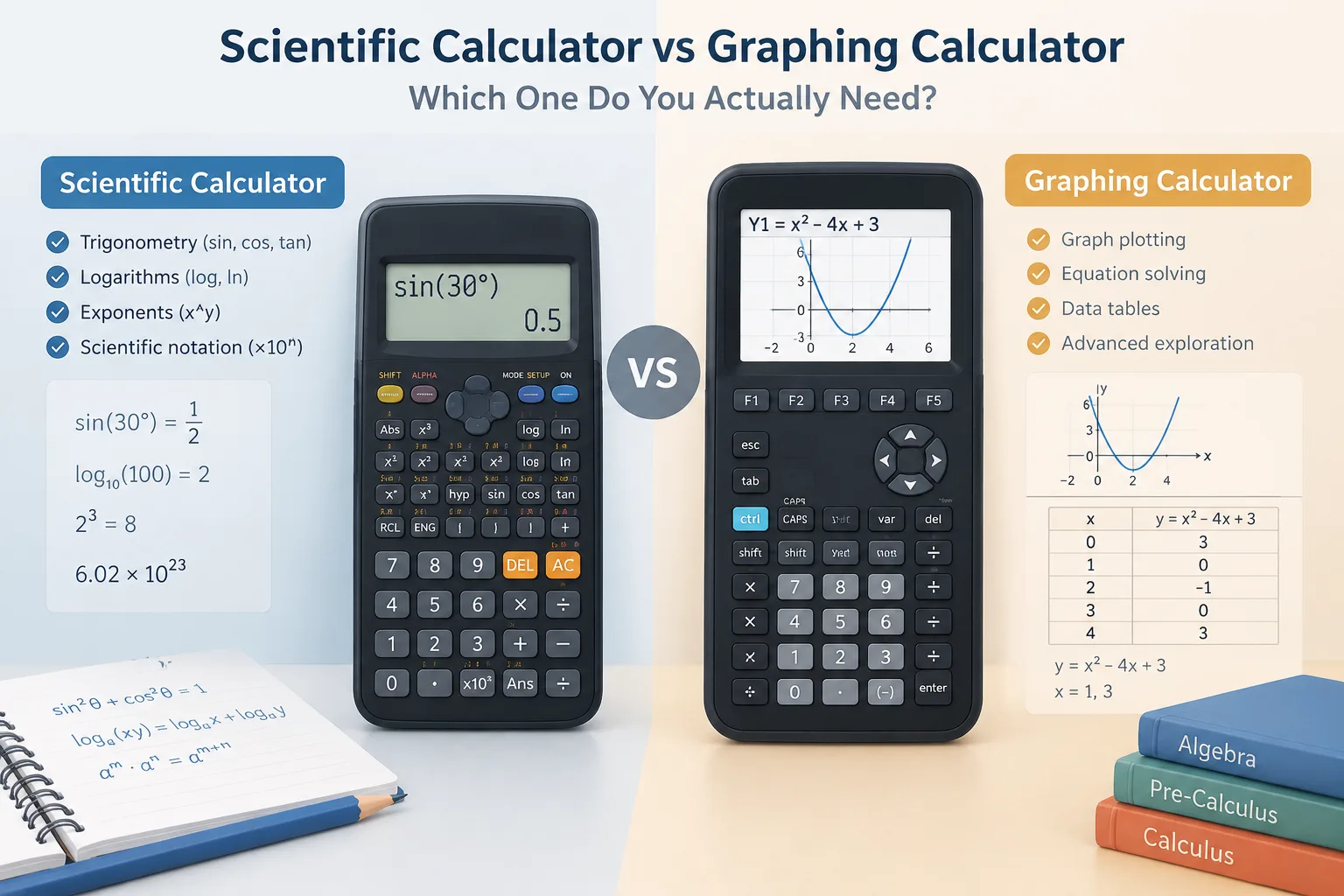
What Is the Difference Between Scientific and Graphing Calculator Tools?
The main difference between scientific and graphing calculator devices is the amount of mathematical visualization and problem exploration they support. Both calculators can perform many common calculations, but they are designed for different levels of interaction.
A scientific calculator is focused on numerical calculations. It can solve expressions involving powers, roots, trigonometric functions, logarithms, fractions, and scientific notation. Many students use scientific calculators for algebra, geometry, chemistry, physics, and statistics classes.
A graphing calculator includes many scientific calculator functions but adds a screen and software features for displaying mathematical relationships. Users can graph equations, compare functions, create tables of values, and study how variables affect results.
For example, solving (y = 2x + 3) on a scientific calculator usually means calculating individual values. A graphing calculator can display the complete line and show how the equation changes across a range of values.
If you need quick calculations, a scientific calculator may be enough. If you need visual analysis or repeated equation exploration, a graphing calculator may provide additional tools.
Scientific Calculator Features and Common Uses
A scientific calculator is designed for efficient calculation rather than visual learning. Typical features include:
- Trigonometric functions such as sine, cosine, and tangent
- Logarithms and exponential calculations
- Fractions and mixed numbers
- Powers and roots
- Scientific notation operations
- Parentheses and order-of-operation support
For example, a scientific calculator can evaluate:
This type of calculation is useful when working through formulas in math and science.
Scientific calculators are commonly used for:
- Algebra assignments
- Chemistry calculations
- Physics formulas
- Geometry problems
- Engineering basics
Calculator Lists also provides online math tools for users who need browser-based calculations, including the scientific calculator and other practical math resources.
A scientific calculator may be the better choice when the goal is calculating answers quickly and accurately without needing graphs or interactive displays.
Graphing Calculator Features and When They Help
A graphing calculator is designed for exploring relationships between numbers and equations. In addition to standard scientific functions, it can often display graphs, create data tables, and analyze functions.
Common graphing calculator features include:
- Equation plotting
- Function comparison
- Table generation
- Variable-based exploration
- Advanced algebra support
Consider the quadratic equation:
A scientific calculator can help calculate individual values. For example, when (x = 2):
A graphing calculator can plot the entire parabola and show the curve, intercepts, and overall behavior of the function.
This makes graphing calculators useful for topics such as:
- Functions and transformations
- Quadratic equations
- Data analysis
- Advanced algebra
- Calculus preparation
Students who frequently study how equations behave may find graphing features helpful because they provide a visual connection between formulas and results.
How the Calculations Work: Formula and Example Comparison
Both calculator types rely on mathematical formulas. The difference is mainly how the results are displayed and explored.
For example, calculating the area of a circle uses the formula:
where (A) is area and (r) is radius.
With a radius of 5 units:
A scientific calculator can directly calculate this value using the pi function.
A graphing calculator can also calculate the result and may additionally help students visualize circles, compare equations, or explore how changing (r) affects area.
Another example is solving a linear equation:
Rearranging the equation:
A scientific calculator supports the arithmetic steps. A graphing calculator can also show the related line and intersection point when the equation is represented graphically.
The correct choice depends on whether you need numerical answers only or additional visual analysis.
Which Calculator for High School: Choosing Based on Your Needs
Many students ask, "Do I need a graphing calculator?" The answer depends on course requirements, learning goals, and the type of problems being solved.
A scientific calculator may be suitable if you mainly need to:
- Evaluate formulas
- Check arithmetic
- Work with trigonometry
- Calculate scientific values
- Complete standard algebra exercises
A graphing calculator may be useful if you need to:
- Study functions visually
- Compare multiple equations
- Analyze graphs
- Explore algebra concepts interactively
Before choosing a calculator, check your class requirements because some courses or exams specify allowed calculator types.
For students practicing mathematical concepts online, Calculator Lists offers tools such as the percentage calculator and resources related to significant figures rules.
Step-by-Step Guide: How to Decide Between the Two
Step 1: Identify the Math Topics You Use
List the subjects where you need a calculator. Basic algebra and science calculations often require fewer features than advanced function analysis.
Step 2: Check Required Functions
Look for the functions you actually need. If you only need logarithms, roots, powers, and trigonometry, a scientific calculator may cover those needs.
Step 3: Decide Whether You Need Graphs
Ask whether seeing a graph helps you understand the problem. If you regularly study curves, functions, or data trends, graphing features may be valuable.
Step 4: Compare Learning and Testing Requirements
Some schools, teachers, or exams have specific calculator rules. Confirm requirements before buying or relying on a calculator.
Step 5: Practice With Online Calculator Tools
Online calculators can help you understand formulas and verify calculations. Try the free online scientific calculator to explore common functions before selecting a device.
Common Mistakes and Limitations
A common mistake is assuming that a more advanced calculator automatically improves math understanding. A calculator can process numbers, but it does not replace learning formulas, interpreting results, or checking whether an answer makes sense.
Another mistake is choosing based only on the number of features. Extra functions may not be useful if they are never needed.
Important limitations include:
- Calculator results depend on correct inputs.
- Different models may have different interfaces.
- Some exams restrict calculator features.
- Graphs still require users to understand equations and scales.
Both scientific and graphing calculators are tools that support mathematical work. They do not remove the need to understand concepts and methods.
Scientific Calculator vs Graphing Calculator FAQ
What is the difference between scientific and graphing calculator?
The difference between scientific and graphing calculator tools is that scientific calculators focus on numerical calculations, while graphing calculators add features for displaying equations, graphs, and tables. Both can handle many advanced math operations, but graphing calculators provide more visual exploration.
Do I need a graphing calculator for algebra?
Whether you need a graphing calculator for algebra depends on your course requirements and the type of algebra problems you study. Basic algebra calculations can often be completed with a scientific calculator, while graphing calculators may help with functions and visual analysis.
Is a scientific vs graphing calc for algebra comparison important for students?
Yes. A scientific vs graphing calc for algebra comparison helps students understand which features match their assignments. Students working mainly with expressions may need fewer features than students studying graphs and functions.
Which calculator for high school should I choose?
Which calculator for high school depends on your classes, teacher requirements, and the topics you study. Review your course expectations and choose a tool that supports the calculations you regularly perform.
Can an online scientific calculator replace a graphing calculator?
An online scientific calculator can handle many numerical tasks, but it may not provide the same graphing experience as a dedicated graphing calculator. It is useful for practicing calculations and checking results.
What calculator should I use for science classes?
Many science classes use calculations involving formulas, units, powers, and scientific notation. A scientific calculator may support these tasks, while advanced courses may use additional graphing features depending on requirements.
Final Thoughts
The scientific calculator vs graphing calculator choice depends on what you need to accomplish. Scientific calculators are designed for efficient numerical work, while graphing calculators add tools for visualizing and exploring mathematical relationships. Understanding the difference between scientific and graphing calculator features can help you choose a practical tool for your learning goals.
Use Calculator Lists math tools to practice calculations, explore formulas, and understand how different mathematical operations work.
Looking for more tools?
Try our free Free Calculators