coast fire
What Is Coast FIRE? The Concept, the Math, and Who It Fits
Coast FIRE is a retirement strategy where you invest heavily early, then stop adding new retirement contributions once your existing portfolio is on track to grow into your full retirement target on its own. You keep working and covering your living costs — you simply stop saving for the future. This article explains the concept, works through the Coast FIRE number math with real figures, and describes who it tends to suit.
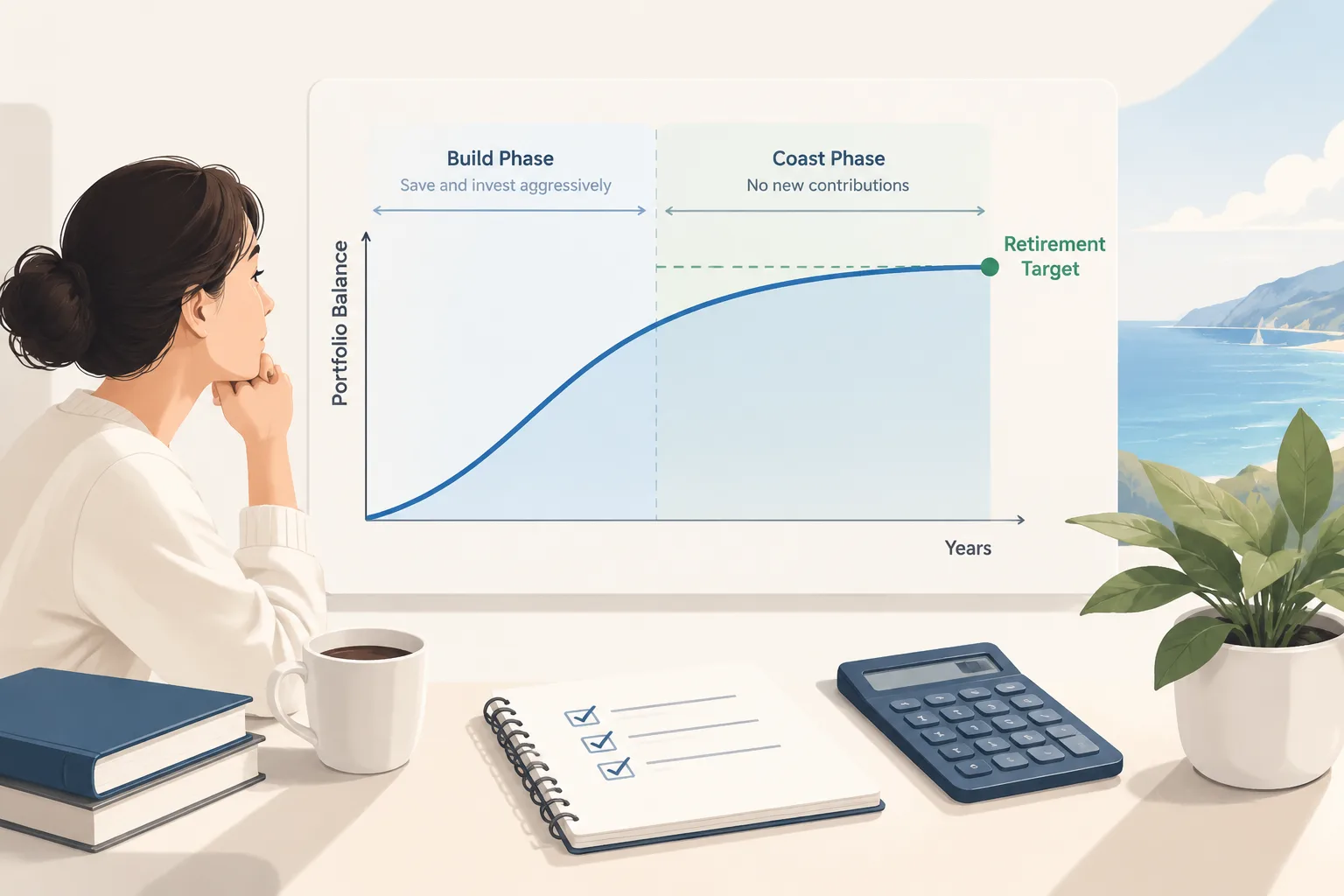
The core idea behind Coast FIRE
The name describes the second half of the plan. In the first phase you push hard: high savings rate, consistent contributions, time in the market. In the second phase you coast — no new retirement contributions, while the existing balance keeps compounding. At your target retirement age, the portfolio is expected to have reached the amount you need.
Two landmarks matter:
- Your FI number — the portfolio size that could support your retirement spending. Under a 4% withdrawal convention, that is 25 times annual spending.
- Your Coast FIRE number — the smaller balance you need today for that future FI number to appear later without further contributions.
The gap between the two is filled by compounding, not by you. That is why the idea is so sensitive to age: the more years between now and retirement, the more time does the heavy lifting, and the smaller the balance you need to reach today. Coast FIRE explained this way is really just a discounted present-value target with a savings behaviour attached to it.
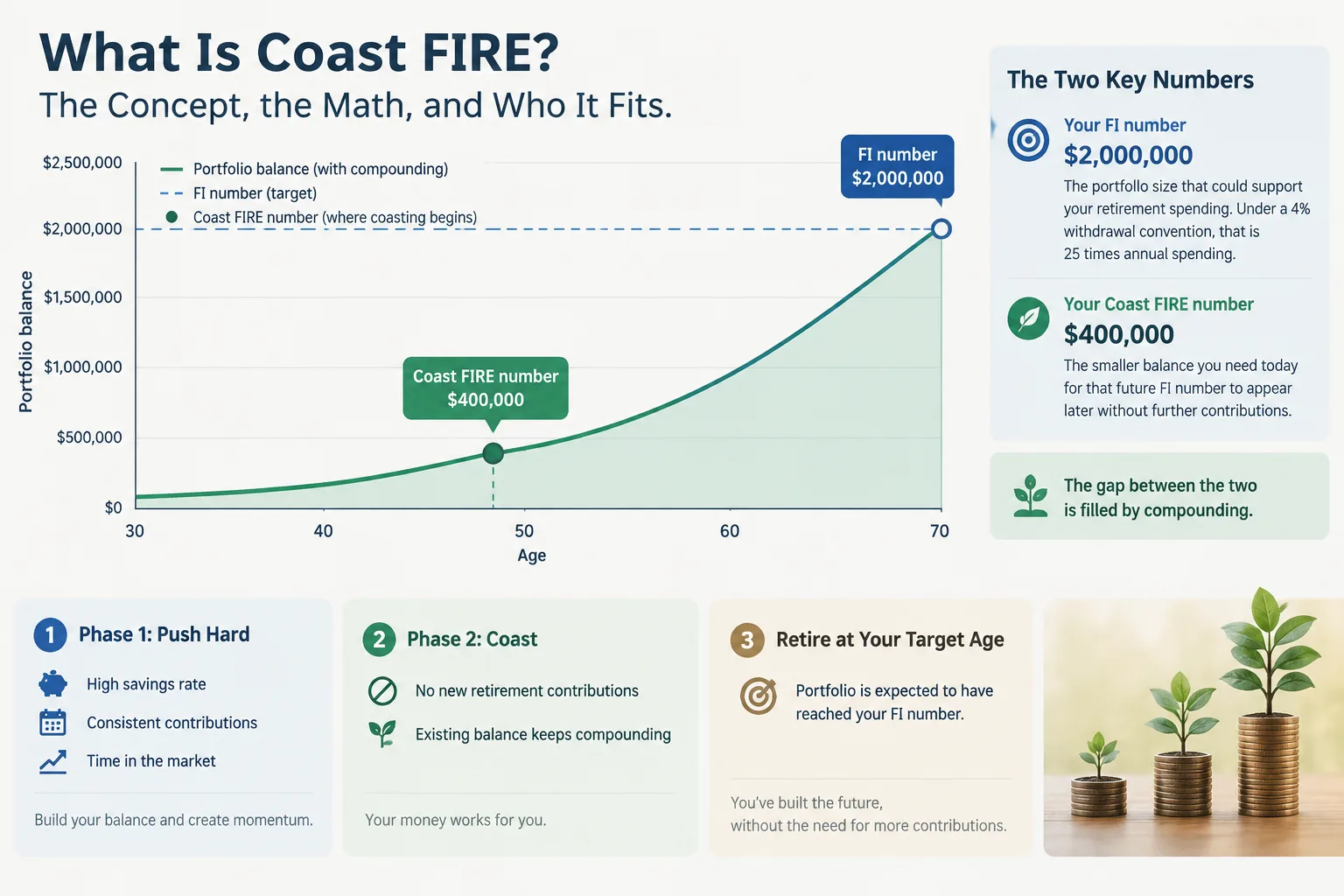
One framing note: this is a planning heuristic, not a guarantee. It depends on return and withdrawal assumptions that you choose, and markets do not deliver smooth average returns. Treat the output as a number to reason with, not a promise.
The Coast FIRE formula
Two equations do all the work. First, the FI number:
Then the Coast FIRE number, which discounts that future target back to today:
where is your FI number, is the expected annual real return (after inflation), and is the number of years until your target retirement age. Working in real returns keeps everything in today's purchasing power, so inflation does not have to be modelled twice.
Coast FIRE number: a worked example
Assume annual retirement spending of $40,000, a 4% withdrawal rate, a 5% real return, and 35 years to retirement (age 30 to age 65).
Step 1 — the FI number:
Step 2 — the growth factor over 35 years:
Step 3 — the Coast FIRE number:
So roughly $181,000 invested today would be expected to grow to about $1,000,000 in today's dollars by age 65 with no further contributions, at a 5% real return.
The same example with different assumptions
Change one input and the answer moves a lot. Keeping the same $1,000,000 target:
| Real return | Years to retirement | Growth factor | Coast FIRE number |
|---|---|---|---|
| 5% | 35 (starting at 30) | ≈ 5.52 | ≈ $181,000 |
| 4% | 35 (starting at 30) | ≈ 3.95 | ≈ $253,000 |
| 5% | 25 (starting at 40) | ≈ 3.39 | ≈ $295,000 |
The lesson: starting ten years later raises the required balance by more than half in this example, and lowering the return assumption by one percentage point raises it by roughly 40%. Both inputs are assumptions you choose, not facts the market hands you.
How to calculate your own Coast FIRE number
- Estimate annual retirement spending in today's dollars. Start from current spending, then adjust for costs that disappear and costs that appear later.
- Choose a withdrawal rate. 4% is a common planning convention; more conservative planners use 3.5% or lower. Write down why you chose yours.
- Divide to get the FI number. Spending divided by withdrawal rate.
- Set a target retirement age. This gives you , the years remaining.
- Pick a real return assumption. Many planners use something in the 4–6% range for a diversified portfolio after inflation, but this is an assumption worth stress-testing.
- Discount the FI number. Divide by .
- Compare with your current invested balance. The difference is your remaining gap. A compound interest calculator shows how monthly contributions would close it.
Once you have a number, a retirement calculator helps you check whether the resulting portfolio could plausibly support the spending you projected. Our Coast FIRE calculator runs both steps in one place and lets you change the assumptions and see the effect immediately.
Coast FIRE vs regular FIRE
Regular FIRE targets the full FI number as quickly as possible and then generally ends paid work. Coast FIRE reaches a smaller number earlier and keeps working.
| Regular FIRE | Coast FIRE | |
|---|---|---|
| Portfolio target | Full FI number | FI number divided by the growth factor |
| Contributions | Continue until the FI number is reached | Stop once the coast number is reached |
| Work after the milestone | Optional | Needed to cover living costs |
| Main driver | Savings rate | Time in the market |
| Nature of the milestone | Portfolio covers spending | Contributions can stop |
| Key risk | Sequence of returns near retirement | A long, unchecked growth period with no new money added |
Both routes aim at the same finish line. The difference is who does the funding — you, or the compounding of what you already invested.
Coast FIRE savings rate: front-loaded, then zero
Coast FIRE savings rate is unusual because it is high at the start and drops to zero later. Take the same person, starting from zero and wanting to reach about $181,000 in eight years at a 5% real return with monthly contributions:
where is the monthly real return (0.05 divided by 12) and is the number of months (96). Plugging in gives about $1,540 per month — roughly 31% of a $60,000 income.
That is the trade-off: a hard squeeze now in exchange for no retirement contributions later. Shorter accumulation windows push the required monthly amount up quickly, which is why reaching the coast point is far easier at 25 than at 45. If you want to model the target from the other direction, our guide to working out your coast FIRE number walks through the same inputs in more detail.
Who Coast FIRE fits — and where the math is fragile
The approach tends to appeal to people who like their work but dislike the pressure of saving indefinitely, or who want to move to a lower-paying role, go part-time, or take a career risk. It fits best when you have decades of compounding ahead and a stable enough income to save aggressively for a while.
The fragile parts are worth naming:
- Smooth returns are fiction. A single average return hides good years, bad years, and long flat stretches. A poor decade early in the coast period matters more than the average suggests.
- You cannot easily top up. Once contributions stop, recovering from a shortfall usually means resuming saving, which is what the plan was meant to avoid.
- The withdrawal rate is a choice. A lower rate raises the FI number, and the coast number rises with it.
- Account access rules matter. Age-based rules on retirement accounts can mean the money is not reachable when you want it, so the years before access may need taxable savings or other assets.
- Fees and life changes. Subtract fund fees from your return assumption, and remember that health costs, family changes, or a long career gap can invalidate the spending figure the whole calculation rests on.
It is not a licence to stop earning. The coast is about contributions, not employment. If your income changes, a check on how long money lasts helps confirm the new income still covers your costs, and if housing is your largest expense, the rent vs buy calculator shows how that decision changes the monthly picture.
FAQ
What is Coast FIRE in simple terms?
Coast FIRE means investing enough early that your existing portfolio, left alone, is projected to grow into your full retirement target by your chosen retirement age. After that point you stop saving for retirement but keep working to cover current expenses.
How do I calculate my Coast FIRE number?
Divide annual retirement spending by your withdrawal rate to get the FI number, then divide that by , where is the real return and is the years to retirement. The Coast FIRE calculator runs both steps and lets you test different assumptions side by side.
What savings rate do I need to reach Coast FIRE?
There is no single rate. It depends on your age, income, spending target, and return assumption. The pattern is front-loading: a high savings rate for a limited number of years, followed by a long stretch at zero retirement contributions.
Is Coast FIRE the same as regular FIRE?
No. Regular FIRE targets the full FI number and usually ends paid work. Coast FIRE targets a smaller balance earlier and then relies on compounding while you keep working. The finish line is the same size; the timing and the contributing pattern differ.
What happens if the market underperforms while I coast?
The target may be missed. With no new money going in, the portfolio has to recover on its own, so you may need to resume contributions, delay retirement, or reduce planned spending. Test lower return assumptions before committing to the plan.
Run your own numbers
Coast FIRE is easiest to judge once you see your own figures rather than someone else's example. Change the spending level, the withdrawal rate, the return assumption, and the years to retirement in the Coast FIRE calculator and watch the target move. It is free, it runs in your browser, and every formula behind it is shown on the page so you can check the arithmetic yourself.
Looking for more tools?
Try our free Free Calculators