Math
Lbs to Kilos: The Formula, a Conversion Chart and Mental Math Tricks
Convert pounds to kilograms with the exact formula, a quick conversion chart, and mental math tricks that get you close without a calculator.
Lbs to kilos conversion is a single multiplication: take the weight in pounds and multiply it by 0.45359237 to get kilograms. This guide gives you the exact formula, worked examples, a pounds to kilograms chart covering 1 lb to 300 lb, and mental-math shortcuts you can run in your head. It is written for anyone converting body weight, gym loads, luggage limits, or shipping labels — and for anyone who wants to verify a converter's answer instead of trusting it.
What a Pound and a Kilogram Actually Measure
Both the pound and the kilogram measure mass. The kilogram is the SI base unit of mass; the international avoirdupois pound, written lb, is the mass unit used in US customary and imperial measurements. Since the 1959 international yard and pound agreement, the pound is defined through the kilogram: one pound is exactly 0.45359237 kilograms. That makes the conversion a fixed multiplication rather than an approximation, even though the constant looks untidy.
One thing worth separating early: lb as a mass unit is not the same as lbf, the pound-force used in engineering. The conversion factor in this article applies to mass. If a specification is written in lbf, you are looking at a force figure and a different calculation entirely.
The Lbs to Kg Formula
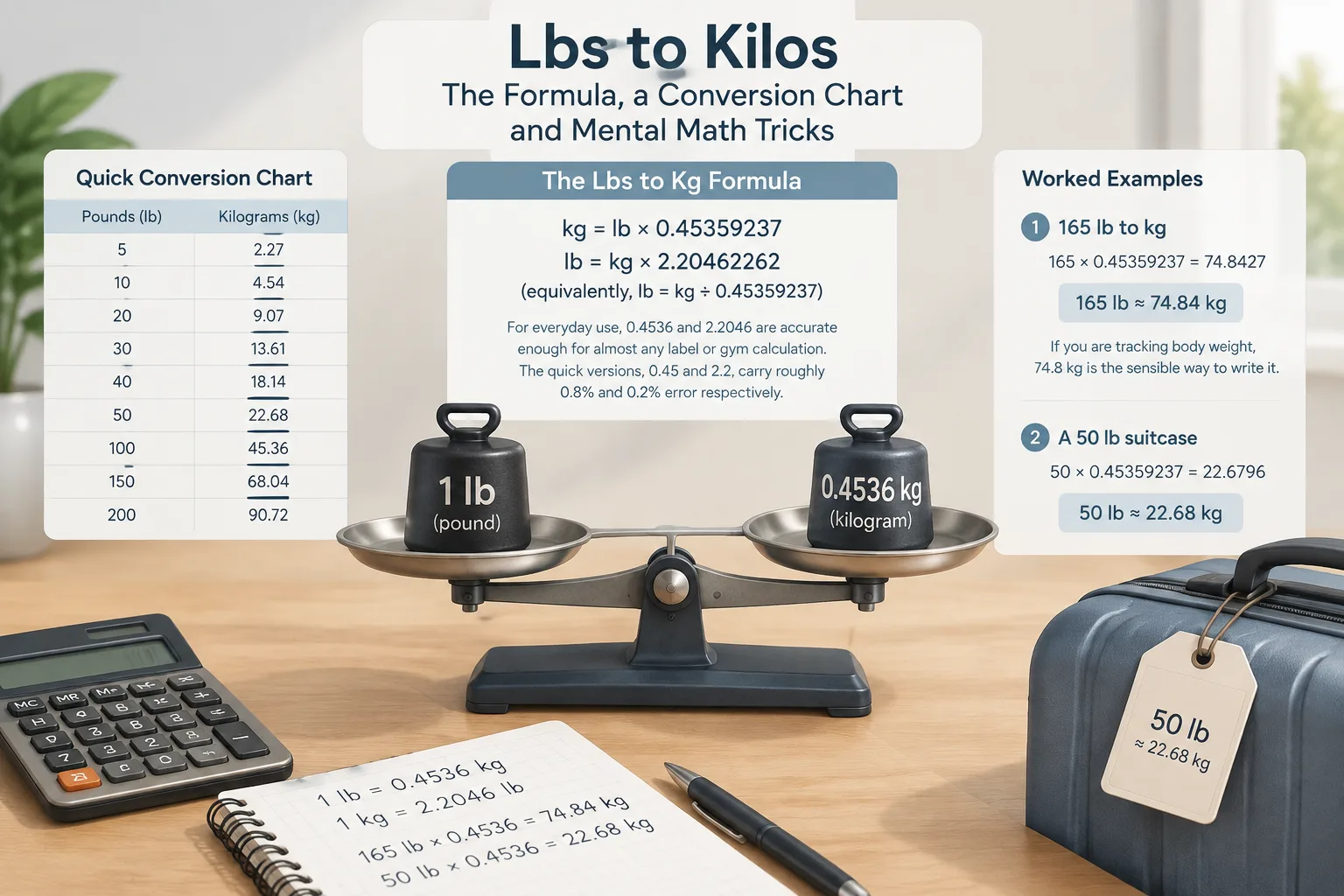
The forward conversion is:
The reverse conversion, kilograms to pounds, is:
Equivalently, . For everyday use, 0.4536 and 2.2046 are accurate enough for almost any label or gym calculation. The quick versions, 0.45 and 2.2, carry roughly 0.8% and 0.2% error respectively.
Worked example: 165 lb to kg
Multiply the pound value by the exact factor:
So 165 lb converts to about 74.84 kg. If you are tracking body weight, 74.8 kg is the sensible way to write it.
Worked example: a 50 lb suitcase
A 50 lb bag is roughly 22.68 kg, which sits just under a common 23 kg checked-baggage allowance. Notice how close that is: the gap between 22.68 kg and 23.00 kg is only about 0.7 lb, so a reading near the limit is genuinely near the limit.
Worked example: working backwards from 80 kg
80 kg is about 176.4 lb. If you only remember the halving trick, work it from the other side: 80 doubled is 160, then add 10% for 176.
Pounds to Kilograms Conversion Chart
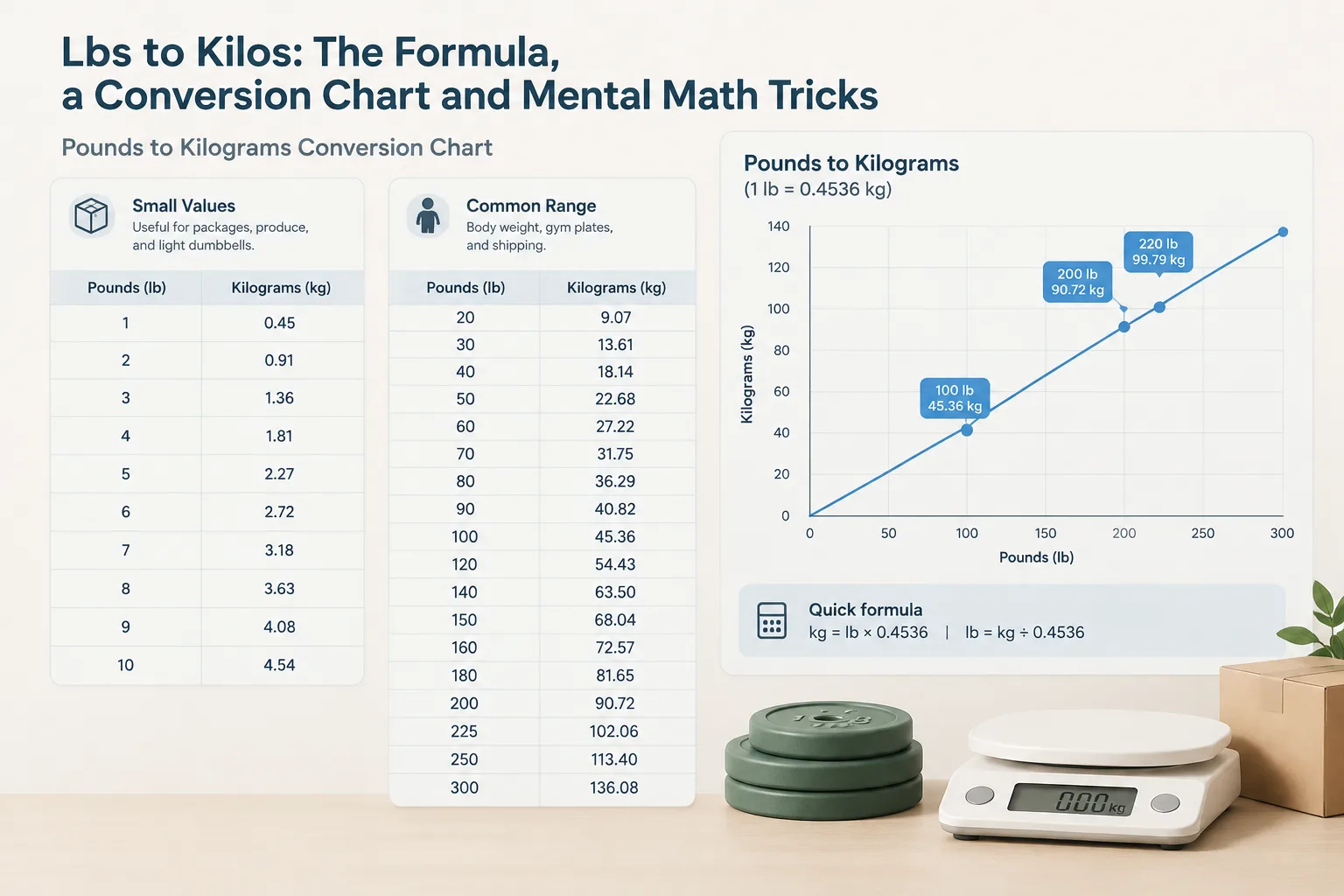
The first table covers small values, useful for packages, produce, and light dumbbells. Results are rounded to two decimals.
| Pounds (lb) | Kilograms (kg) |
|---|---|
| 1 | 0.45 |
| 2 | 0.91 |
| 3 | 1.36 |
| 4 | 1.81 |
| 5 | 2.27 |
| 6 | 2.72 |
| 7 | 3.18 |
| 8 | 3.63 |
| 9 | 4.08 |
| 10 | 4.54 |
The second table covers the range most people actually search for: body weight, gym plates, and shipping.
| Pounds (lb) | Kilograms (kg) |
|---|---|
| 20 | 9.07 |
| 30 | 13.61 |
| 40 | 18.14 |
| 50 | 22.68 |
| 60 | 27.22 |
| 70 | 31.75 |
| 80 | 36.29 |
| 90 | 40.82 |
| 100 | 45.36 |
| 120 | 54.43 |
| 140 | 63.50 |
| 150 | 68.04 |
| 160 | 72.57 |
| 180 | 81.65 |
| 200 | 90.72 |
| 225 | 102.06 |
| 250 | 113.40 |
| 300 | 136.08 |
How to Convert Lbs to Kg in Your Head
Every mental method below rests on the same fact: 0.45 is only about 0.8% below the true factor of 0.45359237.
Method 1: Halve it, then remove 10%
Take 200 lb. Half is 100; ten percent of 100 is 10; subtract and you get 90 kg. The exact answer is 90.72 kg, so the trick lands within about 1%.
Method 2: Multiply by 0.45 and nudge upward
60 lb gives kg. The exact value is 27.22 kg. For the extra precision, add roughly 1% of the result — about 0.27 — which lands at 27.27, a shade over but close.
Method 3: Memorize anchor points
Anchors beat arithmetic once you use them often:
- 10 lb is about 4.5 kg
- 50 lb is about 22.7 kg
- 100 lb is about 45.4 kg
- 150 lb is about 68 kg
- 200 lb is about 90.7 kg
- 220 lb is about 100 kg
That last pair is the most useful in the list, because 100 kg equals 220.46 lb. If someone gives you a weight in kilos, doubling it and subtracting roughly 10% gets you back to pounds: 90 kg becomes 180, then 198 lb, against an exact 198.4 lb.
Method 4: Going from kg to lb
Double the kilogram figure and add 10%:
For 75 kg: 150, then plus 15 gives 165 lb. The exact answer is 165.35 lb, so the shortcut is essentially exact for practical purposes.
Using the Lbs to Kilos Calculator
If you would rather not carry a factor around, the pounds to kilos converter does the arithmetic and reports the result to a consistent number of decimals.
- Open the converter page.
- Pick the direction you need — pounds to kilograms, or kilograms to pounds.
- Type the weight. Decimals are fine, so 165.5 lb works.
- Read the output. The tool applies the exact 0.45359237 factor rather than the rounded 0.45.
- Round to the precision your situation calls for: one decimal for body weight, two for shipping, more only if a specification demands it.
- Cross-check with a mental method if the number matters. The halving trick should land within about 1%, so a large disagreement usually means a mistyped digit.
Everything runs in the browser, and no sign-up is required.
Rounding, Precision, and Significant Figures
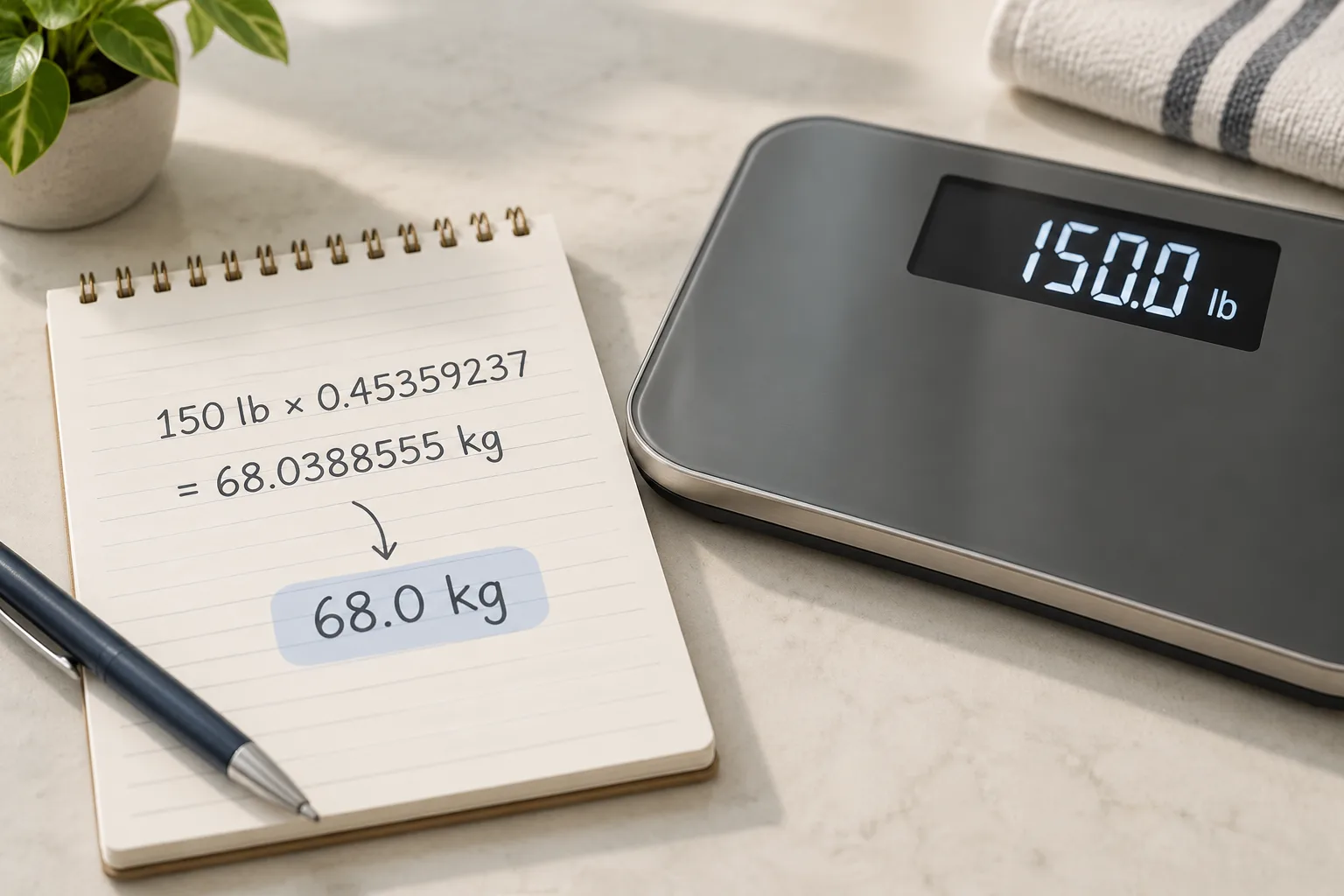
The factor is exact, but your input rarely is. If a scale reads 150 lb, it is already reporting a rounded value, so quoting 68.0388555 kg implies precision that does not exist. A sensible rule is to match output precision to input precision: 150 lb becomes 68.0 kg.
When a measurement genuinely needs disciplined rounding — lab work, engineering specs, multi-step calculations — the rules for counting significant figures and deciding where to round matter more than the conversion itself. We cover that in significant figures rules.
Common Mistakes and Where the Conversion Stops Being Useful
Confusing mass and force. lb is mass; lbf is force. Converting a torque or load figure marked lbf with 0.45359237 produces a meaningless result.
Rounding the factor instead of the answer. Using 0.45 throughout is fine for a rough estimate, but in a chain of calculations the error compounds.
Forgetting stones. British body weight is often written as 11 stone 4. A stone is 14 lb, so convert to pounds first — 11 times 14 plus 4 equals 158 lb — then apply the factor.
Assuming every pound is the same pound. Precious metals are quoted in troy ounces and troy pounds, which differ from avoirdupois units. The 0.45359237 factor applies to the avoirdupois pound.
Treating the result as a health judgment. Converting 180 lb to 81.6 kg tells you the mass, nothing more. Whether that mass sits in a healthy range depends on height and body composition, which is what the BMI calculator and the ideal weight calculator are built for, each with its own stated assumptions and limits.
FAQ
How do I convert lbs to kilos quickly?
Multiply by 0.45359237 for an exact result, or halve the pounds and remove 10% for a fast estimate. For 160 lb: exact is 72.57 kg, the mental method gives 72 kg.
What is the lbs to kg formula?
. In reverse, .
Is 1 kg exactly 2.2 lbs?
No. 1 kg equals 2.20462262 lb. Using 2.2 produces roughly a 0.2% error, which matters in shipping and laboratory work but not in casual body-weight talk.
How many kilos is 150 lbs?
150 times 0.45359237 equals 68.0388555, so 150 lb is about 68.04 kg, or 68.0 kg if you are matching the precision of a typical bathroom scale.
What is the difference between kg and lbs?
Both are units of mass. The kilogram is the SI base unit; the pound is an imperial and US customary unit defined as exactly 0.45359237 kg. The difference is convention and definition, not the physical quantity being measured.
Can I use the same lbs to kilos conversion for body weight and luggage?
Yes. The factor is identical. Only the rounding changes: body weight is usually fine to one decimal place, while airlines and couriers may specify their own rounding rules, so check the carrier's published limits rather than assuming.
If you want a number you can copy straight into a form, use the lbs to kilos calculator — it applies the exact factor and handles the rounding for you.
Looking for more tools?
Try our free Math Calculators