Formulas
Compound Interest Formula: How It Works and How to Calculate Growth
Learn the compound interest formula, see the calculation steps with examples, understand monthly contributions and continuous compounding, and use a calculator to check results.
Compound interest formula is a mathematical method used to calculate how an amount grows when earned interest is added back to the balance and then earns additional interest. It is used by savers, students, and anyone comparing financial scenarios. The basic formula uses the starting amount, interest rate, number of compounding periods, and time. A compound interest formula calculator can help verify results quickly, but understanding the formula makes the calculation transparent.
What Is the Compound Interest Formula?
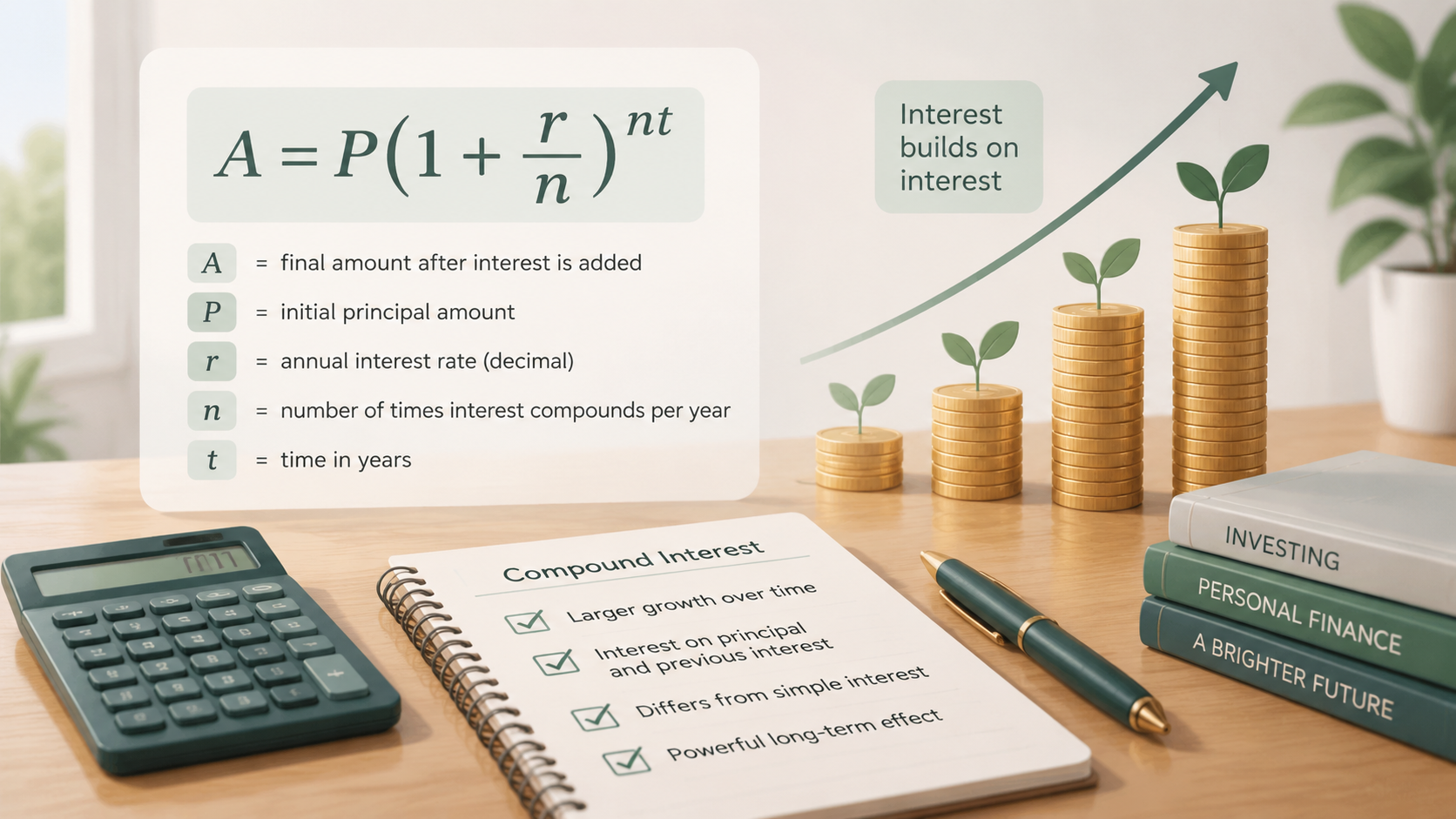
Compound interest means that interest is calculated not only on the original principal but also on previously added interest. This differs from simple interest, where interest is calculated only on the initial amount.
The standard compound interest formula is:
Where:
- (A) = the final amount after interest is added
- (P) = the initial principal amount
- (r) = annual interest rate expressed as a decimal
- (n) = number of times interest compounds per year
- (t) = time in years
For example, an annual interest rate of 5% should be entered as 0.05 in the formula. The result represents the balance before considering factors such as taxes, fees, inflation, or changing rates.
Compound interest is commonly used in savings projections, loan calculations, and financial education. It is a calculation method, not a prediction of future financial results. Actual outcomes can vary depending on account terms, market conditions, fees, and other factors.
Compound Interest Formula Calculation
Basic Formula Example
Suppose you deposit $1,000 with an annual interest rate of 5%, compounded once per year, for 3 years.
Given:
- P = 1,000
- r = 0.05
- n = 1
- t = 3
Using the formula:
The final balance is approximately $1,157.63. The total interest earned is about $157.63.
Compound Interest Formula With Monthly Contributions
Many real savings situations include regular deposits. A separate formula is used when adding equal contributions each month:
Where:
- (PMT) = the regular contribution amount
- Other variables have the same meanings as above
Example assumptions:
- Initial deposit: $1,000
- Monthly contribution: $100
- Annual interest rate: 5%
- Monthly compounding: 12 times per year
- Time: 5 years
The formula calculates the combined value of the starting deposit and the repeated contributions. Because contributions occur over time, each deposit earns interest for a different length of time.
For a faster calculation, use the compound interest calculator and enter the starting balance, rate, time period, and contribution details.
Continuous Compound Interest Formula
When interest compounds continuously, the formula changes to:
Where:
- (e) = Euler’s number, approximately 2.71828
- P = principal
- r = annual interest rate as a decimal
- (t) = time in years
Example:
A $1,000 amount grows at a continuous annual rate of 5% for 3 years.
A = 1,000 × e^(0.05 × 3)
A ≈ 1,161.83
Continuous compounding usually represents a mathematical model. Real financial products may use daily, monthly, quarterly, or other compounding schedules instead.
How to Use a Compound Interest Calculator
A calculator can reduce manual errors and make it easier to compare different scenarios.
Step 1: Enter the Starting Amount
Input the initial amount, also called the principal. This is the money available at the beginning of the calculation period.
Step 2: Add the Interest Rate
Enter the annual interest rate. Convert percentage values into the format required by the calculator.
For example:
- 4% becomes 4 or 0.04 depending on the tool format
- 6.5% becomes 6.5 or 0.065 depending on the tool format
Step 3: Choose the Compounding Frequency
Select how often interest is added:
- Annually
- Semi-annually
- Quarterly
- Monthly
- Daily
- Continuously, when available
More frequent compounding generally changes the mathematical result because interest is added more often.
Step 4: Enter the Time Period and Contributions
Add the number of years and any regular deposits if the calculator supports contributions. Review the final amount and interest earned separately.
Common Mistakes and Limitations
Confusing Simple Interest and Compound Interest
A common mistake is using a simple interest formula for a compound interest problem. Simple interest only applies the rate to the original principal, while compound interest applies it to the accumulated balance.
Using the Wrong Interest Rate Format
A percentage must be converted correctly. Entering 5 instead of 0.05 in a manual formula can create a significantly incorrect result.
Ignoring Fees, Taxes, and Inflation
The formula shows mathematical growth under stated assumptions. It does not automatically include taxes, account fees, purchasing power changes, or changes in interest rates.
Treating Calculations as Guaranteed Outcomes
Compound interest examples are projections based on chosen inputs. They do not guarantee future earnings or represent financial advice. For broader financial planning calculations, tools such as a retirement calculator can help explore different assumptions.
Frequently Asked Questions
What is the compound interest formula?
The compound interest formula is A = P(1 + r/n)^(nt). It calculates the future value of an amount when interest is added to the balance and then earns additional interest.
How do I calculate compound interest with monthly contributions?
Use a formula that includes both the initial principal and recurring payments. Each contribution earns interest based on how long it remains in the account. A compound interest calculator with contribution settings can simplify this process.
What is the difference between simple interest and compound interest?
Simple interest calculates earnings only on the original principal. Compound interest calculates earnings on the principal plus previously added interest.
Does compound interest guarantee investment growth?
No. The formula only calculates a result based on the inputs provided. Actual financial outcomes depend on account terms, rates, fees, taxes, and other conditions.
When should I use a compound interest calculator?
Use one when you want to estimate how different starting amounts, rates, time periods, or contribution schedules affect a potential future balance.
More from the Wiki
Other definitions and formulas from the calculator wiki.
Put the formula to work
Skip the manual math - use the free calculator built on this formula.
Open Calculators