formulas
Mortgage Amortization Formula
Learn the mortgage amortization formula, how monthly payments are calculated, the variables involved, worked examples, and common mistakes. Use a mortgage amortization calculator to check your results.
A mortgage amortization formula is a mathematical method used to calculate the fixed periodic payment required to repay a mortgage loan over a specific term. It shows how much of each payment goes toward interest and how much reduces the loan balance. Home buyers, borrowers, and anyone comparing mortgage scenarios can use this formula or a mortgage calculator to understand estimated payments before making financial decisions.
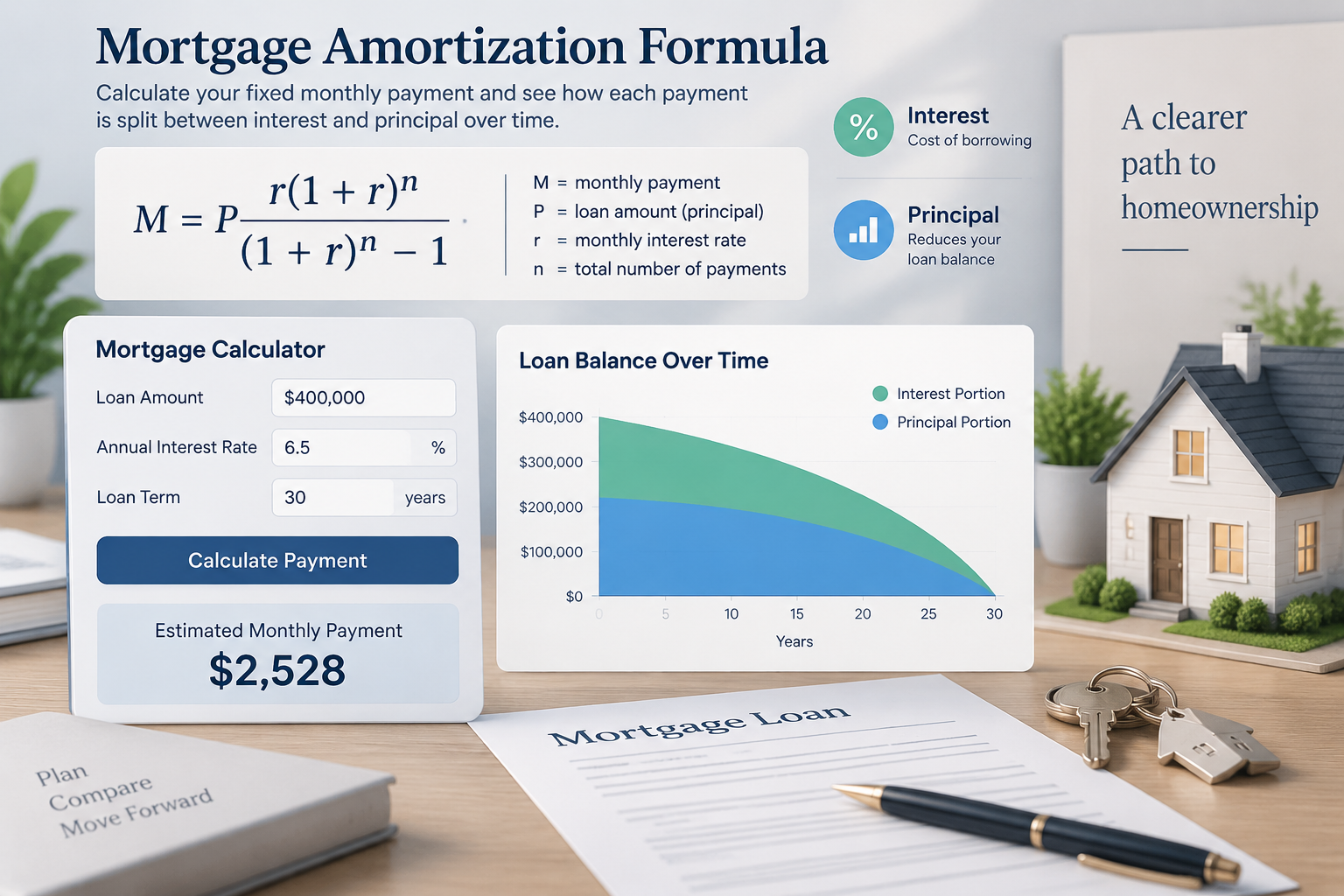
What Is a Mortgage Amortization Formula?
A mortgage amortization formula determines the payment amount needed to fully repay a loan through equal payments over time. Most traditional mortgages use an amortization schedule, meaning each payment contains two parts:
- Interest: the cost of borrowing money, calculated from the remaining loan balance.
- Principal: the portion of the payment that reduces the amount owed.
At the beginning of a mortgage, a larger share of the payment usually goes toward interest because the outstanding balance is higher. As the balance decreases, more of each payment is applied to principal.
The formula is commonly used for fixed-rate mortgages where the interest rate and payment amount remain consistent during the loan term. Adjustable-rate mortgages may require different calculations because the interest rate can change.
Mortgage Amortization Formula Explained
The standard monthly payment formula for an amortizing mortgage is:
M = P × [r(1 + r)^n] / [(1 + r)^n − 1]
Where:
- M = monthly mortgage payment
- P = principal loan amount
- r = monthly interest rate (annual interest rate divided by 12)
- n = total number of monthly payments
The formula calculates the payment required so that the loan balance reaches zero at the end of the repayment period.
How Each Variable Works
Principal (P)
The principal is the original amount borrowed. For example, if someone takes out a $300,000 mortgage, the principal used in the formula is $300,000.
Monthly interest rate (r)
Mortgage rates are usually quoted as annual percentages. To use the formula, convert the annual rate into a monthly decimal rate.
Example:
Annual interest rate = 6%
Monthly interest rate:
6% ÷ 12 = 0.5% per month
Convert the percentage to a decimal:
0.5% = 0.005
Number of payments (n)
The loan term determines the total number of payments.
Example:
30-year mortgage:
30 × 12 = 360 monthly payments
Mortgage Amortization Formula Example
Suppose a borrower has:
- Loan amount: $300,000
- Annual interest rate: 6%
- Loan term: 30 years
First, convert the annual rate:
r = 6% ÷ 12 = 0.005
Next, calculate the number of payments:
n = 30 × 12 = 360
Apply the formula:
M = 300,000 × [0.005(1.005)^360] / [(1.005)^360 − 1]
The estimated monthly principal and interest payment is approximately $1,799.
This example only includes principal and interest. A real mortgage payment may also include other costs such as property taxes, homeowners insurance, mortgage insurance, or fees. These additional expenses are not part of the basic amortization formula.
You can use the amortization calculator to generate a payment breakdown and view how principal and interest change over time.
How to Use the Mortgage Amortization Formula
Step 1: Identify the loan amount
Find the total amount borrowed. This is the principal value used in the formula.
Step 2: Convert the interest rate
Divide the annual interest rate by 12 to find the monthly rate. Convert the result into decimal form before inserting it into the formula.
Step 3: Calculate the payment count
Multiply the loan term in years by 12 to determine the total number of monthly payments.
Step 4: Apply the formula
Insert the values for principal, monthly rate, and payment count into the equation.
Step 5: Review the amortization schedule
A complete amortization schedule shows each payment, remaining balance, interest paid, and principal reduction. This helps borrowers understand how repayment progresses.
Common Mistakes and Limitations
Using the annual interest rate instead of the monthly rate
The formula requires a monthly interest rate. Entering the annual percentage directly will produce an incorrect result.
Forgetting to convert years into months
A 15-year or 30-year mortgage does not use 15 or 30 payments. The formula requires the total number of monthly payments.
Including extra mortgage costs in the wrong calculation
Property taxes, insurance, and other housing expenses are not included in the basic amortization formula. They may affect the total monthly housing cost but are calculated separately.
Assuming every mortgage follows the same schedule
The formula works best for fixed-rate amortizing loans. Loans with changing interest rates, irregular payments, or special repayment structures may need different methods.
Treating the calculation as financial advice
A mortgage formula provides an estimate of payment mechanics. It does not determine whether a loan is suitable for a specific borrower. Consider personal finances, loan terms, and professional guidance when making borrowing decisions.
Frequently Asked Questions
What is the mortgage amortization formula?
The mortgage amortization formula is an equation used to calculate the fixed payment needed to repay a loan over time. It uses the loan amount, monthly interest rate, and number of payments to determine the payment amount.
How do I calculate a mortgage payment manually?
To calculate a mortgage payment manually, convert the annual interest rate into a monthly rate, determine the total number of monthly payments, and apply the amortization formula. A mortgage calculator can perform the calculation automatically and reduce calculation errors.
Does the mortgage amortization formula include taxes and insurance?
No. The standard formula calculates principal and interest only. Taxes, insurance, and other housing costs are separate expenses that may increase the total monthly payment.
Why does the interest portion decrease over time?
Interest is calculated using the remaining loan balance. As the borrower pays down the principal, the balance becomes smaller, so the interest portion of later payments usually decreases.
Can I use the amortization formula for other loans?
Yes. Similar amortization formulas can be used for many installment loans with fixed payments, although the terms, rates, and repayment structures may differ.
Summary
The mortgage amortization formula explains how fixed mortgage payments are calculated and how each payment is divided between interest and principal. By understanding the variables and assumptions behind the formula, borrowers can better interpret loan estimates and repayment schedules. For faster calculations, use the free mortgage amortization calculator to explore payment scenarios and repayment details.
More from the Wiki
Other definitions and formulas from the calculator wiki.
Put the formula to work
Skip the manual math - use the free calculator built on this formula.
Open Calculators